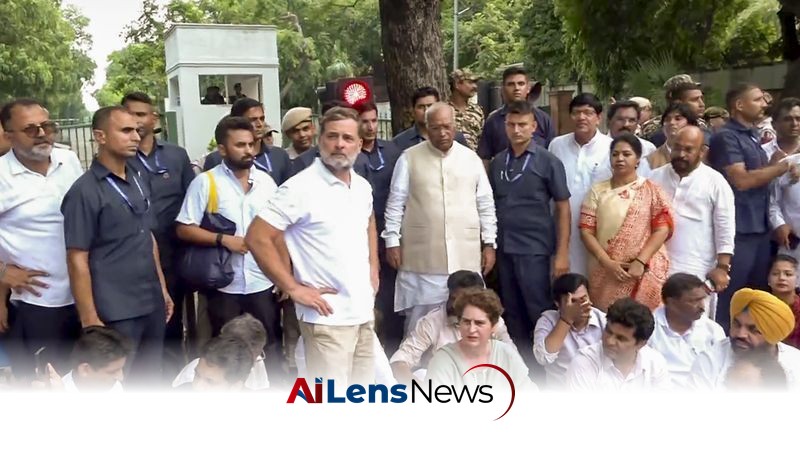


Congress MPs staged a sit-in at the entrance of Prime Minister Modi's residence, using Mallikarjun Kharge's birthday as a strategic move to gain visibility and proximity to power.
Chandigarh, India Jul 21, 2026 ALN: In a move that appeared spontaneous but was meticulously planned, Congress leaders gathered for a sit-in at one of the entry gates to 7, Lok Kalyan Marg, the official residence of Prime Minister Narendra Modi. This gathering coincided with the birthday celebrations of Congress President Mallikarjun Kharge, turning a personal milestone into a political statement.
The sit-in, which attracted significant media attention, was not merely a celebration but a strategic maneuver aimed at drawing attention to the Congress party's ongoing efforts to challenge the ruling government. By positioning themselves in close proximity to the Prime Minister's residence, the Congress leaders sought to underline their presence in the political landscape and assert their relevance.
While the event was framed as a birthday celebration for Kharge, it was clear that the timing and location were chosen to maximize impact. Congress leaders, including prominent figures like Rahul Gandhi and Priyanka Gandhi Vadra, were seen participating actively, which further amplified the visibility of the event. This duality of purpose—celebrating a personal occasion while simultaneously engaging in political protest—reflects a broader trend in Indian politics where personal and political narratives often intertwine.
This tactic of using personal occasions for political gain is not new in Indian politics, but the Congress party's decision to stage it at the Prime Minister's doorstep signals a bold approach to reclaiming political space. The gathering served as a reminder of the Congress's historical significance and its ongoing efforts to remain relevant in the current political climate. The choice of location, directly in front of the Prime Minister's residence, was particularly symbolic, representing a direct challenge to the current administration and its policies.
Political protests and demonstrations have long been a staple of Indian democracy. The country has a rich history of public gatherings that serve both to celebrate significant events and to voice dissent against government actions. From the independence movement led by figures like Mahatma Gandhi to contemporary protests against various laws and policies, the streets of India have often been the stage for political expression. In this context, the Congress party's sit-in can be seen as part of a larger tradition of using public demonstrations to influence political discourse.
Moreover, the Congress party, once the dominant political force in India, has faced significant challenges in recent years, particularly with the rise of the Bharatiya Janata Party (BJP). The BJP's consolidation of power has led to a perception of the Congress as a party struggling to regain its footing. Events like the sit-in not only aim to rally support but also serve as a reminder of the Congress's historical roots and its role in shaping India's political landscape.
The sit-in garnered mixed reactions from the public and political analysts. Supporters of the Congress party viewed it as a necessary assertion of their political identity, while critics dismissed it as a mere publicity stunt. Media coverage of the event highlighted the juxtaposition of a birthday celebration against the backdrop of political dissent, showcasing the complexities of contemporary Indian politics.
Social media platforms were abuzz with commentary, with supporters sharing images and messages of solidarity, while detractors criticized the event as an opportunistic move by the Congress leaders. This polarization reflects the current state of Indian politics, where public opinion is often sharply divided along party lines. The Congress party's ability to navigate this landscape and connect with a broader audience will be critical as it seeks to rebuild its base and regain influence.
As the Congress party continues to navigate its challenges, events like these may play a crucial role in shaping its narrative and public perception. The strategic use of personal milestones, such as Kharge's birthday, may become a recurring theme as the party seeks to strengthen its position in the political arena. This approach not only highlights the leaders' personal stories but also allows the party to frame its political agenda in a more relatable context.
Looking ahead, the Congress party may need to consider how to balance such symbolic gestures with substantive policy discussions. While public demonstrations can energize supporters and draw attention, they must be complemented by clear policy proposals and a coherent vision for the future. The challenge will be to transform the momentum generated by events like the sit-in into tangible political gains in upcoming elections.
The political landscape in India is increasingly complex, with multiple parties vying for power at both the national and state levels. The BJP, under Prime Minister Modi, has established a stronghold, but regional parties and coalitions have also emerged as significant players. In this environment, the Congress party's strategy of reclaiming its political identity through high-visibility events is crucial for its survival.
Moreover, the role of social media and digital communication cannot be underestimated. The Congress party's ability to effectively leverage these platforms will be essential in reaching younger voters and those disenchanted with the current administration. As political dynamics continue to evolve, the Congress must adapt its strategies to engage with a diverse electorate and address the pressing issues facing the nation.
In conclusion, the Congress leaders' sit-in at the Prime Minister's residence, framed around Kharge's birthday, reflects a calculated effort to engage with the public and assert their political relevance. As the political landscape evolves, such strategies may become increasingly important for parties aiming to maintain visibility and influence. The intersection of personal and political narratives will likely continue to shape the discourse in Indian politics, making events like these pivotal in the ongoing struggle for power and representation.
To learn more about the latest developments in Political Controversies, stay updated with our exclusive reports and analyses on AiLensNews.

