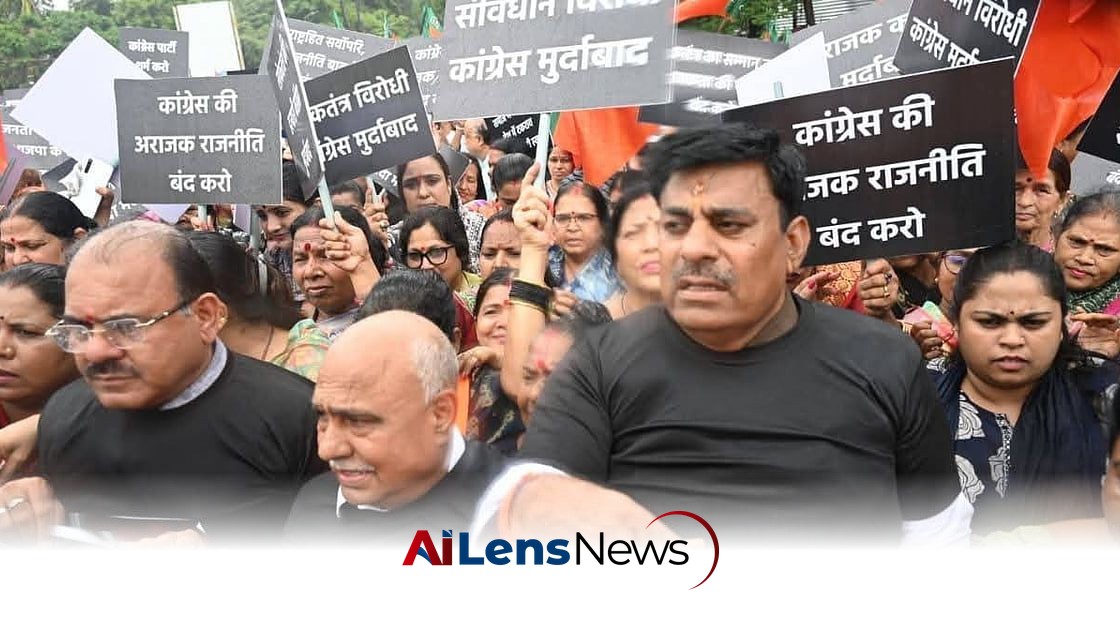


Protests erupted in Bhopal as both BJP and Congress rallied against the NEET-UG paper leak, reflecting tensions from similar demonstrations in Delhi.
New Delhi, India Jul 22, 2026 ALN: Reverberations of the ongoing students' and youths' protests in Delhi, as well as Tuesday's protest by Leader of Opposition Rahul Gandhi outside the Prime Minister's residence and his subsequent detention by Delhi Police, were strongly felt in BJP-ruled Madhya Pradesh on Wednesday. The protests have emerged in response to a significant issue affecting students across the nation—the alleged leak of the National Eligibility cum Entrance Test for Undergraduate (NEET-UG) examination papers.
Both the opposition Congress and the ruling BJP staged protests over the issue in the state capital, Bhopal. The NEET-UG examination is a critical gateway for aspiring medical students in India, and any disruption related to it can have far-reaching implications for students' futures. The recent allegations of a paper leak have led to widespread outrage, as many students feel their hard work and aspirations have been undermined.
A day after the Congress protested outside the Prime Minister's residence in Delhi over the NEET-UG paper leak and police action against protesting students, and also held demonstrations in Bhopal, the ruling BJP staged a protest outside the Madhya Pradesh Congress headquarters in Bhopal on Wednesday. The BJP's counter-protest appears to be an effort to assert its position and respond to the narrative set by the Congress party regarding the handling of student issues.
The ruling party's protest outside the state Congress headquarters was led by state BJP president Hemant Khandelwal and attended by other senior party leaders, including third-time MLA Rameshwar Sharma. Khandelwal's speech during the protest was aimed at framing the Congress party as a disruptor of peace and stability in the country. He accused the Congress of creating unrest and anarchy in the country after suffering repeated electoral defeats, which he claimed had left them desperate to regain relevance.
"Our message is that if the Congress wants to fight, it should do so in the electoral arena. But it is scared because the people have already rejected it," Khandelwal said. His remarks reflect a common political strategy where parties seek to divert attention from pressing issues by framing the opposition as politically motivated rather than genuinely concerned about the welfare of students.
He also alleged that the Congress leadership was trying to defame the BJP government and trigger chaos in the country. This rhetoric is not uncommon in Indian politics, where parties often engage in blame games, especially during periods of unrest or protests. The clash of narratives between the BJP and Congress highlights the polarized political landscape in India, where issues affecting students can become battlegrounds for larger political contests.
Around 3.5 km away, at the Madhya Pradesh Vidhan Sabha, Congress MLAs created a ruckus after their demand for a debate through an adjournment motion on the alleged lathi charge on students and youths in Delhi and the NEET-UG paper leak was disallowed by Assembly Speaker Narendra Singh Tomar on the grounds that the matter was outside the purview of the state government. This refusal to allow a debate illustrates the challenges opposition parties face in raising issues they consider critical, especially when the ruling party holds a majority.
The Congress MLAs, led by Leader of Opposition Umang Singhar, entered the House wearing black armbands and went into the well, demanding that the debate be allowed. The symbolism of wearing black armbands is significant; it represents mourning and protest, indicating that the Congress party views the situation as a serious violation of students' rights and a crisis that needs urgent attention. They argued that thousands of students from Madhya Pradesh had appeared for the first NEET-UG 2026 examination, whose question paper was leaked, and that at least two NEET-UG aspirants from the state had died by suicide following the leak. Such tragic outcomes underscore the high stakes involved for students and the emotional toll that examination-related pressures can exert on them.
The developments unfolded shortly after Question Hour ended on the third day of the five-day Monsoon Session of the Vidhan Sabha. Heated exchanges between Congress and BJP MLAs compelled the Speaker to adjourn the House for 15 minutes soon after Zero Hour began. The interruptions in the assembly not only reflect the contentious atmosphere but also the urgent need for dialogue on issues impacting the youth, particularly in an educational context.
The protests by Congress MLAs inside the House came just hours after they had demonstrated outside the Governor's residence in Bhopal and outside the Chief Minister's chamber in the Vidhan Sabha building on Tuesday evening and night. This multi-faceted approach to protest indicates a strategic effort by the Congress party to maintain visibility and pressure on the ruling government across various platforms.
Parliamentary Affairs Minister Kailash Vijayvargiya and LoP Umang Singhar trade charges
Meanwhile, Leader of Opposition Umang Singhar continued to accuse the state's Urban Development, Housing and Parliamentary Affairs Minister Kailash Vijayvargiya of using objectionable words such as "keeda" (worms/insects) and "cockroach" for students protesting in Delhi. Singhar's accusations highlight the sensitivity surrounding language used by political leaders, especially when addressing issues that affect vulnerable populations such as students. The choice of words can either escalate tensions or promote understanding, and in this case, the allegations have fueled further discord between the two parties.
Singhar, who first made the allegations against Vijayvargiya in the House on Tuesday night, repeated them in the Vidhan Sabha on Wednesday, drawing sharp reactions from BJP members. The BJP's defensive posture reflects its concern over the possible fallout of such language, especially in a politically charged environment where student sentiments are at the forefront of public discourse.
Towards the latter part of the Vidhan Sabha proceedings, Minister Kailash Vijayvargiya raised the issue of the Leader of the Opposition making what he described as false accusations against him and demanded an apology. This demand for accountability is a common strategy used by political figures to assert their integrity and challenge the credibility of their opponents.
The senior-most minister in the state government was backed by other Cabinet colleagues, including Prahlad Singh Patel and Deputy Chief Minister Rajendra Shukla, as well as other BJP MLAs, who pressed for an apology from the LoP for allegedly making false accusations against Vijayvargiya. This collective stance from the BJP demonstrates party solidarity in the face of controversy and aims to project a united front against opposition claims.
The LoP, however, claimed that he had evidence that the minister had used the objectionable words. This claim adds another layer of complexity to the ongoing dispute, as it raises questions about accountability and the standards of discourse expected from public officials.
Meanwhile, Assembly Speaker Narendra Singh Tomar said, "The minister (Vijayvargiya) had met me in the morning and raised the issue, besides telling me that the false allegations had the potential of tarnishing his image before students in his home city Indore. I've gone through the House's Tuesday proceedings record, but didn't find any such utterance by the minister." The Speaker's comments serve to reinforce the importance of maintaining decorum in the assembly and highlight the procedural aspects that govern legislative discussions.
While the ruling BJP MLAs demanded an apology from the LoP, the concerned minister, Kailash Vijayvargiya, said, "I have no expectations from the Leader of the Opposition... Nor do I expect him to express regret. Mr Speaker, please tell us -- you have seen the record. You tell us... What is the truth?" This statement underscores the ongoing tension and the difficulty of reaching a consensus in a politically charged environment.
Meanwhile, social activist couple Prahlad and Sangeeta Pandey were reportedly detained by police in Indore for staging an unauthorized protest outside Vijayvargiya's house in the city's Nanda Nagar locality on Wednesday. Their actions reflect a broader trend of civil society engagement in political issues, particularly concerning student rights and education policies. The couple alleged that Vijayvargiya had made inappropriate comments about the students protesting in Delhi, indicating that public sentiment is increasingly vocal against perceived injustices.
The protests in Bhopal, along with the actions of the Congress party and the BJP, highlight the ongoing struggle over educational policies and student rights in India. As the nation grapples with issues related to access to education, equity in examination processes, and the mental health of students, the political ramifications of these protests will likely extend beyond immediate confrontations, influencing future electoral dynamics and policy discussions. The NEET-UG paper leak incident has not only sparked protests but has also reignited conversations about the integrity of examination systems and the responsibilities of governments to ensure fair and transparent processes for all students.
To learn more about the latest developments in Elections, stay updated with our exclusive reports and analyses on AiLensNews.

