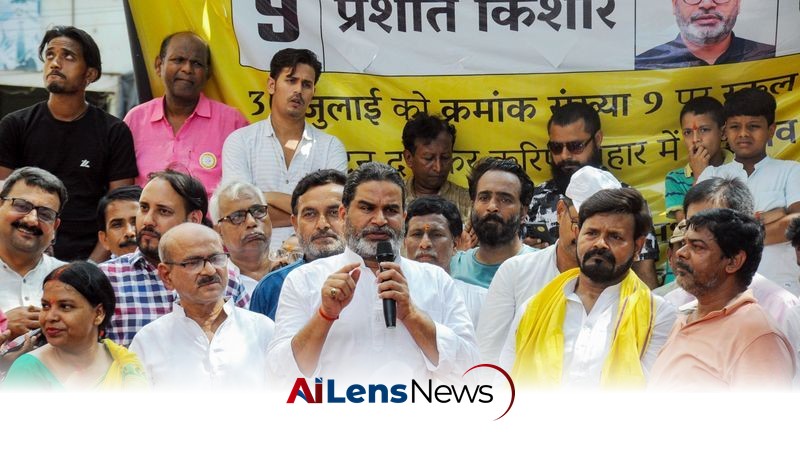


Tensions escalated in Bihar as Prashant Kishor confronted police over the alleged detention of his party workers before the Bankipur by-election.
Patna, India Jul 30, 2026 ALN: High drama unfolded at the Jakkanpur police station late on Wednesday night as Prashant Kishor, the founder of Jan Suraaj and candidate for the Bankipur Assembly by-election, arrived with a large group of supporters. The confrontation was sparked by allegations that multiple party workers had been detained by the police. This incident not only reflects the current political climate in Bihar but also underscores the increasing tensions as various political factions gear up for the upcoming bypoll.
Kishor confronted Station House Officer (SHO) Rituraj Kumar Singh, demanding the release of his detained party members. The situation escalated as Kishor and his supporters expressed their outrage, claiming that the police were acting under political pressure to suppress their campaign efforts. Such accusations are not new in Indian politics, where the interaction between law enforcement and political entities often raises concerns about impartiality. Kishor’s allegations specifically point to a broader narrative in which police actions are viewed as tools of political oppression.
This incident highlights the growing tensions in Bihar's political landscape as the Bankipur by-election approaches. Bihar has a long and complex political history characterized by a myriad of parties vying for power, often resulting in fierce rivalries. The state has witnessed a multitude of political shifts and realignments, with various parties forming alliances and breaking apart based on changing circumstances and electoral strategies. Kishor's allegations come amidst a backdrop of heightened political rivalry and accusations of intimidation tactics being employed by rival parties. The political environment in Bihar has been particularly charged in recent years, with various parties leveraging both traditional campaigning methods and social media to galvanize support.
Supporters of Kishor rallied outside the police station, chanting slogans and demanding justice. They argued that the detentions were an attempt to stifle their voices and undermine their electoral chances. The emotional response from Kishor's supporters is indicative of the grassroots mobilization that his campaign has managed to achieve. Kishor, known for his strategic acumen, has been attempting to carve out a significant political space for himself in Bihar, which has historically been dominated by established parties such as the Rashtriya Janata Dal (RJD) and the Janata Dal (United) (JD(U)). His efforts to build a political base have resonated particularly with younger voters and those disillusioned by traditional political paradigms, who are eager for change.
The police, however, maintained that the detentions were necessary for maintaining order and that no political motivations were involved. They stated that some individuals were taken in for questioning regarding potential disturbances during the election period. This assertion raises questions about the balance between maintaining public order and ensuring a fair electoral process. The role of law enforcement during elections is crucial, as it can either facilitate a free and fair environment or, conversely, contribute to a climate of fear and repression. The police's justification for their actions often hinges on the need to prevent violence and maintain peace, but this can sometimes be perceived as a pretext for suppressing dissent or targeting specific political groups.
Kishor's campaign has gained significant traction in recent months, particularly among younger voters and those disillusioned by traditional political paradigms. His approach has often focused on transparency, good governance, and grassroots engagement, which resonates with constituents seeking change. This incident could further galvanize his supporters as they prepare for the upcoming election, potentially framing Kishor as a victim of political machinations, thus enhancing his appeal. Political narratives often play a crucial role in shaping voter perceptions, and Kishor's ability to present himself as a champion of democratic values could be pivotal in attracting undecided voters.
The Bankipur bypoll is seen as a crucial test for Kishor's political ambitions and the strength of his party in Bihar. By-elections often serve as a litmus test for the popularity of political parties and their candidates, providing insights into voter sentiments ahead of larger elections. The stakes are high not only for Kishor but also for the established political entities that may be wary of emerging challenges to their dominance. A strong showing by Kishor could signal a shift in the political landscape of Bihar, potentially encouraging other new political entrants to challenge the status quo.
As the political drama unfolds, all eyes will be on the actions of the authorities and the response from Kishor's camp in the days leading up to the election. The implications of this incident extend beyond just the immediate bypoll; they may influence the broader political discourse in Bihar and set precedents for how political campaigns are conducted in the region. Observers will be keen to see how the situation develops, particularly in light of Kishor's growing popularity and the potential for his party to disrupt the traditional power dynamics. The outcome of this by-election could also affect the strategies of rival parties, prompting them to reassess their approaches in light of Kishor's rising influence.
Moreover, this incident raises critical questions about the role of law enforcement in democratic societies. The intersection of policing and politics can often lead to contentious situations, especially during election periods when emotions run high. The response from the police and the government will be scrutinized, as any perceived bias or misuse of power could lead to public outcry and further unrest. The challenge for law enforcement agencies is to navigate the fine line between ensuring security and upholding democratic principles, which can become particularly complicated in a politically charged atmosphere.
In summary, the detainment of Kishor's party workers at the Jakkanpur police station is emblematic of the larger political struggles in Bihar. It reflects the challenges faced by emerging political leaders in a landscape dominated by established parties and raises essential questions about the nature of political engagement and the role of law enforcement in ensuring a fair electoral process. As the Bankipur by-election approaches, the actions of both Kishor's campaign and the authorities will be pivotal in shaping the future political narrative in Bihar. The incident serves as a reminder of the ongoing power struggles that characterize Indian politics, particularly in states like Bihar, where historical grievances and contemporary aspirations collide in the quest for political representation.
To learn more about the latest developments in Political Controversies, stay updated with our exclusive reports and analyses on AiLensNews.

