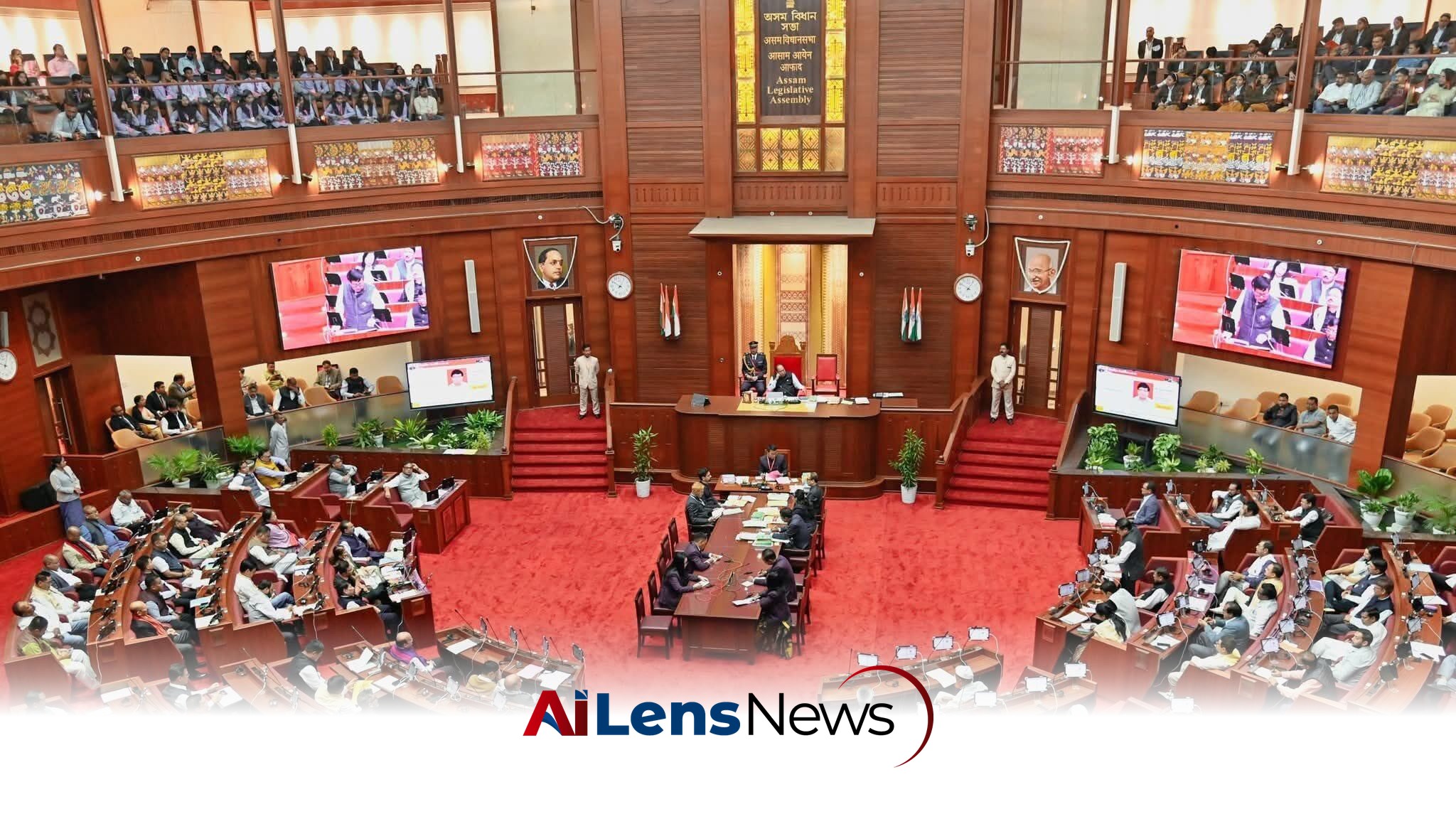


The Assam Legislative Assembly concluded its Budget Session by passing five bills, including a contentious land amendment that sparked debate over the definition of 'original inhabitant'.
New Delhi, India Jul 29, 2026 ALN: The Assam Legislative Assembly on Wednesday passed five Bills on the concluding day of its Budget Session, including the contentious Assam Land and Revenue Regulation (Amendment) Bill, 2026, after an extended debate over the definition of "original inhabitant" and its implications for land rights around the state's iconic heritage institutions.
Besides the land amendment legislation, the House also approved the Registration (Assam Amendment) Bill, 2026, the Indian Stamp (Assam Amendment) Bill, 2026, the Assam Fixation of Ceiling on Land Holdings (Amendment) Bill, 2026, and the Assam State Higher Education Council Bill, 2026.
The most intense debate centred on the Assam Land and Revenue Regulation (Amendment) Bill, tabled by Parliamentary Affairs Minister Pijush Hazarika on behalf of Revenue and Disaster Management Minister Keshab Mahanta. This particular Bill has stirred significant controversy due to its potential ramifications on land ownership and rights within Assam, a state that has seen various socio-political upheavals regarding identity and citizenship over the decades.
Opposition members questioned the rationale behind defining "original inhabitants" as families residing in Assam before 1971 while also requiring proof of three generations before 2006, arguing that the provisions created ambiguity and could lead to constitutional challenges. The choice of 2006 as a reference year has been particularly contentious, as it diverges from the widely accepted cut-off date of March 25, 1971, established by the Assam Accord, which aimed to resolve the issue of illegal immigration from Bangladesh and its impact on the demographic composition of the state.
Replying to the debate, Chief Minister Himanta Biswa Sarma maintained that the amendment had a limited objective and was intended solely to protect land surrounding Assam's iconic heritage and religious institutions from being purchased by outsiders. This assertion reflects the government's ongoing efforts to safeguard cultural heritage within the state, which is home to numerous historical sites that are integral to Assam's identity.
"This is not a new law. We have discussed these provisions in this Assembly before and they have already been approved. The amendment simply ensures that around heritage institutions that are over 250 years old, the surrounding area remains with communities historically associated with those institutions. It is not targeted against any religious minority," Sarma told the House. This statement underscores the government's stance that the legislation is aimed at preserving historical integrity rather than discriminating against specific groups.
He clarified that the restrictions would apply only to notified heritage zones. "From today, outsiders cannot purchase land in these protected areas. Merely calling oneself Assamese cannot be the only criterion. If a person has not been associated with the land for three generations, they cannot buy land in these notified zones," he said. This provision has raised concerns among various communities, particularly those who may have settled in Assam more recently but have established strong ties to the region.
Explaining the three-generation requirement, the Chief Minister said the government had relied on the accepted norm of one generation being equivalent to 25 years. This benchmark has historical precedence in various government policies, including those related to land rights and citizenship. The three-generation formula is not something we invented. The 25-year benchmark for one generation has existed in government policy, including during the tenure of the previous UPA government. The same principle is used while determining eligibility for forest land rights for non-tribal communities under the 2006 law," he said, attempting to contextualize the amendment within a broader framework of existing legislation.
Leader of the Opposition Abdur Rahim Ahmed of the Congress argued that the Bill should strictly adhere to the Assam Accord by using March 25, 1971, as the sole cut-off for determining eligibility. His argument highlights the ongoing tensions between various political factions in Assam, particularly surrounding the sensitive issue of citizenship and the rights of those who may be deemed as outsiders.
"The Assam Accord, accepted by all parties and upheld by the Supreme Court, recognises March 25, 1971, as the cut-off. We cannot create different categories of citizens through land laws. Land rights should be based on Indian citizenship, not classifications that divide people," he said while moving amendments to the Bill. This perspective reflects a broader concern among some legislators that the amendment could exacerbate existing divisions within the state.
All India Trinamool Congress MLA Sherman Ali Ahmed also opposed the legislation, questioning the choice of 2006 as the reference year and warning that the provisions could be challenged on constitutional grounds. The implications of such challenges could lead to further legal scrutiny of the amendment, potentially delaying its implementation and exacerbating existing tensions among various communities in Assam.
Responding to the concern, Sarma assured the House that the government would remove any ambiguity if required. "I assure the House that the definition is intended only for iconic heritage institutions. If there is any possibility of it affecting other provisions of the Act, we will amend the legislation to explicitly state that the definition applies only to the heritage chapter. There should be no confusion on this," he said, indicating a willingness to clarify and refine the legislation to address concerns raised by opposition members.
Later in the day, legislators also cleared the Assam State Higher Education Council Bill, 2026 after a brief debate over the composition of the proposed Council. The establishment of this Council is seen as a significant step towards improving higher education in Assam, which has faced challenges in terms of quality and accessibility.
Congress MLA Zakir Hussain Sikdar moved two amendments seeking the inclusion of five MLAs nominated by the Assembly and the senior-most Secretary of the Assam Legislative Assembly as members of the Council. This proposal reflects a desire among some legislators to ensure that the voices of elected representatives are included in the governance of higher education, which is a critical sector for the development of the state.
Education Minister Ranoj Pegu opposed the proposals, saying the government had consistently maintained that legislators should not be directly involved in the management of colleges. This position is rooted in a belief that political interference can undermine the integrity and effectiveness of educational institutions.
"The Assam Government has consistently followed the principle that MLAs should not be directly involved in the management of colleges. We have discouraged the direct involvement of MLAs or political office-bearers in college governing bodies, and we want to maintain that spirit. Therefore, we have not proposed the inclusion of MLAs in the Executive Council," Pegu said. This statement emphasizes the government's commitment to maintaining a separation between politics and education, which is a crucial consideration in the governance of academic institutions.
He added that while the Assembly plays a role in framing higher education policy and enacting legislation, implementing those policies should remain outside the direct involvement of legislators. This perspective reflects a broader trend in governance where the separation of powers is seen as essential for effective administration.
Following the Minister's assurance, Sikdar withdrew his amendments, after which the House passed the Bill. The passage of these Bills marks a significant moment in Assam's legislative history, particularly as the state navigates complex issues related to identity, citizenship, and governance. As the implications of these laws unfold, they will undoubtedly continue to be a focal point of discussion and debate among various stakeholders in Assam.
To learn more about the latest developments in Elections, stay updated with our exclusive reports and analyses on AiLensNews.

