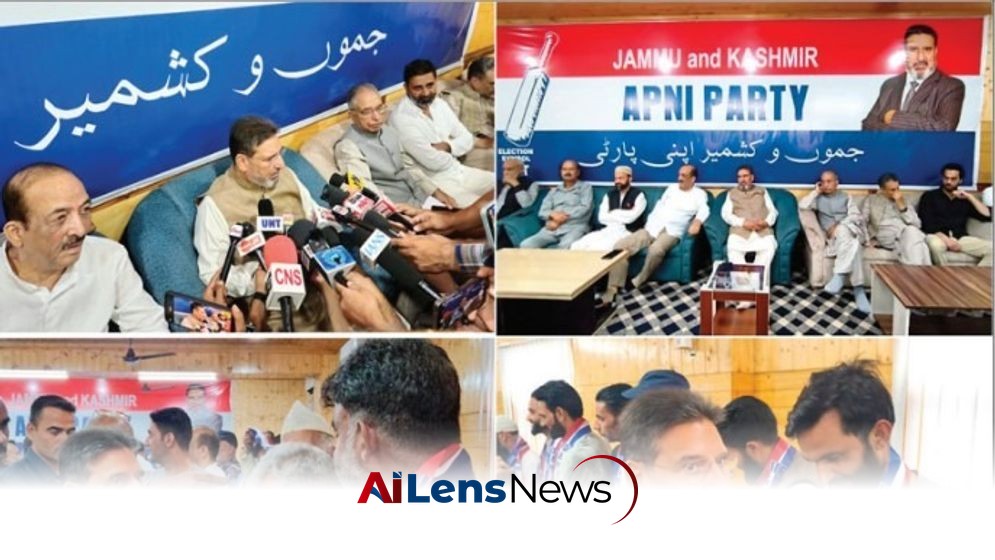


Apni Party president Altaf Bukhari emphasizes the need for dialogue with the Government of India to restore Jammu and Kashmir's constitutional rights lost in 2019.
New Delhi, India Jul 30, 2026 ALN: The political landscape of Jammu and Kashmir has been significantly affected since the abrogation of Article 370 on August 5, 2019, an event that marked a pivotal moment in the region's history. Syed Mohammad Altaf Bukhari, president of the Apni Party, has recently emphasized that the restoration of the constitutional and political rights lost on that day cannot be achieved through protests or confrontational tactics. Instead, he advocates for a dialogue-based approach that includes consultation and a well-defined roadmap involving both the Government of India and the residents of Jammu and Kashmir.
Addressing reporters at a party event in Srinagar, Bukhari described August 5 as a “dark day” for the region, underscoring the emotional and political weight that this date carries for many residents. The abrogation of Article 370 not only stripped the region of its special status but also bifurcated the erstwhile state into two Union Territories: Jammu and Kashmir, and Ladakh. This change led to widespread unrest and a re-evaluation of political allegiances among the populace.
Bukhari's assertion that confrontation would not aid in regaining lost rights reflects a broader sentiment among various political leaders who believe that dialogue is essential for reconciliation and healing. He stated, “The rights lost on August 5, 2019, cannot be retrieved through protests or confrontation, but through consultation and a clear roadmap.” This perspective is crucial in understanding the current political dynamics in Jammu and Kashmir, where many feel disconnected from the central government.
One of the key points raised by Bukhari is the need for the Government of India to engage directly with the people of Jammu and Kashmir. This engagement is seen as vital for addressing the genuine aspirations of the populace and for bridging what he describes as a “trust deficit.” The concept of trust is particularly significant in Jammu and Kashmir, a region that has experienced decades of conflict and political instability. Bukhari's call for dialogue suggests a recognition that lasting solutions require more than just policy changes; they necessitate a rebuilding of relationships between the government and the governed.
Moreover, Bukhari reiterated his party’s commitment to supporting any political formation that raises legitimate issues concerning the people of Jammu and Kashmir. This includes demands for the restoration of statehood, the reintroduction of Articles 370 and 35A, the release of political prisoners, and the creation of employment opportunities. These issues resonate deeply with many residents who feel that their voices have been marginalized in the political discourse following the changes in 2019.
In a response to recent comments made by Mehbooba Mufti, president of the People’s Democratic Party (PDP), regarding the use of force against Kashmiris, Bukhari suggested that the issue should be considered resolved following Mufti's subsequent apology. This incident highlights the often contentious nature of political rhetoric in Jammu and Kashmir, where statements can quickly escalate into significant controversies, reflecting the sensitivities surrounding the region's political climate.
Furthermore, Bukhari's comments regarding the Bharatiya Janata Party's (BJP) electoral strategy in the upcoming 2024 Assembly elections reveal concerns about the politicization of religious sentiments in the region. He alleged that the BJP has sought to mobilize Hindu voters in Jammu by invoking religious sentiments, a strategy that he believes could be detrimental to the broader interests of Jammu and Kashmir. This assertion points to the ongoing complexities of regional politics, where communal identities often intersect with electoral strategies, potentially exacerbating existing divisions.
In a broader context, the political landscape of Jammu and Kashmir is characterized by a multitude of parties and movements, each with its own vision for the future of the region. The Apni Party, under Bukhari's leadership, aims to position itself as a unifying force that prioritizes the welfare of the people over sectarian or partisan divides. This approach is particularly relevant in a region where historical grievances and aspirations for autonomy have shaped political affiliations and public sentiment.
During the recent joining program at the party headquarters, several political and social leaders from Sopore joined the Apni Party, indicating a potential shift in political alliances within the region. Senior Apni Party leader and Chairman of the party’s Parliamentary Affairs Committee, Mohammad Dilawar Mir, emphasized Sopore's historical and political significance, arguing for the restoration of its stature. He highlighted the crucial role of the youth in this endeavor, suggesting that empowering the younger generation is essential for the region’s future.
Mir's remarks resonate with the broader narrative in Jammu and Kashmir, where youth engagement is seen as pivotal for fostering a more inclusive and dynamic political environment. The youth are often viewed as key stakeholders in shaping the future, and their involvement in politics can lead to the emergence of new ideas and solutions to longstanding issues.
The joining program was attended by various party functionaries, reflecting the Apni Party's expanding base and its efforts to consolidate support from diverse segments of society. The inclusion of leaders and activists from Sopore, a town with a rich political history, underscores the party's strategy of building a grassroots movement that addresses local concerns while advocating for broader political rights.
In conclusion, Altaf Bukhari's advocacy for dialogue and consultation as a means to restore the rights of Jammu and Kashmir’s residents highlights a critical juncture in the region's political narrative. The emphasis on engagement with the Government of India and the need for a clear roadmap for the future are essential components of any sustainable resolution to the challenges faced by the people of Jammu and Kashmir. As the political landscape continues to evolve, the ability of parties like the Apni Party to navigate these complexities and foster a sense of inclusivity will be crucial for the region's stability and progress.
To learn more about the latest developments in Political Controversies, stay updated with our exclusive reports and analyses on AiLensNews.

