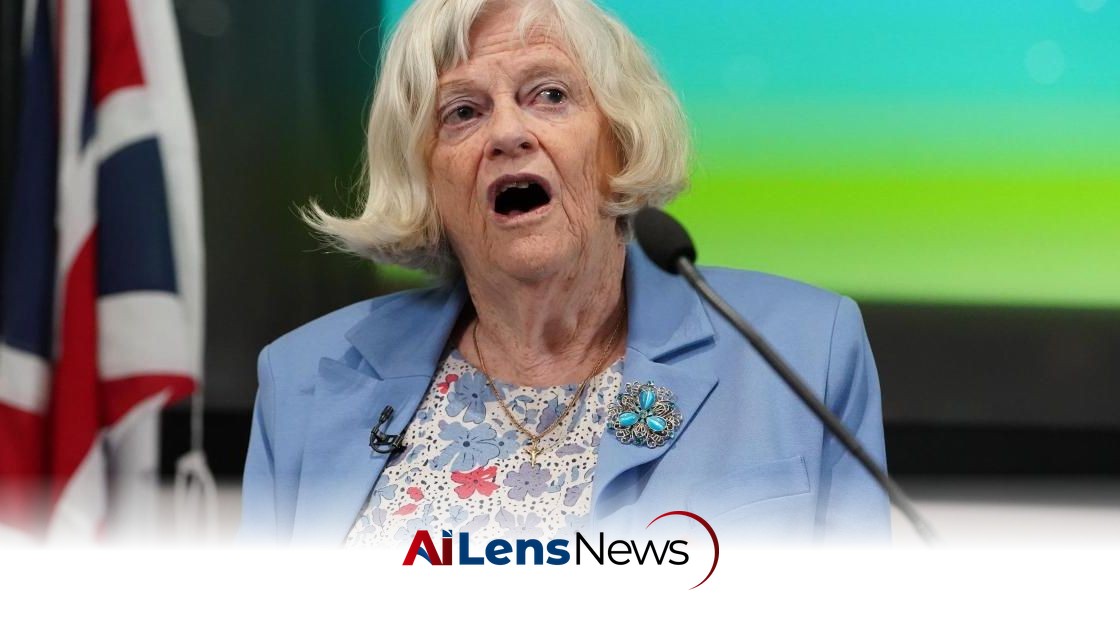


The backlash following Ann Widdecombe's death raises concerns about the acceptance of traditional Christian views in contemporary society.
London, United Kingdom Jul 14, 2026 ALN: Some of the reactions to Ann Widdecombe’s death last week showed that she was deeply admired across society but there were some who hated her for her Catholic faith. Several prominent people felt that the outpouring of affection for Ann Widdecombe following her death last week needed to be qualified. They felt moved to tell everyone that, of course, they found her views so very disagreeable, but that no one deserved to die this way.
How generous of them to state publicly that it really is a bad thing for a 78-year-old woman to die a violent death alone and in her own home. Would it have been a little more acceptable if the circumstances had been less unpleasantly tragic? Nobody should die “like this,” they said.
Many others were so vindictively vicious about Ms. Widdecombe’s death that it seemed rooted in a diseased collective mindset that regards people who hold different views as sub-human. One prominent broadcaster felt emboldened to describe Ms. Widdecombe in such sexist terms that they’d have been deemed unacceptable in a 1970s social club. This chap described her as an ‘old maid’ and ‘a spinster’.
Yet those of us who had ever watched Ms. Widdecombe or heard her during her political career or later as a television and radio pundit knew that she was possessed of a razor-sharp mind that could dismantle your arguments in seconds if you couldn’t properly back up your thesis. More importantly, those who knew her well, including many who fundamentally disagreed with her positions on faith and human morality, said that she was never anything other than kind and compassionate in expressing those views.
Harvey Proctor, the former Conservative MP, saw his life almost destroyed by false claims of sex abuse 12 years ago that had a malevolent undercurrent of extreme homophobia. Following the news of Ms. Widdecombe’s death, he chastised the gay and trans rights campaigner, Peter Tatchell, for his ugly reaction to it. “How dare Peter Tatchell brand Ann Widdecombe a bigot,” Mr. Proctor wrote, “she stood by me when it mattered. Where were the gay rights campaigners when I was being persecuted? They weren’t there, but Ann was.”
You see, that’s the thing about being a Catholic. It’s no use saying you believe that Jesus is the Son of God and that you must be merciful and compassionate in His name if you don’t actually practice it. No amount of sacramental confessions will cut the mustard if you merely talk a good game, but don’t live it.
I never met Ann Widdecombe, but it would seem that she’d truly lived her faith in the way she treated all those in her life and career with whom she engaged. When she converted to Catholicism, it can’t have been a surprise to anyone who knew her that a woman of such fierce intellect would have come to this moment only after intense meditation and reflection. Nor would it have surprised them that she would embrace all aspects of her faith and not just the state-approved cuddly bits that secure you an easy life.
Like me and millions of other Catholics, she thought that abortion was wrong because our faith believes that human life begins at the moment of conception. She accepted the Church’s teaching that the sacrament of marriage is reserved to the union of a man and a woman. She also believed that no person born male can ever be a woman. All of these positions are consistent with the Catholic worldview in respect of the way it interprets the fundamental dignity of human life and human relationships. They are neither left-wing nor right-wing, but are crucial to what the Catholic Church holds to be The Truth.
The Church can never alter what has reinforced it and kept it alive for more than 2,000 years through persecution, discrimination and the sins of some of its own leaders. If it were to remove even one of these tenets then the rest of it falls. Yet, those of us who accept these teachings are also obliged to avoid judgment and condemnation of those who reject them. Many of us who do cling to our Catholicism do so precariously in grey areas where what’s black and what’s white isn’t so clear.
And thank goodness for that. In the secular world, the Church can’t influence the state (nor should it). It asks only that in this agreed separation that the right to hold these views and to express them reasonably without being subjected to cancellation, persecution or imprisonment is upheld.
Ann Widdecombe’s death was mourned by so many who rejected her worldview because she expressed it so eloquently and with a degree of compassion. I sensed she understood the challenges that people encounter in their lives, which make it difficult to impose moral ukases. She was a better Catholic than I’ll ever be.
I sympathize with the Aberdeen University employee who is now being hounded for expressing such uncharitable views about Ms. Widdecombe’s death. I suspect this individual may be dealing with other challenges and may have experienced hurt and prejudice in a difficult life. I hope that the university does not consider these comments to be a sacking offense. This person has also been encouraged in the belief that such comments are acceptable by a state orthodoxy that promotes dehumanizing and delegitimizing women who believe in the primacy of sex over gender.
Scotland has a First Minister who joined in the witch-hunt against Kate Forbes when she contested the SNP leadership because she held the same beliefs as Ann Widdecombe. John Swinney embraced Catholicism and its beliefs for his family, but denied them to Ms. Forbes simply to please a mob wielding pitchforks and burning crosses.
As a politician, Kate Forbes maintained the concept of separation between church and state but was condemned simply for the thought-crime of being a faithful believer in the teachings of the Free Church of Scotland. It showed us that freedom of belief for authentic Christians no longer exists in modern Scotland. Ann Widdecombe was welcomed and admired across society and in the media. In Scotland, under this illiberal regime, she’d have been cancelled a long time ago.
Kevin McKenna is Scotland’s Columnist of the Year
To learn more about the latest developments in Social Commentary, stay updated with our exclusive reports and analyses on AiLensNews.

