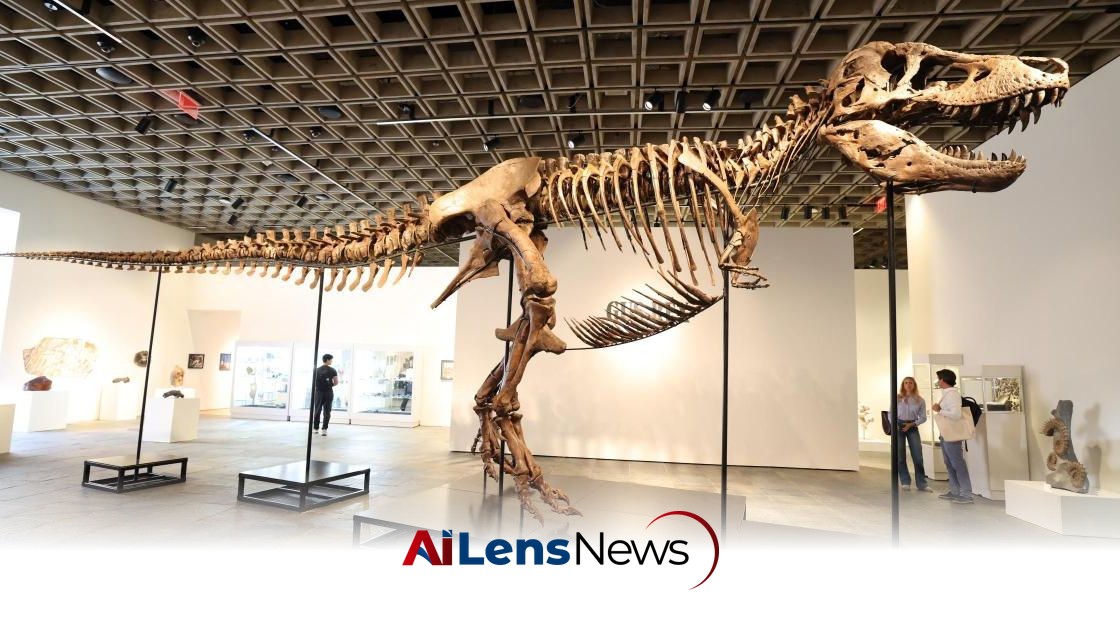


The recent sale of a T-Rex skeleton for £37 million highlights the troubling trend of commodifying nature, raising questions about wealth and environmental respect.
London, United Kingdom Jul 16, 2026 ALN: It's impossible to be certain about how our ancestors lived in the ancient past. There’s no recorded history, after all.
However, scholars are pretty sure that when we were hunter-gatherers we revered nature and the Earth in ways that are impossible to imagine today.
Ethnographers, archaeologists and anthropologists have tried to reconstruct how our ancestors would have lived before the invention of farming - and so-called ‘civilisation’ - by studying the few ritual artefacts they left behind, and the societies of tribes untouched by the modern world today in places like the Amazon rainforest.
The best guess is that our ancestors saw themselves as equals with animals. Everything - even rocks and plants - were likely imbued with the notion of a soul. The Earth was something to respect and revere.
Sometime around the late Stone Age or dawn of the Bronze Age humanity shifted in its attitudes. We came to think of the Earth and all life on it as ours to dominate.
There were tensions as the old way of thinking gave way to the new - just as there are always tensions at times of revolutionary change, such as now.
The tensions can be seen in myths like Cain and Abel. Cain is a farmer. He represents the new way of living.
It was farmers who built the first settlements which became cities. Farmers developed the concept of land-ownership.
Before farming, nobody owned land; it was shared. Even today, there are tribes around the world who would laugh the notion of land-ownership to scorn, viewing such ideas as grotesque hubris.
Abel represented the old pastoralist way of living: nomadic, moving across the land with the animals that sustained him, and still abiding by the ancient customs which kept humanity in harmony with nature.
The God of the Bible favoured Abel. That’s why Cain killed him.
With Abel gone, the symbolism is clear: humanity would now dominate the Earth and the creatures upon it. If we could profit from the planet, then we would profit from the planet.
You could, metaphorically, see this as the real ‘original sin’ rather than Eve eating the apple of knowledge.
We lost our sense of proportionality, of living in balance with the planet we depend upon. We stopped respecting nature, and began treating it like chattel.
Skip forward a few dozen millennia and we’ve created a world where in many countries you must pay for water - an abundant, essential resource which belongs to us all. We’ve monetised every inch of the planet and every creature upon it.
Indeed, we’ve even monetised the invisible and the imaginary. Our thoughts are digitised for profit on social media and scraped by data-gathering companies.
If the rentier class could find a way to monetise thin air then we’d be paying to breathe.
We’ve monetised the Earth to such an extent - and for the benefit of such a small number of people - that it’s now burning under our feet. All sense of harmony is gone. Rather than respect, we destroy.
We’ve just witnessed an event which underscores - like a giant blood-red marker pen - the greed and vandalism of humanity, our contempt for the Earth and nature, and the complete disregard we have for the notion that this planet is for all of us to share, not for the rich to exploit and plunder.
It was the sale, to a private owner, of one of the largest and most complete Tyrannosaurus Rex skeletons ever discovered. The fossil, nicknamed Gus, went for £37 million.
Whoever the billionaire owner is, they’re staying silent. No surprise. Few would want to be known as the man - for it’s surely a man given most billionaires are men - who snatched such a prize away from science.
Gus is now gone. Disappeared into some air-conditioned Xanadu that soothes what passes for the soul of a billionaire.
The T-Rex was dug up in South Dakota by a private fossil-hunting company. In many countries, like Brazil or Mongolia, fossils belong to the nation.
They cannot be dragged from the Earth on the whim of corporations and sold like soap powder to the highest-bidder.
Museums and universities cannot afford to buy such fossils in the face of competition from the billionaire class.
That means Gus will never be seen by you or your children. Gus won’t be studied. Gus will yield no new discoveries. It would be better if Gus remained in the ground.
Now some petty man with more money than decency will flaunt the T-Rex skeleton to their equally petty guests at dinner parties, where the cost of the starters could feed a village of starving children.
It’s bewildering that anyone could take pleasure in such a moment given they’ve deprived the world of knowledge.
But then shame and obscene wealth aren’t bed-fellows.
Scientists have spoken out in disgust about fossils being turned into status symbols and investments. Pitifully, some hope that the anonymous buyer will lend the fossil to museums for research.
We’re back to the time of noblesse oblige, with science dependent upon the largesse of rich benefactors lending their toys.
We are all, in a way, the playthings of the rich, today. Billionaires now dream of extending their lives by decades, whilst in Britain drugs which could save millions from Alzheimer's are deemed too expensive for the likes of you or I.
Tech companies like Microsoft - among the richest corporations on Earth - are laying off thousands of staff because their enormous profits just aren’t big enough.
It’s as if we’re ruled by the eponymous monster Gargantua from the François Rabelais novel: a huge monstrosity which just keeps eating and eating, gobbling up the world around it.
Everything goes into the gaping maw of the super-rich, from our jobs to the very fossils in the earth.
And look at what this way of living has done to us. Look at our towns and high streets. What do you see? Charity stores and betting shops. Does that symbolism not drive home the folly of what we’ve come to accept?
Everything has been devoured. Yet gambling - the last great hope of the desperate - remains, offering a phoney dream to cling to. But as we all know: it’s always the house that wins.
To learn more about the latest developments in Social Commentary, stay updated with our exclusive reports and analyses on AiLensNews.

