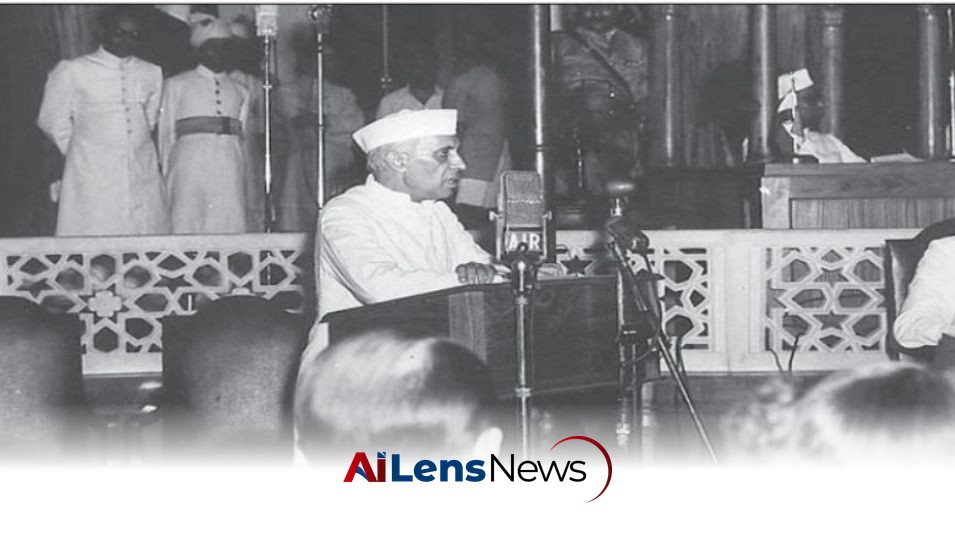


As India commemorates its independence, it is essential to recognize the ongoing responsibility to uphold the diverse legacy of freedom, which was not the achievement of a single community but a shared struggle.
Leh, India Aug 15, 2026 ALN: Every August, India performs a ritual of remembering that risks becoming a ritual of forgetting. We hoist flags, recite a familiar pantheon of names, and retire the past into ceremony. But independence was not a single, luminous event delivered on the morning of 15 August 1947. It was a wager, made by exhausted and divided men and women, that a civilisation of extraordinary diversity could govern itself as one republic rather than dissolve into its many parts. That wager has not yet been fully settled. It is renewed, or betrayed, in every generation that inherits it.
It is worth remembering how contingent the whole enterprise was. Between 25 July and 14 August 1947, as Jawaharlal Nehru and Muhammad Ali Jinnah sparred in public and Lord Mountbatten prepared to preside over two new dominions, a small, largely unheralded group of civil servants worked in near-obscurity to prevent a third catastrophe: the Balkanisation of the subcontinent into hundreds of fragments. Over five hundred and fifty princely states, ruling nearly two-fifths of the land and a quarter of its population, stood legally free to remain independent, join Pakistan, or join India. There was no constitutional inevitability that they would choose union. The India we take as a settled fact was, until the last possible hour, an open question and the investigative journalist Josy Joseph’s recent account of those twenty-one days is a useful reminder that the republic was assembled, not merely declared.
This matters philosophically, not just historically. We tend to speak of nations as though they possess an essence — some prior, natural unity waiting to be liberated from colonial rule. But India’s founders knew better. Sardar Vallabhbhai Patel and V.P. Menon, working through the States Department, did not appeal to a pre-existing oneness; they built one, through negotiation, pressure, and an act of collective will. The nation was not found. It was made. And anything that is made by human hands and human choices can, by the same token, be unmade by human neglect. This is the first hard truth an honest article on independence must confront: sovereignty is not a possession, like an heirloom passed down and simply held. It is closer to a practice, like a language, or a marriage, that persists only for as long as it is actively spoken and renewed.
There is a second, equally uncomfortable truth: the freedom that was won in 1947 was not won by any one community on behalf of the others. It was, in the fullest sense, a shared inheritance and the amnesia that has crept into public memory on this point deserves to be named plainly as a distortion, not a difference of opinion.
Ashfaqulla Khan, a young poet and revolutionary from Shahjahanpur, went to the gallows in December 1927 alongside his comrade Ram Prasad Bismil for their part in the Kakori conspiracy, having chosen armed insurrection over accommodation with an empire he considered illegitimate. His last words are said to have invoked both his faith and his country in the same breath, seeing no contradiction between the two. A decade later, Khan Abdul Ghaffar Khan — the “Frontier Gandhi” — built among the Pashtuns of the North-West Frontier a movement of nonviolent resistance so disciplined that the British feared it more than they feared the sword, and he paid for that discipline with decades of imprisonment, first under colonial rule and then, bitterly, under the postcolonial state he helped bring into being. Maulana Abul Kalam Azad, meanwhile, offered a rival vision of nationhood to the very idea of Partition — that a composite Indian identity, rather than a religiously defined one, was both truer to India’s civilisational history and more durable as a political foundation. And Bhagat Singh, executed at twenty-three for the bombing of the Central Legislative Assembly and his defiant courtroom testimony, remains perhaps the starkest case of all: an avowed atheist and socialist revolutionary whose sacrifice has since been folded into every ideological camp except, often, the internationalist and irreligious one he actually held.
To set these lives side by side is not an act of statistical balancing, some anxious effort to ensure proportional representation among the dead. It is to recover a simple and inconvenient fact: the freedom struggle was pluralist in its very architecture, animated by believers, atheists, socialists, and conservatives who disagreed profoundly with one another about the shape of the future India should have, yet judged the present subjugation intolerable enough to die for its end. A nation that silently edits this plurality out of its founding story is not correcting history; it is impoverishing itself, trading a complicated but true inheritance for a simple and false one.
Here the argument must turn from memory to obligation, because the past, however faithfully recovered, cannot by itself discharge our present duties. What, then, does it mean to protect a nation once it exists?
It cannot mean merely defending its borders, though that is necessary. Nor can it mean defending its symbols like flags, anthems, dates, though these too have their place. The deeper protection a republic requires is the protection of the conditions under which the original wager continues to make sense: that people fundamentally unlike one another in faith, language, and inheritance can nonetheless share equal standing before a common law. This is a more demanding and more fragile achievement than unity of blood or creed, precisely because it rests on nothing more solid than mutual recognition, continually re-extended. The moment one community’s citizenship is treated as more original, more authentic, or more entitled to define the nation’s character than another’s, the philosophical basis of 1947 - the shared sacrifice memorialised above - is quietly repudiated, even if the flag still flies and the anthem still plays.
Freedom, then, is not a state achieved once and inherited passively thereafter, like property. It is closer to what philosophers have called a practice of self-legislation - a people continually choosing, through its institutions, its speech, and its treatment of the vulnerable among it, to remain the kind of political community its founders judged worth dying for. Ashfaqulla Khan and Bhagat Singh did not sacrifice themselves for a flag; Ghaffar Khan did not spend decades in prison for a date on the calendar. They wagered their lives on the proposition that a genuinely plural, self-governing India was possible and worth having.
Eight decades later, the question is not whether that wager was won in 1947. It plainly was. The harder question - the one this anniversary should force upon us, uncomfortably, each year - is whether we are still willing to place the same wager today, in a country grown large, unequal, and impatient with the difficulty of holding so much difference together. Independence was the easier half of the task, if anything about it can be called easy. It required courage, but courage aimed at a visible, external adversary - an empire whose injustice was, in the end, legible to the world and to history. What remains is a subtler and lonelier struggle, aimed inward, without the moral clarity of a foreign oppressor to unite against: the daily, unglamorous, often thankless labour of protecting a plural republic from its own worst instincts, its own appetite for simplification. This is the harder inheritance, and unlike the flag or the anthem, it cannot simply be received. It must be re-earned, by each generation, in the manner it chooses to treat the citizen who prays differently, speaks differently, or remembers 1947 differently than it does. That, finally, is what it would mean to have been worthy of what Ashfaqulla Khan, Bhagat Singh, and Ghaffar Khan gave up.
Malik Daniyal is an economics graduate from Delhi University.
To learn more about the latest developments in Social Commentary, stay updated with our exclusive reports and analyses on AiLensNews.

