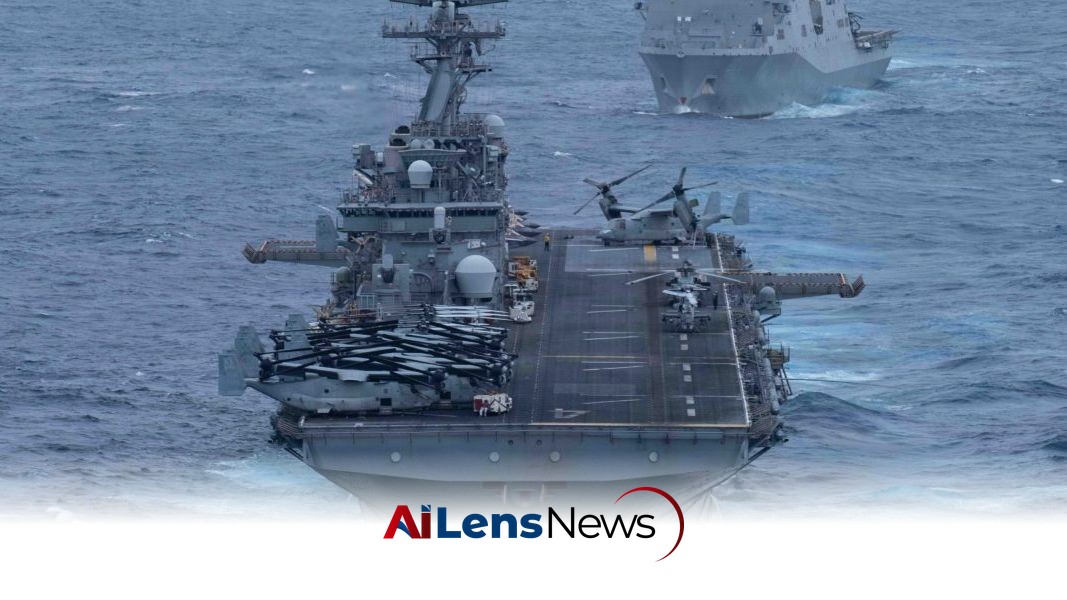


In response to a deadly attack in Jordan, the U.S. military has launched airstrikes targeting Iran's Revolutionary Guard, escalating tensions in the region.
Washington DC, United States Jul 19, 2026 ALN: The U.S. military announced on Saturday that it has initiated new airstrikes against Iran, aimed at "swiftly punishing" the country's Revolutionary Guard for an attack in Jordan that resulted in the deaths of two American service members, with one more missing and four hospitalized.
According to U.S. Central Command, these strikes are intended to further degrade Iran's capability to control oil tanker traffic through the Strait of Hormuz, a crucial waterway that previously accounted for approximately 20% of global oil supplies.
The identities of the deceased service members have not been disclosed. Since the onset of the conflict, a total of 16 U.S. service members have been killed, and over 430 have sustained injuries.
Shortly before the announcement of the airstrikes, Iran's supreme leader issued a warning of "unforgettable lessons" if the U.S. continues its military actions against the Islamic Republic. These remarks, broadcasted on state television and attributed to Mojtaba Khamenei, also dismissed President Donald Trump's recent agreements as "worthless and invalid." An Iranian negotiator indicated that Tehran is suspending its commitments to an interim deal established about a month ago, which aimed to bring a permanent end to hostilities.
These declarations have further strained an already fragile situation, as the conflict shows no signs of resolution. Khamenei cautioned that the consequences would not only come from Iran but also from its regional armed proxies, collectively referred to as the "Axis of Resistance." In light of the escalating tensions, the U.S. has issued a global travel alert.
The conflict has primarily revolved around control of the Strait of Hormuz, which has become increasingly perilous for civilians and infrastructure, including critical desalination plants. The global economy remains on high alert as the situation develops.
Iran's Deputy Foreign Minister, Kazem Gharibabadi, stated that the U.S. has violated its commitments under the existing deal, leading Iran to cease its compliance.
There has been no new information regarding mediation efforts to de-escalate the situation.
The most recent recorded death of a U.S. service member occurred earlier this month when a helicopter pilot crashed in the Arabian Sea. In the early days of the conflict, an Iranian drone strike on a command center in Kuwait resulted in the deaths of six soldiers, while another soldier was killed in an attack on a base in Saudi Arabia. Additionally, six service members died when a refueling aircraft crashed in Iraq.
On Saturday, significant damage from Iranian strikes was reported in Kuwait, where both a water desalination plant and an oil facility were targeted, according to local authorities. This marks the second attack on a desalination plant within two days in the small desert nation, which relies on desalination for 90% of its drinking water supply. The strikes have resulted in injuries to several individuals at the oil facility and have caused a fire at the desalination plant, leading to the shutdown of multiple power generation units.
Firefighters and workers have sustained injuries while responding to two additional blazes ignited by Iranian strikes, as reported by the Kuwait Fire Force. In response to missile threats, Kuwait briefly closed its airspace, and Kuwait Airways announced the rescheduling of most flights to and from the capital.
Meanwhile, Iraq reported that it successfully shot down attack drones over the city of Irbil. Jordan's state-run Petra news agency indicated that the kingdom's air defense systems intercepted Iranian missiles, while air sirens were activated multiple times in Bahrain and Saudi Arabia throughout the day.
The Secretary-General of the Gulf Cooperation Council, Jasem Mohamed al-Budaiwi, has accused Iran of committing war crimes through its strikes on civilian infrastructure.
U.S. Central Command confirmed that its airstrikes have continued for a seventh consecutive night, targeting "surveillance sites, military logistics infrastructure, underground weapons storage, and maritime capabilities." Reports from Iranian state television indicated that U.S. airstrikes hit an electricity and desalination plant in Iran's Hormozgan province, destroying the Bonji desalination plant and cutting off water supplies to approximately 10,000 residents.
Overnight strikes also damaged two tunnels and a bridge, disrupting a major highway leading to Bandar Abbas, Iran's primary port located near the narrowest part of the Strait of Hormuz. Iranian state media reported that three bridges were hit on Saturday, including one leading to Bandar Abbas.
For the first time, Iranian authorities acknowledged "attacks on power infrastructure" during the U.S. airstrikes, with the Energy Ministry urging residents in southern provinces experiencing extreme heat to conserve electricity.
Iranian officials have reported that at least 50 individuals have been killed and over 500 injured due to U.S. strikes in the past three weeks, including eight fatalities from a recent strike on a bridge.
Since the conflict began, Iran has effectively closed the Strait of Hormuz to shipping traffic following U.S. and Israeli strikes on February 28. This has granted Tehran considerable leverage in ongoing negotiations.
Iran insists that the strait must remain under its exclusive control and that vessels should pay fees to Tehran, despite the international community's longstanding recognition of the strait as an international waterway. Recent reports indicate that Iran has fired on ships, and shipping transits have dropped to a three-week low, according to an international shipping tracker.
President Trump has renewed threats to target Iran's power stations and bridges to compel Tehran to loosen its grip on the strait. In the past week, the U.S. has reinstated a naval blockade on Iranian ports to halt crude oil shipments, with military officials reporting the redirection of five ships and the disabling of one since the blockade was reimposed.
Prior to the outbreak of hostilities, the U.S. had been engaged in negotiations with Iran regarding its nuclear program. Trump now faces mounting political pressure to bring an end to the conflict and avoid the prolonged military engagement in the Middle East that he had campaigned against.
To learn more about the latest developments in Politics, stay updated with our exclusive reports and analyses on AiLensNews.

