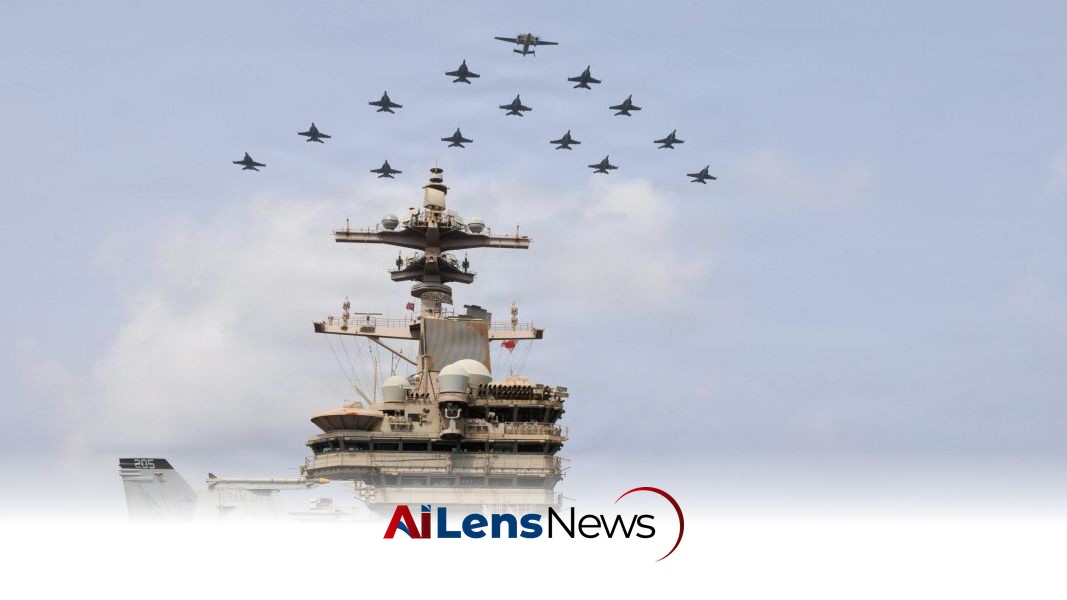


Recent U.S. military actions in the Strait of Hormuz have heightened fears about the stability of oil markets, despite previous confidence in recovery.
Washington DC, United States Jul 13, 2026 ALN: The Strait of Hormuz, a narrow waterway connecting the Persian Gulf to the Gulf of Oman, is one of the most strategically significant maritime passages in the world. This vital chokepoint is responsible for the transit of approximately 20% of the world's oil supply, making it a focal point for global energy security. Given its importance, any disruption in the Strait can have immediate and far-reaching implications for oil prices, global markets, and geopolitical stability.
In recent weeks, the situation in the Strait of Hormuz has become increasingly precarious due to escalating military tensions. These tensions have raised significant concerns among investors and market analysts, particularly in light of the rising oil prices and fluctuating stock futures. The geopolitical landscape surrounding the Strait has long been marked by volatility, with various nations vying for influence and control over this critical maritime route. The latest developments underscore the fragility of stability in this corridor, which is vital not only for oil transport but also for the broader geopolitical dynamics of the Middle East.
As of late Sunday, U.S. stock futures reflected a cautious market sentiment, with the Dow Jones industrial average futures experiencing a slight decline of 100 points, or 0.19%. Similarly, futures for the S&P 500 and Nasdaq fell by 0.27% and 0.48%, respectively. In contrast, oil prices saw an uptick, with U.S. oil futures rising 3.2% to $73.70 a barrel and Brent crude following suit with a 3.2% increase to $78.45. This divergence in market reactions indicates a complex interplay between investor sentiment and the realities of geopolitical risks. The gold market, often viewed as a safe haven during times of uncertainty, also experienced fluctuations, with a decrease of 0.7% to $4,085 per ounce, further illustrating the multifaceted nature of market responses to the ongoing tensions.
Bob McNally, the founder and president of Rapidan Energy, provided insights into the market's response to these geopolitical risks. He noted that the crude oil markets have largely dismissed such risks for years, leading to a perception among traders that the recent rise in oil prices is "pretty tame." This sentiment suggests a level of confidence among traders that the most severe impacts of the conflict in the Strait of Hormuz may have already passed. Notably, the stock market has largely ignored developments related to Iran since April, indicating a degree of complacency among investors regarding the potential for escalation in the region.
On the evening of the same day, U.S. Central Command announced a series of military strikes targeting Iranian positions. These strikes were aimed at diminishing Iran's capability to carry out attacks on civilian vessels and commercial shipping in the Strait. This marked the fifth round of U.S. strikes in a week and the third within a 24-hour period, highlighting a significant escalation in military operations. The latest wave of strikes was prompted by an incident in which the Islamic Revolutionary Guard Corps (IRGC) targeted a commercial ship, leading to the interception of an Iranian missile and drone by U.S. forces. This incident exemplifies the growing threat posed by Iranian military actions in the region, further complicating an already tense maritime security situation.
Prior to this escalation, U.S. forces had conducted strikes on approximately 300 targets over the previous three rounds of attacks, with the most intense day being Saturday, when 140 targets were hit. These targets included missile and drone sites, naval capabilities, ammunition storage facilities, communication networks, and coastal surveillance locations. The rapid succession of these military actions illustrates a significant increase in operational tempo and a shift in the U.S. approach to dealing with Iranian aggression in the region. Such military maneuvers signal a clear intent by the U.S. to assert its influence and protect its interests in the Strait of Hormuz.
Iran's military actions have not been limited to targeting commercial vessels. The country has also launched attacks against its Gulf Arab neighbors, including Bahrain, Kuwait, Qatar, Jordan, and Oman. Iran's justification for these actions stems from a memorandum of understanding signed with the U.S. last month, which it claims grants it the authority to regulate maritime traffic in the region. This assertion has led to increased tensions, as Iran has specifically targeted vessels that do not adhere to a regime-backed corridor along its coast. Such actions further complicate the already volatile maritime security situation and raise the stakes for all parties involved.
In response to these aggressive maneuvers, the U.S. has emphasized the necessity of restoring freedom of navigation in the Strait of Hormuz. The U.S. military has established an alternate shipping corridor that hugs the coast of Oman, which has been utilized to assist over 800 commercial vessels and facilitate the transit of 400 million barrels of crude oil since early May. This proactive approach underscores the U.S. commitment to ensuring the security of maritime routes that are critical to global energy supplies. The establishment of this alternate corridor is a strategic move aimed at mitigating the risks posed by Iranian actions while maintaining the flow of oil through this essential passageway.
The ongoing standoff between the U.S. and Iran has led to increasingly violent skirmishes as both sides seek to assert their influence and control over the strategic waterway. Sal Mercogliano, a professor specializing in military and maritime history at Campbell University, expressed concern over the recent combat, describing the ceasefire as a "facade" that has persisted for some time. He warned that the situation might be evolving into an "undeclared naval war," a scenario that carries the potential for significant escalation and broader regional instability. Such a development could have profound implications not only for the countries directly involved but also for global markets and international relations.
The implications of these developments extend beyond immediate military concerns. The Strait of Hormuz is not only a vital artery for oil transport but also a focal point of geopolitical rivalry in the Middle East. The tensions between the U.S. and Iran have the potential to impact global oil prices, disrupt shipping routes, and influence international relations in the region. As the situation continues to unfold, market participants will be closely monitoring developments, as any significant escalation could lead to a more pronounced reaction in both oil prices and stock markets. The interconnectedness of global markets means that disruptions in the Strait of Hormuz could reverberate worldwide, affecting economies far beyond the immediate region.
In conclusion, the recent military actions in the Strait of Hormuz highlight the precarious balance of power in the region and the ongoing struggle for control over critical maritime routes. The response from global markets reflects a mix of caution and confidence, as investors weigh the risks of potential conflict against the backdrop of a recovering oil market. As the situation remains fluid, the international community will be watching closely, aware that any further escalation could have far-reaching consequences for both regional stability and global economic conditions. The stakes are high, and the need for diplomatic solutions has never been more pressing, as the world grapples with the implications of renewed conflict in one of its most vital maritime corridors.
To learn more about the latest developments in World News & International Affairs, stay updated with our exclusive reports and analyses on AiLensNews.

