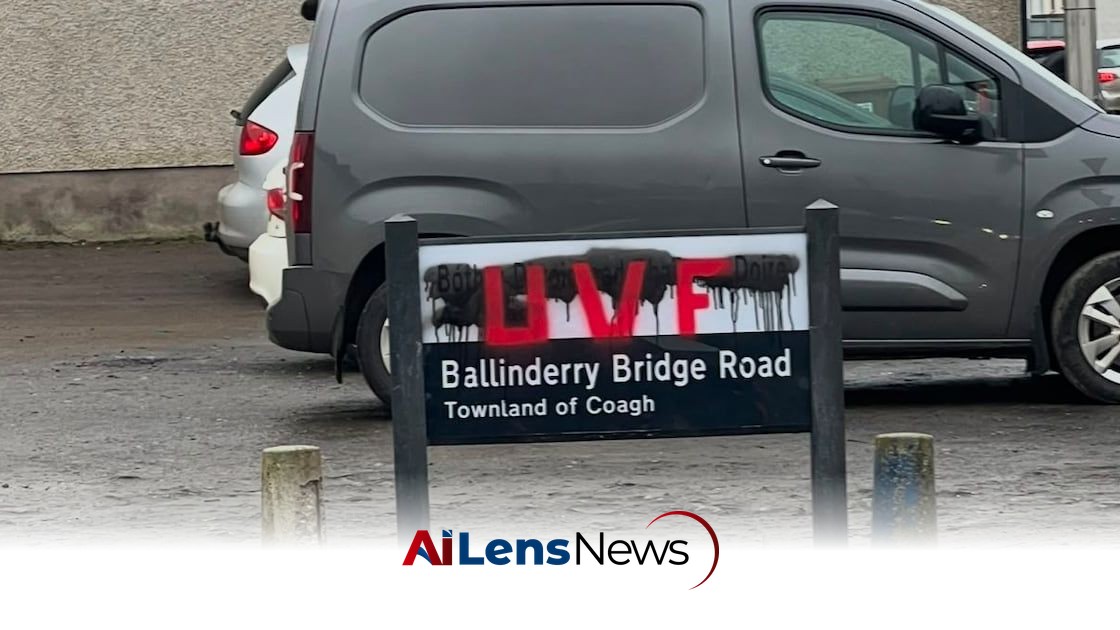


A dual language street sign in Co Tyrone has faced over 60 acts of vandalism since its installation in 2018, prompting local officials to condemn the attacks.
London, United Kingdom Jul 26, 2026 ALN: The ongoing issue of vandalism against an Irish dual-language street sign in Co Tyrone has highlighted deeper societal divisions and tensions within the region. The sign, which was installed in 2018 after a local referendum showed that 54% of residents along Ballinderry Bridge Road supported the addition of Irish language signage, has become a focal point for broader discussions about cultural identity, community dynamics, and political representation in Northern Ireland.
Coagh, a predominantly unionist area, contrasts sharply with nearby Ballinderry, which is viewed as predominantly nationalist. This geographical and political dichotomy reflects the historical complexities of Northern Ireland, where community identities are often intertwined with political affiliations and cultural expressions. The installation of bilingual signs is often seen as a symbol of recognition and respect for the Irish language, which has experienced a revival in recent years but remains contentious in certain areas.
Local councillor Gavin Bell, representing Sinn Féin, has been vocal about the repeated vandalism of the sign, which he claims has been targeted over 60 times. This includes instances where graffiti associated with the Ulster Volunteer Force (UVF), a loyalist paramilitary group, has been painted onto the sign. Cllr Bell's condemnation of the vandalism underscores the challenges faced by communities attempting to navigate the complexities of identity and language in a post-conflict society.
"It’s by far the most damaged sign in Mid Ulster," Cllr Bell stated, emphasizing the need for respect toward public property and the democratic process that led to the sign's installation. His remarks reflect a broader sentiment among those who advocate for the recognition of the Irish language as an integral part of Northern Ireland's cultural heritage. The vandalism not only represents a physical attack on the sign itself but also serves as a metaphorical assault on the rights of individuals to express their cultural identity.
In recent days, reports have emerged that residents in mixed housing developments have been approached to sign a petition demanding the removal of the Irish language from the signage. This has raised concerns about intimidation and pressure tactics being employed against those who support the bilingual signs. Cllr Bell has called for police investigations into these incidents, highlighting the need for community safety and the importance of fostering an environment where all residents feel secure in expressing their views.
The financial implications of the vandalism are also significant. Recent figures indicate that the average cost to repair a damaged street sign in Northern Ireland is around £110. Since 2020, local councils have reportedly spent approximately £55,000 on repairs due to vandalism. This financial burden raises questions about resource allocation and the prioritization of community needs in the face of ongoing damage to public property.
In November of the previous year, a 49-year-old man was arrested as part of a Police Service of Northern Ireland (PSNI) investigation into the repeated damage of the sign. This incident underscores the law enforcement challenges associated with addressing vandalism that is often rooted in deeper community tensions. Following the arrest, a file was submitted to the Public Prosecution Service, indicating that authorities are taking the matter seriously.
The Traditional Unionist Voice (TUV), a political party that does not currently hold elected representation in the area, has also expressed concern over the dual-language signage in Coagh. TUV representatives met with council officers and the PSNI to discuss their views, asserting that the only appropriate resolution would be to revert the street sign to only. Their stance reflects the ongoing polarization surrounding language and identity in Northern Ireland, where such issues can provoke strong emotional responses from different segments of the community.
Timothy Gaston, a TUV MLA, highlighted the financial implications of the ongoing repairs, stating that "thousands of pounds" have been spent by the council due to the persistent vandalism. He indicated that a petition would be brought to the local authority to demonstrate that the dual-language sign is "not wanted" by certain community members. This move is indicative of the political maneuvers often employed in Northern Ireland, where public sentiment can be mobilized to influence local governance.
In response to the ongoing issues, a PSNI spokesperson noted that neighborhood police regularly engage with various community groups and organizations across Mid Ulster to discuss relevant local issues. They emphasized their willingness to listen to all viewpoints regarding the ongoing instances of criminal damage to council property. This engagement is crucial in fostering dialogue and understanding among diverse community groups, particularly in areas where tensions may run high.
The situation surrounding the Irish language street sign in Co Tyrone serves as a microcosm of the broader societal challenges facing Northern Ireland. The tensions between unionist and nationalist communities continue to shape the political landscape, and issues related to language and identity remain contentious. As communities navigate these complexities, the need for constructive dialogue and mutual respect becomes increasingly important. The ongoing vandalism of the sign not only represents a physical act of defiance against a symbol of cultural recognition but also highlights the urgent need for efforts to bridge divides and foster a more inclusive society.
As the debate continues, it remains to be seen how local authorities, community leaders, and residents will address the underlying issues that fuel such divisions. The response to the vandalism and the future of the dual-language sign will likely influence broader discussions about identity, representation, and coexistence in Northern Ireland, making it a critical issue for all stakeholders involved.
To learn more about the latest developments in Crime & Law, stay updated with our exclusive reports and analyses on AiLensNews.

