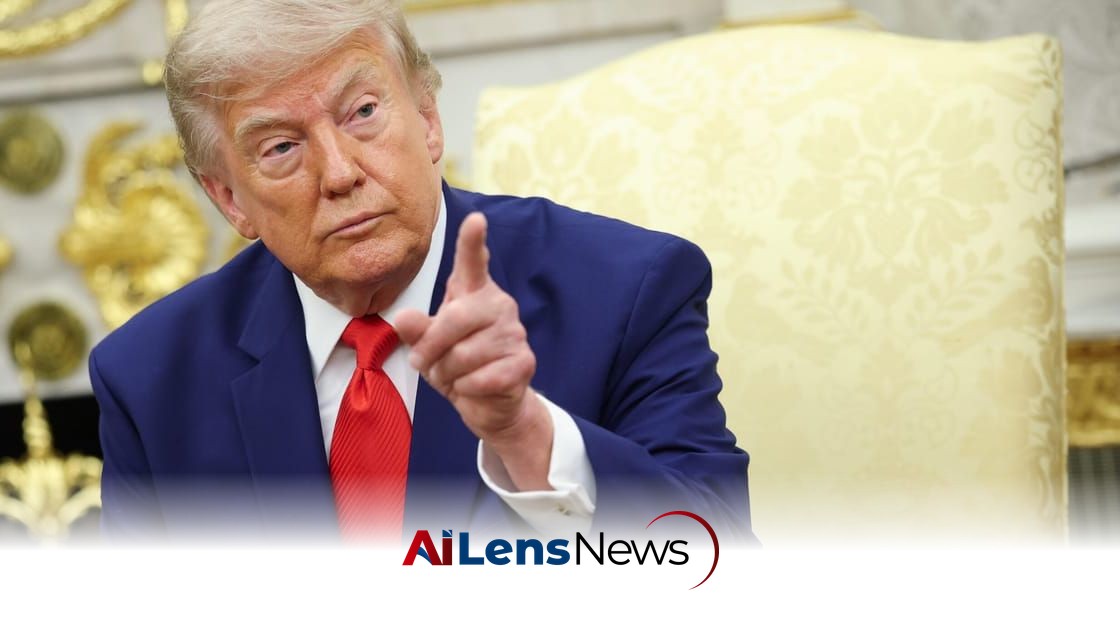


The EU's record fine against Google coincides with President Trump's impending tariff decisions, raising fears of renewed trade tensions.
London, United Kingdom Jul 23, 2026 ALN: The European Union knew its €890 million fine against Google risked poking the bear in Washington. And the timing couldn’t be worse.
President Donald Trump, who’s lashed out at previous EU fines against U.S. tech companies, is in the final hours of deciding a new regime of tariffs, expected when a temporary 10 percent levy is due to expire Friday. That hastily imposed global tax on imports was imposed after the U.S. Supreme Court had struck down Trump's “Liberation Day” global tariffs in February.
The fear in Europe is that Thursday’s fine — the highest-ever imposed for violation of the EU’s signature Digital Markets Act that regulates major tech platforms — could trigger Trump to respond in what he sees as a tit-for-tat trade war.
European officials insist that the two-part fine on Google that includes €460 million for favoring its own search services and €430 million for the unfair way the Play Store is installed on smartphones, has nothing to do with trade policy. Brussels says the penalties reflect normal enforcement of EU law, like a similar fine against China’s Alibaba earlier this week. They also note that the total penalty is relatively modest, amounting to around 0.22 percent of the global annual turnover of Google’s parent company, Alphabet.
“We'd rather have a very friendly relationship with all our partners but we are not going to refrain from acting because one of our partners doesn't like our law,” said Teresa Ribera, the European Commission's executive vice president for competition policy.
But that European attempt to keep the Google case separate from trade policy is unlikely to count for much in Washington as Trump gears up for his new tariff round.
U.S. trade czar Jamieson Greer said the “EU’s recent actions ... pose a real risk to the continuation of transatlantic stability with respect to trade” while Andrew Puzder, the U.S. ambassador to the EU, called the Google fine “the latest example of Brussels using regulation as a blunt instrument against American innovation.”
U.S. lawmakers this week also called on Trump to push back against the EU’s “discriminatory” digital policies and keep up the pressure on Brussels in order to defend American interests. The Republican legislators thanked the president for his “recent threat to impose tariffs” on countries imposing a digital service tax. The appeal underscored how the EU’s regulation of U.S. tech firms has become intertwined with domestic politics, particularly ahead of the U.S. midterm elections in November.
The expiration of the temporary 10 percent tariffs on Friday opens the way for the administration to rebuild its tariffs against Europe using other legal mechanisms.
The U.S. is now studying potential duties based on Europe's alleged failure to crack down on imports of goods made with forced labor — a measure specifically combating manufacturing from America's trade rivals in Asia. Washington is also probing alleged industrial overcapacity in Europe and is considering expanding its investigation into pharmaceutical pricing policies — currently only focused on Germany — to other EU countries.
The European Parliament's trade chief Bernd Lange praised the European Commission for pressing ahead with the Google fine, despite that looming tariff threat.
With the fine against Google, “the Commission has shown backbone despite uncertainty over U.S. tariffs after 24 July,” Lange said on X, celebrating from the U.S., where he is meeting with American officials together with fellow European lawmakers. But it “must not become pretext for US tariff retaliation,” he warned.
Greer has suggested action is imminent to replace the 10 percent tariffs. He hinted as much on Wednesday when he quipped to reporters that “you all are just going to have to stay tuned. You’re going to be busy the next few days, probably.”
The key question, however, is whether Washington will honor the hard-fought 15 percent tariff ceiling on EU exports enshrined in a fragile transatlantic truce struck just a year ago at a summit in Scotland.
Publicly, Brussels is projecting confidence in Washington that it will respect the Turnberry commitments. Privately, officials acknowledge the White House could always unveil a new wave of higher tariffs.
During a meeting with the EU’s 27 envoys on Wednesday, the newly appointed head of the Commission’s trade department, Ditte Juul Jørgensen, said that although Brussels was confident Washington would respect the commitments listed under the Turnberry deal, it was ready to react if it didn’t, three EU diplomats familiar with the conversation told.
One added that ambassadors would be ready to convene an extraordinary meeting next week “to talk strategy and discuss possible countermeasures.”
In the meantime, though, nobody knows when exactly the next tariffs will come.
“We’re not focused on a particular timeline. We’re focused on fulfilling the legal and statutory requirements,” Greer said after a hearing in the U.S. Senate.
Even if the administration has yet to finalize tariffs under the most immediate investigation into imports made with forced labor, it has several legal avenues available to avoid any gap once the temporary tariffs — imposed under Section 122 of the Trade Act of 1974 — lapse.
Washington could still reissue the 10 percent tariff for another 150 days, or declare that any new tariffs retroactively began on July 25, according to Greta Peisch, who was general counsel for the U.S. Trade Representative under former President Joe Biden. These options are legally precarious, however, with a U.S. trade court already ruling that Trump’s use of the measure to set the existing 10 percent duty is illegal.
In Brussels, when asked whether the U.S. had reacted to the Google fine, the Commission’s deputy chief spokesperson Olof Gill said: “The Commission maintains regular contact with its U.S. counterparts across the full range of our very deep and comprehensive cooperation.”
Striking a less diplomatic note, other European officials would have liked to see a heftier fine. “The EU is still incentivizing tech companies to build monopolies and kill competition,” said Alexandra Geese, a Green member of the European Parliament from Germany, calling out a fine that “feels performative.”
Daniel Desrochers and Ari Hawkins in Washington contributed reporting.
To learn more about the latest developments in Politics, stay updated with our exclusive reports and analyses on AiLensNews.

