

Security footage reveals passersby largely ignoring a man's fireworks attack outside a federal building in Lower Manhattan, leading to arson charges against him.
London, United Kingdom Jul 23, 2026 ALN: The recent incident outside a federal building in Lower Manhattan has drawn attention not only for its bizarre nature but also for the reactions of bystanders who seemed unfazed by the chaos unfolding before them. On Monday morning, Andrew Arrabaca, a 43-year-old former U.S. Army soldier, allegedly set off a spectacular display of fireworks and ignited a fire outside the 26 Federal Plaza, an area that houses several federal agencies, including the U.S. Immigration and Customs Enforcement (ICE) and the FBI. This incident has raised further questions about public safety, mental health issues among veterans, and the potential for violence in politically charged environments.
The surveillance footage released by the U.S. Attorney's Office provides a detailed account of the events. It shows Arrabaca arriving at the scene with a wagon filled with fireworks and other supplies. As he sets up a large fireworks dispenser, the situation escalates quickly. The fireworks begin to shoot into the air and, in a moment of chaos, the dispenser topples over, sending rockets flying in all directions. One rocket even strikes the wagon, causing an explosion that sends sparks flying dangerously close to pedestrians and passing vehicles.
While many New Yorkers are known for their ability to maintain composure in the face of unusual occurrences, the reactions of some bystanders during this incident were particularly striking. One pair of pedestrians walked past Arrabaca as he unleashed the fireworks, seemingly unaffected by the imminent danger. However, their demeanor changed dramatically when Arrabaca brandished what appeared to be a rifle, later identified as a pellet gun, prompting them to seek cover. This moment highlights the complex relationship New Yorkers have with their environment, often choosing to ignore chaos unless it directly threatens their safety.
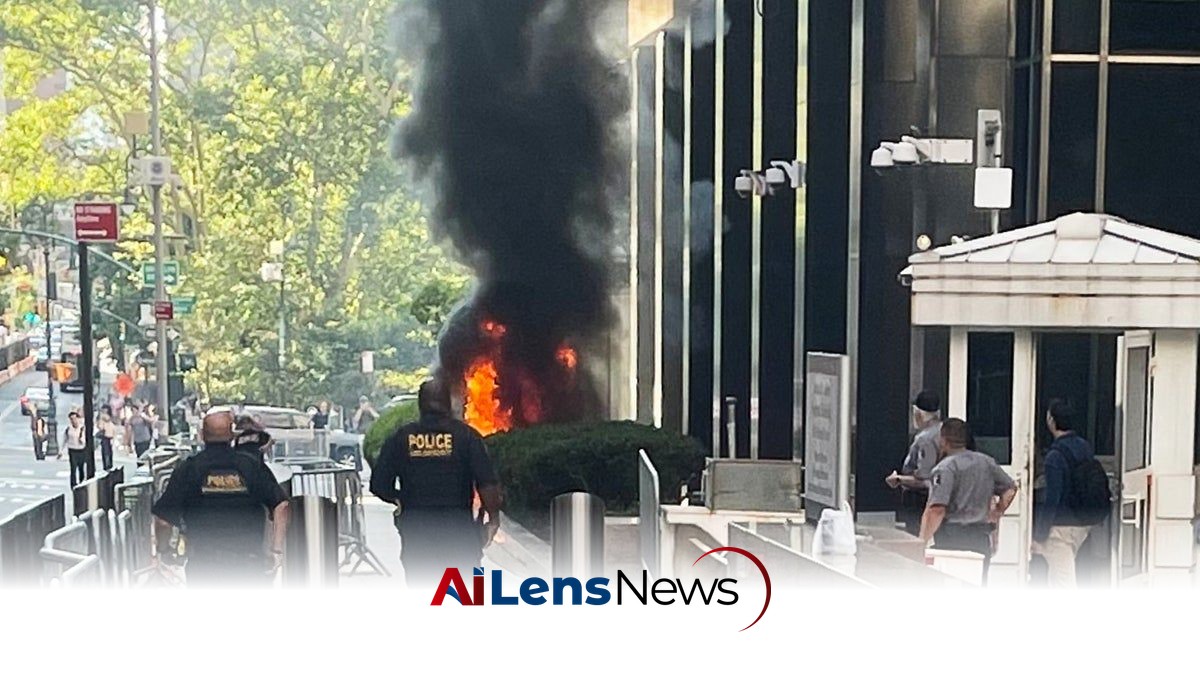
The situation escalated further when Arrabaca dumped a bucket of what appeared to be gasoline, igniting a large fire on the sidewalk that spread to the steps of the federal building. The fire created a scene of panic, yet some individuals continued to navigate the chaos, including a cyclist who rode by seemingly oblivious to the unfolding crisis. This juxtaposition of calmness amidst chaos raises questions about the psychological resilience of urban dwellers in high-stress environments.
Authorities quickly responded to the scene, and Arrabaca was arrested without incident. During his arrest, he reportedly made anti-government and anti-American statements, and he was found in possession of an anti-ICE sign, which suggests a politically motivated agenda behind his actions. The presence of weapons, including two axes, three fixed-blade knives, a hammer, and a machete, further underscores the potentially dangerous nature of his intentions.
Fortunately, the incident did not result in serious injuries, although three individuals sustained minor injuries, including a person who was attending an immigration court hearing at the building. The rapid response by security personnel and law enforcement likely prevented a more catastrophic outcome.
Federal prosecutors have indicated that Arrabaca had been planning this attack for months and had even considered targeting other locations within New York City. His travels to purchase weapons in upstate New York and fireworks in Pennsylvania indicate a premeditated effort to carry out his plans. This raises concerns about the ease with which individuals can obtain dangerous materials and the implications for public safety in urban settings.
During Arrabaca's hearing, U.S. Magistrate Judge Robyn F. Tarnofsky remarked on his apparent mental health issues, stating that he was “quite clearly ill.” Reports indicate that Arrabaca had been living in his car and had slept in a park the night before the attack. His struggles with mental health are further compounded by his history as a veteran; he was prescribed medication for a mental health condition in 2020 but ceased taking it approximately a year later. This highlights the ongoing challenges faced by many veterans in accessing proper mental health care and the potential consequences of untreated conditions.
Arrabaca's defense attorney has suggested that he be sent to a locked ward at a Veterans Health Administration facility for mental health evaluation. However, the court ordered him to be jailed first and then evaluated, reflecting a legal system that often grapples with balancing public safety and the mental health needs of defendants.
Arrabaca's military background adds another layer of complexity to this incident. He served in the Army from 2001 to 2004, where he was responsible for repairing Patriot missile systems. His time in the New York Army National Guard, although without deployments, may have influenced his mental health trajectory and contributed to the challenges he faced post-service. The experiences of veterans, particularly those who have served in combat roles, are critical to understanding the broader context of mental health issues in the military community.
This incident serves as a stark reminder of the potential for violence in politically charged atmospheres, particularly in areas associated with federal enforcement. The implications of Arrabaca's actions extend beyond the immediate chaos; they prompt discussions about the effectiveness of mental health support for veterans, the accessibility of weapons and fireworks, and the overall safety of public spaces in urban environments. As cities continue to navigate the complexities of public safety, the need for comprehensive mental health resources and community support systems remains paramount.
In the aftermath of this event, discussions will likely arise regarding how to better equip communities to respond to similar situations in the future. The balance between maintaining public order and addressing the underlying issues of mental health and political extremism will be crucial as authorities seek to prevent such incidents from occurring again.
To learn more about the latest developments in Crime & Law, stay updated with our exclusive reports and analyses on AiLensNews.

