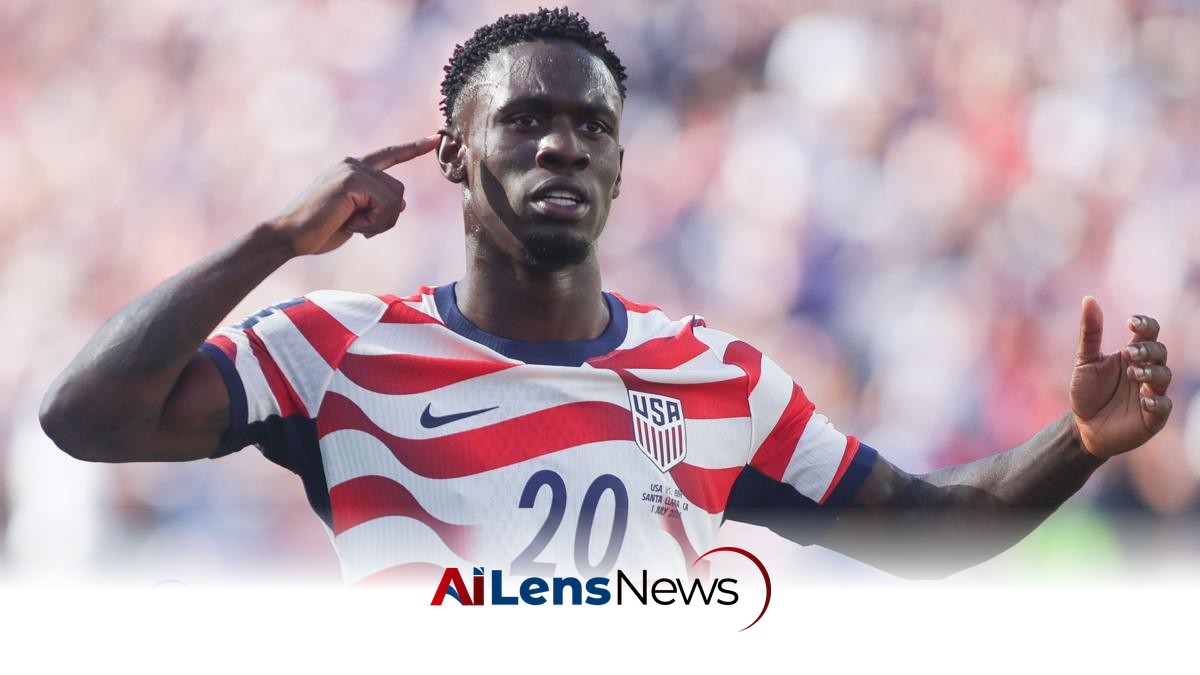


Folarin Balogun can play for the USA in the World Cup after Fifa suspended his one-game ban, prompting reactions from officials and fans.
New Delhi, India Jul 6, 2026 ALN: Folarin Balogun is available to play for the United States in their World Cup last-16 tie against Belgium after his one-game ban was suspended by Fifa.
The 25-year-old star striker, who is the US's top scorer at the tournament with three goals, was shown a straight red card for a foul on Bosnia-Herzegovina defender Tarik Muharemovic as the co-hosts won their last-32 tie 2-0. This incident has sparked significant controversy and debate surrounding the application of disciplinary measures within the tournament.
Fifa stated that the automatic one-match ban would be suspended for a year, without providing further reasoning beyond citing a rule that allows for such suspensions to be postponed. This decision has raised eyebrows among football officials and fans alike, as it appears to diverge from the typical enforcement of red card penalties during World Cup matches.
The Royal Belgian Football Association (RBFA) expressed its astonishment at Fifa's decision and is currently investigating all potential options in response. The RBFA's reaction underscores the broader implications of Fifa's ruling, which could affect not only the current tournament but also future competitions if perceived inconsistencies in disciplinary actions persist.
"In line with article 27 of the Fifa disciplinary code, the implementation of the match suspension is suspended for a probationary period of one year," Fifa said in a statement. This statement indicates that Balogun's suspension could be reinstated if he commits another infringement of a similar nature during the probationary period. This conditional suspension raises questions about how Fifa will handle similar incidents going forward and whether this precedent will influence the behavior of players on the field.
US President Donald Trump thanked Fifa for "reversing a great injustice" in a post on Truth Social. Trump, a friend of Fifa president Gianni Infantino, wrote: "Thank you to Fifa for doing what was right, and reversing a great injustice! President DONALD J. TRUMP." The involvement of a high-profile political figure like Trump in this sporting matter complicates the narrative, suggesting potential political influences on sports governance, which has long been a topic of concern in the realm of international sports.
Reports from AFP and Reuters indicate that Trump called Infantino earlier in the week to request a review of the red card. The BBC has not yet confirmed these reports, but the suggestion that political pressure may have played a role in Fifa's decision adds a layer of complexity to the situation. It raises questions about the integrity of Fifa's disciplinary processes and whether external influences can sway decisions made by the governing body.
USA forward Christian Pulisic mentioned that the squad learned about the suspension of the one-game ban on the bus to training on Sunday, adding that Balogun was "super happy". Pulisic remarked: "Just a big smile on his face and all of ours. The foul wasn't what it was; it was harsh." The team's reaction highlights the camaraderie and support among players, but also reflects the broader sentiment among fans who felt that Balogun's red card was unjust.
The RBFA highlighted that all previous red cards issued at this World Cup have automatically resulted in a suspension, and Fifa's decision contradicts the competition regulations, which were "explicitly reaffirmed" by the governing body to all participating nations in May. This contradiction raises serious concerns about the consistency of Fifa's enforcement of its own rules, which is critical for maintaining fairness in such a prestigious tournament.
It stated: "In order to safeguard the legitimate rights of all participating teams and to protect the fundamental principles of fair play in our sport, both at this Fifa World Cup and at future editions of the tournament, the RBFA is investigating all potential options." This statement reflects the RBFA's commitment to ensuring that all teams are treated equitably and that the integrity of the competition is upheld.
US Secretary of State Marco Rubio was among those who demanded a review of the decision. During a conference, he stated: "It was great. They got screwed with that red card. There needs to be an appeal process for that. It's probably too late for that." Rubio's comments highlight the high-profile nature of this incident and the extent to which it has captured the attention of political figures in the United States, further blurring the lines between sports and politics.
Widespread discontent among fans regarding the red card for one of their star players has been noted, with many media outlets questioning the decision and the application of football rules regarding red cards and subsequent bans. The emotional investment of fans in their national team during the World Cup is immense, and decisions like this can have lasting impacts on public perception of the sport and its governing bodies.
Balogun has been pivotal for the US at the World Cup, scoring twice as the team began their campaign with a 4-1 victory against Paraguay. His contributions to the team have been significant, making the suspension even more contentious among supporters who believe he deserves to compete at the highest level without the threat of an unjust ban.
The former Arsenal forward scored against Bosnia before receiving the red card in the 64th minute after a tussle with Muharemovic for a looping ball. As Balogun attempted to shield the ball, Muharemovic managed to get in front of him, and Balogun's boot landed on the back of the Bosnian's ankle, causing it to twist. The nature of the incident has led to differing interpretations of the foul, with some arguing that the contact was accidental and not deserving of a red card.
Brazilian referee Raphael Claus issued the red card after reviewing the incident on the pitchside monitor, following a super slow-motion replay by the video assistant referee (VAR). The use of VAR has been a contentious topic in football, with debates continuing over its effectiveness and the potential for human error in interpreting replays.
According to Fifa regulations, a red card "automatically incurs suspension from the subsequent match," but the governing body "may impose additional match suspensions and other disciplinary measures." This stipulation emphasizes the importance of consistency in applying disciplinary measures, as players and teams must be able to rely on a clear understanding of the consequences of their actions on the field.
During the group stages, Qatar midfielder Assim Madibo received a five-match suspension for a foul that resulted in a broken leg for Canada's Ismael Kone. The disparity between Madibo's punishment and Balogun's situation raises questions about the criteria used to determine the severity of infractions and the subsequent penalties imposed, leading to accusations of inconsistency in Fifa's disciplinary processes.
However, there is precedent for Fifa suspending a World Cup ban. Portugal captain Cristiano Ronaldo was cleared to play in his country's opening match of the tournament despite a red card received during World Cup qualifiers. This precedent suggests that Fifa has the authority to make exceptions to its rules, but it also raises concerns about the criteria used to determine which cases warrant such leniency.
On Thursday, Balogun became the 12th player to receive a red card at this World Cup and will be the first not to serve a suspension. This unique situation places Balogun in a position of both relief and scrutiny, as his availability for the knockout stage could significantly impact the outcome of the match against Belgium.
Fifa's decision to effectively overturn his red card against Bosnia-Herzegovina is remarkable, especially given that there is no appeal process for red cards at the World Cup, a measure intended to protect the integrity of the referee. This decision may set a concerning precedent for future tournaments, as it raises questions about the reliability of officiating and the potential for external influences on decisions made by referees.
Many will draw comparisons to Ronaldo's situation, but this instance is unique as it involves a red card at the World Cup. The stakes are higher in this context, and the implications of such a decision reverberate beyond the immediate match, affecting the tournament's integrity as a whole.
With the host nation's star player now available for a crucial knockout game, questions arise regarding how this decision was made, especially given the close relationship between the White House and Fifa. The intersection of politics and sports governance can lead to perceptions of favoritism, which can undermine trust in the governing body and the fairness of the competition.
In contrast, Madibo's case, where a serious injury was inflicted, resulted in a much harsher penalty, leaving the impression that Fifa is applying its rules inconsistently. This inconsistency could lead to further scrutiny and calls for reform within Fifa, as stakeholders demand clearer guidelines and more equitable enforcement of disciplinary measures.
To learn more about the latest developments in World News & International Affairs, stay updated with our exclusive reports and analyses on AiLensNews.

