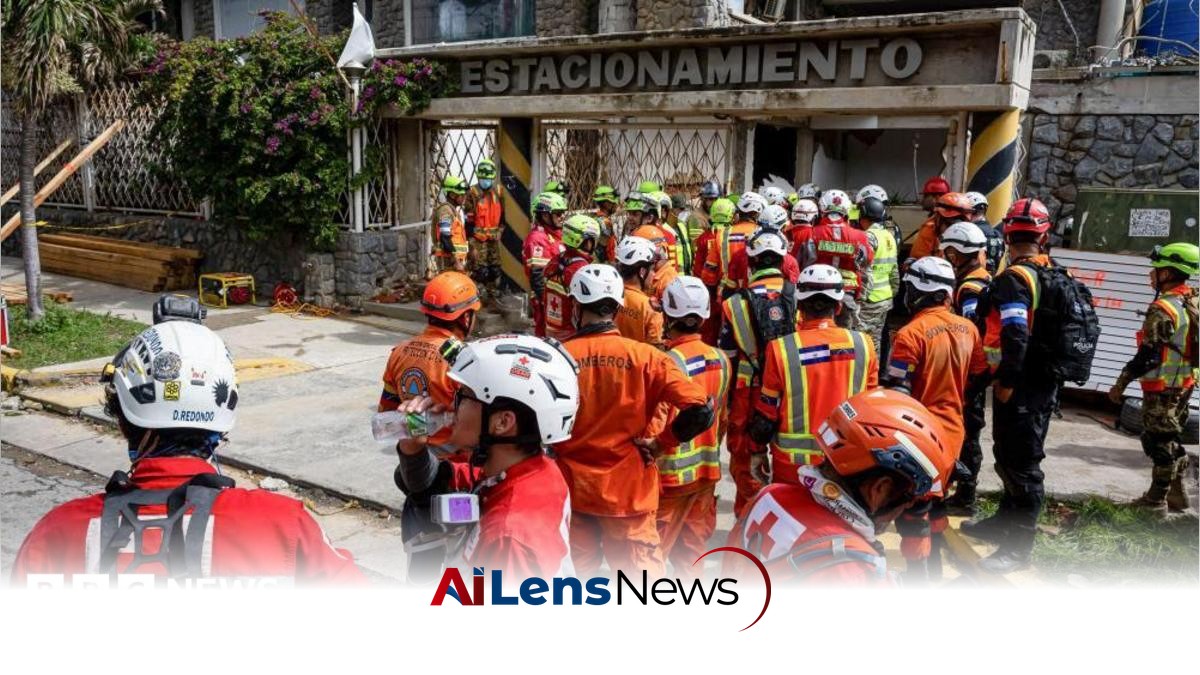


Emergency workers are making progress in rescuing Hernán Gil, who has been trapped under rubble for over 100 hours following the devastating earthquakes in Venezuela.
New Delhi, India Jul 2, 2026 ALN: Rescue teams from seven countries are inching towards a man who survived the twin earthquakes that struck Venezuela eight days ago.
Emergency workers located security guard Hernán Gil on Saturday beneath the ruins of a multi-storey car park in Catia La Mar, but have only been able to make visual contact with him in the last hours. The situation surrounding Gil's survival has captured the attention of the nation and the world, highlighting both the resilience of the human spirit and the challenges faced by rescue operations in disaster-stricken areas.
Despite being buried under nine-metre-deep, highly unstable rubble, rescuers say that Gil, who is in his 40s, is "in good spirits" and cheering them on. His wife has described his survival as "a miracle". Almost 2,300 people are confirmed to have died in the quakes which hit Venezuela on June 24, and tens of thousands are still missing. The earthquakes, which registered significant magnitudes, have led to widespread devastation across the region, affecting not only buildings but also displacing families and disrupting essential services.
Around 350 rescuers have been working against the clock to free Gil since he was located more than 100 hours ago. The international response has been remarkable, with teams from Venezuela, Chile, Costa Rica, El Salvador, Mexico, Portugal, and the United States on the ground trying to free him. Each of these countries has sent specialized teams equipped with the necessary tools and expertise to navigate the dangerous conditions of the collapsed structures. Their collaboration is a testament to the global solidarity that often emerges in times of crisis.
Parts of the access ducts they built to reach him have collapsed several times, highlighting the dangers the work poses to the rescuers as well as Gil. The precariousness of the situation has necessitated careful planning and execution of rescue strategies. Rescuers have had to balance speed with safety, ensuring that their efforts do not further endanger Gil or themselves. This delicate operation illustrates the complexities involved in urban search and rescue missions, where time is of the essence, but so is the stability of the surrounding debris.
Overnight, the search teams were finally able to establish visual contact with Gil. In footage recorded by a small camera inserted into the rubble where Gil is trapped, a Chilean firefighter can be heard asking Gil to turn his head towards the camera. This moment marked a significant breakthrough in the rescue operation, providing not only hope for Gil's family but also for the rescuers who have worked tirelessly in challenging conditions.
One of his eyes is bloodshot and he is wearing a face mask, which rescuers had earlier passed to him through a small hole to protect him from the dust and debris created by their efforts to free him. The presence of the face mask highlights the importance of maintaining Gil's health amidst the dire circumstances. The firefighter also asks him to don goggles to protect his eyes as rescuers continue to carefully dig away at the rubble surrounding him.
Ricardo Arias from the Costa Rican Red Cross told local journalist Joan Camargo that Gil was in a stable condition. He added that they had been able to give him water and attach him to an intravenous drip. The ability to provide hydration and medical support is crucial in such situations, where individuals may be deprived of basic necessities for extended periods. Arias said that Gil appeared to have miraculously escaped being crushed when the shopping centre collapsed. "He has told us that he does not even have a crushed nail," he said. "He is fine." This statement reflects not only Gil's physical condition but also the miraculous nature of his survival given the circumstances surrounding the disaster.
Marco Antonio Franco from the Mexican Red Cross described Gil as "a cheerful man". He told a Mexican site that the survivor "even asked for hydration drinks of specific flavours he likes", adding that "of course we indulged him". This light-hearted interaction between Gil and the rescuers serves as a reminder of the importance of maintaining morale in dire situations. "He himself drives us on, telling us to carry on. He recognises our team members, saying 'how nice that you came back and that you're with me again'." The emotional connection that has developed between Gil and the rescue teams is a testament to the human spirit's resilience, even in the face of overwhelming adversity.
According to Franco, the rescuers and Gil kept up a steady chatter about his family and about the challenging rescue. This communication not only helps to keep Gil's spirits up but also provides the rescuers with valuable information about his condition and needs. Gil was first located on Saturday, and the moment of discovery has been described as both exhilarating and emotional for the rescue teams involved.
Head of Emergency Response for the Costa Rican Red Cross, Wagner Leiva, recalled the moment: "We were removing and cutting some slabs when we were told that it seemed there was someone alive. We went down to the basement, and one of our colleagues, after calling out and listening, detected that someone was indeed answering." This moment of realization that someone was alive beneath the rubble sparked a renewed sense of urgency and hope among the rescue teams.
The security guard had been on duty in a small concrete booth in the basement of the parking lot adjacent to the Galerias Playa Grande mall in Catia La Mar when the twin quakes struck. It appears that the booth created a shell around him, protecting him from the 140 tonnes of rubble which collapsed around and on top of him. This detail highlights the unpredictable nature of such disasters, where sometimes, unlikely circumstances can lead to survival against the odds.
Leiva told reporters that given the precarious nature of rescue efforts, they had to proceed very slowly. "As the days passed, we gained access to him and gave him water. This task lasted nearly three days to give him the first sip of water. Last night, at approximately 22:00 (local time), we had physical contact with Hernán." The painstaking efforts to reach Gil emphasize the complexities of rescue operations in urban environments, where every move must be calculated to avoid further collapses.
The rescuers hope to free Gil within the next 24 hours. As they work tirelessly to achieve this goal, the situation serves as a poignant reminder of the fragility of life in disaster-prone areas, as well as the strength and determination of those who risk their lives to save others. The international community continues to monitor the situation closely, with hopes that Gil's story will inspire further efforts in disaster preparedness and response.
To learn more about the latest developments in Science & Environment, stay updated with our exclusive reports and analyses on AiLensNews.

