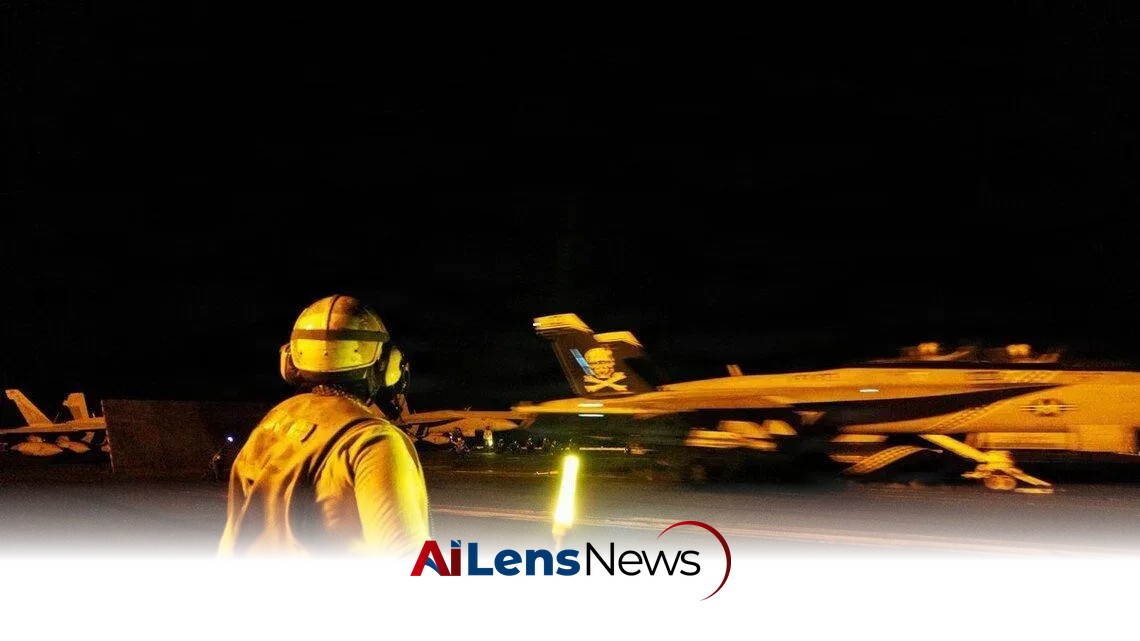


The US military has launched strikes on Iran's coastal defenses and missile sites, escalating tensions as Iran warns of an 'existential war'.
Singapore, Singapore Jul 16, 2026 ALN: CAIRO/DUBAI - The US struck Iran’s coastal defenses and missile sites on July 15 after reimposing a naval blockade of its ports, while Iran threatened to shut off more regional energy exports, saying it was engaged in an “existential war” with America. This escalation marks a significant moment in a long-standing conflict that has seen numerous cycles of tension, military action, and diplomatic efforts over the years.
The latest escalation comes days after a fragile truce collapsed, raising the specter of a return to full-scale war, though analysts generally see that as less likely. The situation has been exacerbated by a series of events, including Iran's announcement on July 11 that it had closed the Strait of Hormuz, a vital waterway through which a significant portion of the world’s oil passes. The Strait is crucial for global commerce, and any disruption can have immediate repercussions on oil prices and energy security worldwide.
Hostilities have intensified as military operations are also keeping ships from transiting this critical artery, which carried about a fifth of global oil and gas shipments before the war. The implications of these actions are far-reaching, as they not only affect oil prices but also the geopolitical landscape of the region. Brent crude oil, the international benchmark, closed at a one-month high at US$84.95 a barrel on July 15, reflecting market anxiety over the ongoing conflict and potential supply disruptions.
The US Central Command reported that military operations targeting Iran’s coastal defense systems and cruise missile storage and launch sites on Iran’s Greater Tunb Island began around 6 am EDT (6 pm in Singapore) and were completed within approximately 90 minutes. Nine hours later, Central Command confirmed a second wave of strikes, indicating a sustained military effort to counter perceived Iranian threats in the region.
“The strikes are targeting Iranian military capabilities used to threaten vessels freely transiting through the Strait of Hormuz, an international waterway vital to global commerce. The US military is holding Iran accountable at the Commander in Chief’s direction,” Central Command stated on social media platform X. This statement underscores the US military's commitment to ensuring the safety and security of maritime navigation in the region.
Three US officials informed Reuters that the strikes aimed not only to reopen the strait but also to target Iranian military capabilities that would need to be neutralized before executing more complex operations. This military strategy reflects a broader US objective to maintain a strong deterrent posture against Iran, particularly as tensions have escalated in recent months.
In a related operation, the US military disabled an unladen oil tanker attempting to sail towards Iran’s Kharg Island after it ignored multiple warnings, firing Hellfire missiles into the ship’s smokestack. This action illustrates the high stakes involved in the ongoing conflict, as both sides seek to assert their dominance in a region critical to global energy supplies.
Following the latest round of strikes, Iran’s Mehr news agency reported that four locations around the city of Ahvaz came under attack, just inland from the northern end of the Persian Gulf, as did Bandar Abbas, Iran’s principal port city on the Strait of Hormuz. In neither case were casualties reported, according to Mehr, although Iranian sources claimed that explosions were heard in Konarak city, at the southern end of Iran on the Gulf of Oman. US projectiles also reportedly hit near Sirik and Qeshm in southern Iran, further escalating tensions in the region.
Iranian state broadcaster IRIB reported that the US attacks struck near a hospital in Ahvaz that houses a pediatric cancer center, forcing the temporary evacuation of the hospital. This incident raises significant humanitarian concerns, as military operations in populated areas can lead to civilian casualties and exacerbate the already dire humanitarian situation in Iran, where many have been displaced due to ongoing conflicts.
After the first wave of strikes, Iran’s top negotiator, Mohammad Baqer Qalibaf, issued a statement declaring that Iranian security depended on maintaining what he termed “Iranian arrangements” in the strait. “We are in an essential and existential war with America,” Qalibaf said, highlighting the high stakes for Iran as it seeks to defend its interests and sovereignty in the face of US military action.
The conflict has resulted in significant loss of life, with reports indicating that the war has killed thousands of people and displaced millions, particularly in Iran and Lebanon, where hostilities have rekindled between Israel and the Iran-backed militant group Hezbollah. The humanitarian toll of the conflict is staggering, with many civilians caught in the crossfire and facing dire conditions.
In a separate development, former President Donald Trump expressed a confident tone regarding the situation, stating that Iran would soon be defeated. Speaking at a roundtable event at the Pennsylvania Defence and Innovation Summit, Trump claimed the Iranians want to “settle so badly.” His comments reflect a broader narrative among some US officials that military pressure could lead to a favorable negotiation outcome with Iran. However, the reality on the ground suggests that the path to resolution remains fraught with challenges.
Trump's assertion that “We’ll find out whether or not we settle with them, or we just finish it off” encapsulates the contentious nature of US-Iran relations, which have been characterized by cycles of confrontation and diplomatic engagement. The prospect of negotiations has become increasingly elusive, particularly in light of recent military actions and escalating rhetoric from both sides.
Iran has been attempting to assert permanent control over shipping in the Strait of Hormuz and to impose fees on vessels passing through it, which would represent a significant shift in the balance of power in a region where the US has long acted as a guarantor of security. The Islamic Revolutionary Guard Corps (IRGC) stated on July 15 that it had struck US military targets in the region, including in Bahrain, Kuwait, and Jordan. This assertion reflects Iran’s broader strategy of projecting power and deterrence in the face of perceived threats from the US and its allies.
Kuwait reported that its armed forces intercepted four missiles and 21 drones from Iran on July 15, although no injuries or material damage were reported. This incident highlights the potential for regional escalation, as missile and drone technology becomes increasingly central to modern warfare, raising the stakes for all parties involved.
The interim ceasefire deal signed in June was intended to pave the way for further negotiations, including discussions on Iran’s nuclear program and the establishment of a permanent truce. However, the recent resurgence of hostilities has undermined these efforts, and a return to talks appears increasingly unlikely. “We have no plans for negotiations at the moment and are focused on defense,” Tasnim news agency quoted Iranian Foreign Ministry spokesperson Esmaeil Baghaei as saying, signaling Tehran's unwillingness to engage diplomatically under current circumstances.
The implications of these developments are profound, not only for US-Iran relations but also for the broader geopolitical landscape in the Middle East. The ongoing conflict has the potential to draw in regional powers and exacerbate existing tensions, leading to further instability in an already volatile region. As both sides continue to assert their military capabilities, the risk of miscalculation and unintended escalation remains a significant concern for analysts and policymakers alike.
In summary, the recent US strikes on Iran, coupled with Iran's threats to regional energy exports and military responses, underscore the precarious nature of the situation. With both sides entrenched in their positions, the prospect for a peaceful resolution seems distant, and the potential for further conflict looms large. The international community watches closely, as the implications of this conflict extend far beyond the borders of Iran and the United States, affecting global energy markets, regional security, and humanitarian conditions for millions caught in the crossfire.
To learn more about the latest developments in World News & International Affairs, stay updated with our exclusive reports and analyses on AiLensNews.

