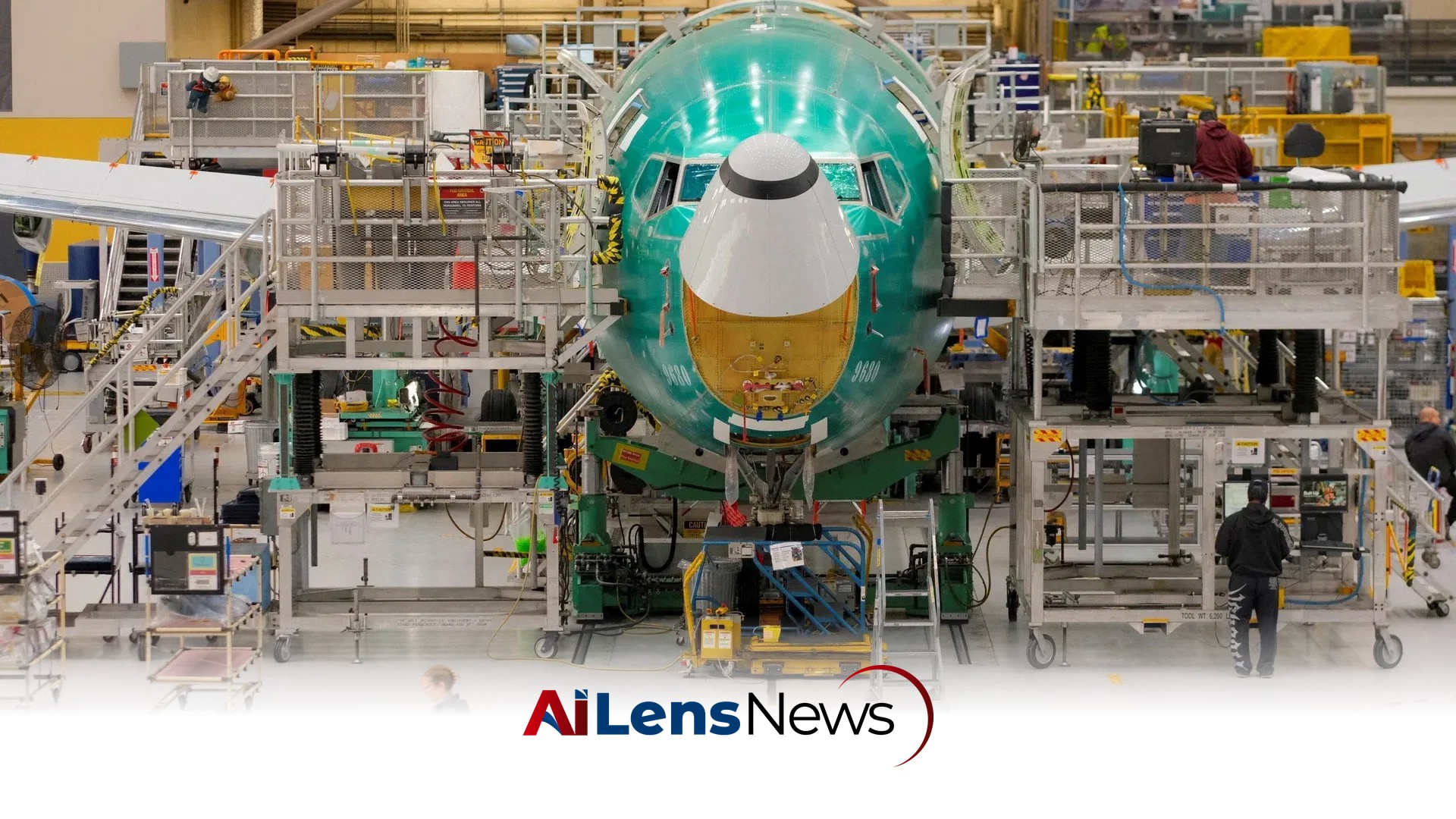


Boeing's CEO emphasizes production improvements over new order announcements, focusing on customer feedback and operational stability.
Singapore, Singapore Jul 19, 2026 ALN: [LONDON] The head of Boeing’s commercial airplane unit stated on Sunday (Jul 19) that the company is focused on increasing and improving aircraft production, “not order announcement.” This strategic shift comes in the wake of Boeing's ongoing efforts to recover from a series of setbacks that have plagued the company in recent years, including the fallout from the 737 MAX crisis and the impact of the COVID-19 pandemic on the aviation industry.
“Backlog is incredibly strong. Demand is not our issue,” Boeing Commercial Airplanes CEO Stephanie Pope told reporters at a roundtable ahead of the Farnborough Airshow. The Farnborough International Airshow is a key event in the aerospace calendar, where industry leaders gather to showcase innovations, discuss trends, and forge new partnerships. For Boeing, this year's airshow represents an opportunity to refocus on production capabilities rather than simply announcing new orders.
“If we announce some orders along the way, we’ll celebrate with our customers based on if they want to do that,” Pope added. This statement underscores Boeing's priority to engage with its clients and suppliers, gathering insights into their needs and challenges. By doing so, the company aims to enhance its production processes and better align its offerings with market demands.
Increasing production is critical to the company’s continued financial recovery and ability to compete with European rival Airbus, whose A320 family has outsold Boeing’s 737 MAX in the lucrative narrow-body market. The competition between Boeing and Airbus has intensified over the years, with both manufacturers vying for dominance in the commercial aircraft sector. The A320 family, known for its efficiency and reliability, has captured a significant share of the market, prompting Boeing to focus on ramping up production of its own narrow-body aircraft.
The 737 makes up the majority of Boeing Commercial Airplanes’ revenue. Increasing output is necessary to pay down the company’s US$26 billion net debt. This substantial debt load has raised concerns among investors and analysts about Boeing's long-term financial health. As the company seeks to stabilize its operations, addressing this debt is paramount to restoring investor confidence and ensuring future growth.
“Boeing is really driven on production rates,” said Tony Bancroft, an analyst with Gabelli Funds investment group. Production rates are a critical metric in the aerospace industry, as they directly impact a manufacturer’s ability to meet customer demand and generate revenue. For Boeing, achieving higher production rates is not only a matter of financial necessity but also a strategic imperative in the face of increasing competition.
The planemaker is studying a new round of production increases for its best-selling 737 MAX after it got regulator approval in May to raise production to 47 a month. This approval marks a significant milestone for Boeing, as it comes after the Federal Aviation Administration (FAA) imposed an unprecedented production cap on the US company following a 2024 midair emergency that revealed widespread production safety and quality lapses at Boeing. The FAA's scrutiny has forced Boeing to reassess its production processes and prioritize safety and quality assurance.
“We’re using the safety management system and our safety risk assessment on when we’re stable and ready to go to the next rate,” Pope said. This statement highlights Boeing's commitment to safety and quality as it navigates the complexities of ramping up production. The company is taking a cautious approach, ensuring that it meets regulatory standards and maintains the trust of its customers.
“I’ve got the team focused on stabilising at 47. Once we get to 47, we’ll go to 52,” she said. From there, she added, “we’ll just keep studying” further rate increases. This phased approach to increasing production rates reflects Boeing's strategy to balance growth with safety, ensuring that any increases are sustainable and do not compromise product quality.
Boeing needs to execute on production now to position itself to compete with Airbus when they both develop new narrow-body aircraft, which are not expected before 2030. The development of new aircraft is a lengthy and complex process, often taking years to bring a new model to market. As both Boeing and Airbus look to the future, the ability to ramp up production of existing models will be critical in maintaining market share and meeting customer demand.
Paying down debt and funding R&D costs for a new airplane mean investors will likely have to wait for several years to see significant returns from Boeing. This reality is compounded by the need for Boeing to invest in research and development to innovate and improve its product offerings. As the aerospace industry evolves, staying at the forefront of technology and efficiency is essential for long-term success.
Investors understand that and likely will be patient, said Bancroft. “I don’t think you need instant gratification of high amounts of growth and profitability and big, big upswings.” This perspective reflects a broader understanding of the cyclical nature of the aerospace industry, where periods of growth can be followed by downturns. Investors are increasingly aware that a focus on sustainable growth and long-term strategy is more valuable than short-term gains.
In addition to Boeing’s financial position, Pope said the airline market has to be ready to adopt a new airplane and the technology has to exist to deliver yield-adequate efficiency improvements. “We’re working on all three of those,” she said. The readiness of the airline market to embrace new aircraft is influenced by various factors, including economic conditions, fuel prices, and environmental regulations. Boeing is actively engaging with airlines to assess their needs and readiness for new models.
Currently, many Boeing engineers are working on certifying the smallest and largest 737 variants – the MAX 7 and 9 – and its new wide-body 777-9. The certification of these aircraft is a crucial step in ensuring that they meet safety and performance standards before entering service. It also represents an opportunity for Boeing to demonstrate its engineering capabilities and commitment to quality.
Pope said that the importance of getting its airplanes certified lies in “not only meeting our commitments to our customers, but that is a lot of engineering expertise and capability that we can start to roll off” and use for developing Boeing’s first clean-sheet jetliner in nearly two decades. This clean-sheet design represents a significant milestone for Boeing, as it seeks to innovate and respond to changing market demands.
“So, while we’ve been working on some technology, you’ll start to see that ramp up as we complete that certification work, and we take those resources and move them over.” This statement indicates that Boeing is poised to leverage its engineering talent and resources to drive future innovation, positioning itself for success in a rapidly evolving aerospace landscape. As the company navigates the challenges of production and certification, its focus on customer engagement and safety will be critical to restoring its reputation and achieving long-term growth.
To learn more about the latest developments in Economy, stay updated with our exclusive reports and analyses on AiLensNews.

