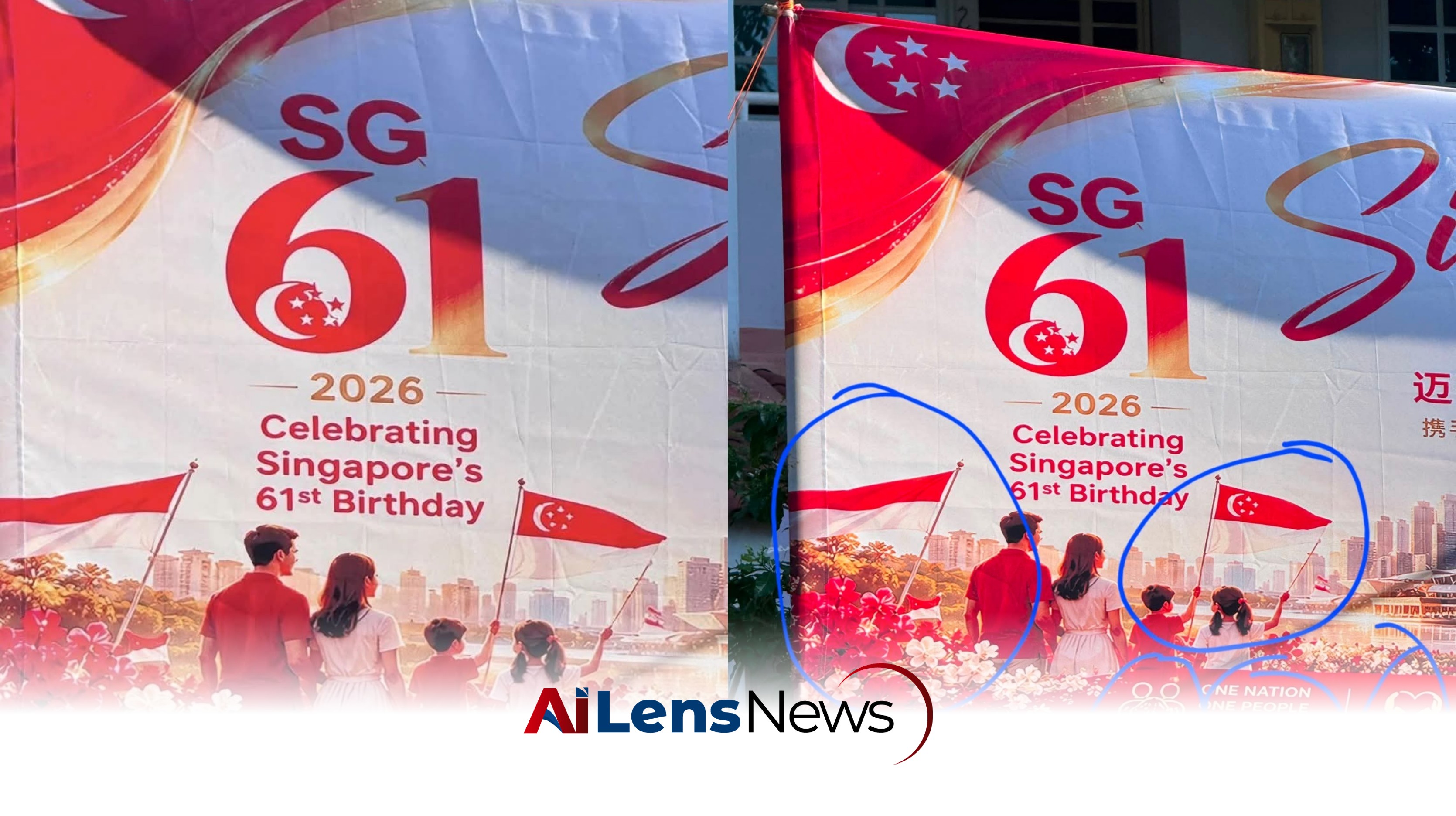


An AI-generated banner for Singapore's National Day has faced backlash due to inaccuracies, including a misrepresented flag and fictional landmarks.
Singapore, Singapore Jul 22, 2026 ALN: A National Day banner displayed in Singapore ahead of the nation’s 61st birthday has come under fire after members of the public spotted multiple apparent inaccuracies, including errors on the Singapore flag and what appears to be a fictional landmark.
The errors have led netizens to assert that the banner appears to be AI-generated, instead of being designed by a human team. The increasing use of artificial intelligence in creative fields has sparked debates about the quality and authenticity of AI-generated content, and this incident has brought those discussions to the forefront.
The banner, which prominently features the slogan “SG61 – Celebrating Singapore’s 61st Birthday”, depicts a family facing Singapore’s skyline while waving national flags. However, several details have drawn criticism online, with many questioning how the design was approved for public display. The approval process for public artwork is typically stringent, involving multiple levels of review to ensure that representations of national symbols, especially, adhere to established guidelines.
Among the most glaring issues is a flag on the left side of the banner that resembles Indonesia’s national flag rather than Singapore’s. The flag features only two horizontal red and white bands and is missing Singapore’s distinctive white crescent moon and five stars in the upper left corner. This misrepresentation raises concerns not only about the accuracy of national symbols but also about the broader implications of using AI without adequate oversight. The Singapore flag, which is a significant national symbol, is protected under the National Symbols Act, emphasizing the importance of accurate representation.
A second Singapore flag held by the children on the right side of the artwork also appears to contain malformed symbols. Instead of five clearly defined stars surrounding the crescent, the stars appear as indistinct blob-like shapes, prompting further criticism over the quality of the AI-generated artwork. These inaccuracies could be seen as a lack of respect for the symbols that represent the nation and its identity, which can be particularly sensitive during national celebrations.
Adding to the list of apparent mistakes is the depiction of what netizens identified as a “Singapore National Indoor Stadium”. Such venue does not exist, which further fueled discussions about the credibility of the artwork. The inclusion of fictional landmarks raises questions about the creative process and whether there was any human intervention to ensure the accuracy of the depicted elements.
A closer look led netizens to identify what they believed were even more AI-generated inconsistencies. Several Singaporeans online pointed out that the skyline in the background does not resemble Singapore’s cityscape, while others highlighted what they described as awkward anatomy and unnatural poses among the people featured in the artwork. These elements contribute to the perception that the banner was hastily produced, lacking the careful consideration typically expected in national commemorative displays.
Pointing out that these are common tell-tale signs often associated with AI-generated images, netizens noted that the girl’s ponytail appeared to be growing out of her left ear instead of the back of her head. She also appears to be holding a stick with no obvious purpose. Such peculiarities not only detract from the overall aesthetic of the banner but also raise concerns about the reliance on AI tools without proper human oversight.
Others even pointed out what they described as an unusually visible panty line on the woman depicted in the banner, saying such an unnecessary detail further reinforced their belief that the image had been generated by AI without proper editing. This kind of oversight—or lack thereof—highlights the potential pitfalls of using generative AI for sensitive projects, particularly those involving national pride and identity.
Some also questioned several pictograms placed along the bottom of the banner, including icons flanking the “One Nation One People” slogan, saying they appeared out of place and lacked any obvious connection to National Day celebrations. This disconnection further contributes to the perception that the banner was produced without a cohesive vision or understanding of the significance of the occasion it was meant to celebrate.
The image quickly circulated online, drawing widespread criticism over what many saw as an overreliance on generative AI without sufficient human review. One commenter dismissed the design as simply “Embarrassing AI slop,” while another lamented, “So much for national pride…” The emotional responses reflect a deeper sentiment among citizens regarding the representation of their national identity and the importance of maintaining high standards in public displays.
Several netizens also argued that the incident reflected a broader failure to support local creative talent. “This is just sad. Instead of commissioning local creatives, we get this AI slop,” one person wrote. This sentiment points to a growing concern about the impact of technology on traditional creative industries, where human artists may feel sidelined by the increasing automation of design processes.
Another commenter called for accountability, saying, “Send to your MP. I’m very disappointed that they would rather outsource national day graphics to AI than to our own citizens who actually care about our country.” They argued, “This sends a message that cutting costs is more important than supporting our own citizens and residents who make a living out creating art.” This raises important questions about the value placed on local talent and the potential consequences of prioritizing cost-efficiency over quality and authenticity.
Others questioned how the banner could have made it through the approval process despite containing multiple obvious mistakes and slipshod work. Asking how the errors escaped multiple rounds of checks, one netizen wrote, “Who didn’t vet ah? So many eyes cannot spot.” This frustration reflects a broader concern about accountability within the systems that govern public displays and the expectations of quality that citizens have for their national celebrations.
“I wonder which robot approved this,” one commenter remarked sarcastically while another netizen said bluntly, “Please sack the useless team who approved this because no work was done.” Such comments highlight the tension between technological innovation and the necessity for human oversight, especially in contexts where cultural and national pride is at stake.
Another commenter said the controversy illustrated that AI-generated content still requires proper human oversight. They wrote, “Why no one pointed out these issues at the time of approval? AI can be used, but still needs editing, can’t blindly generate.” This statement underscores the importance of maintaining a balance between leveraging technology for efficiency and ensuring that the human touch is not lost in the creative process.
Another summed up the situation by saying, “Banner’s a victim of AI slop and negligent humans.” This perspective reflects a growing awareness of the responsibilities that come with using AI in creative fields and the need for a collaborative approach that combines the strengths of both technology and human creativity.
Several commenters stressed that AI should not be blamed exclusively, arguing that the technology still requires competent human oversight. “We all know the slops AI is capable of. But this? Every step of the process totally no human oversight? Is this still AI slop or the humans’ slop?” one netizen asked. This rhetorical question encapsulates the dilemma faced by many as they navigate the implications of AI in creative work and the potential for errors that arise when human judgment is absent.
Some netizens pointed out that the “Indonesia flag” on the banner appears to have been corrected but noted that the image still contains a number of errors. This ongoing dialogue about the banner reflects a community engaged in discussions about national identity, cultural representation, and the role of technology in shaping their public spaces.
Others argued that the incident reflected an excessive dependence on generative AI. “This is so embarrassing, stop using AI for EVERYTHING!!” one frustrated commenter wrote. This sentiment resonates with a growing concern among creative professionals and the general public about the potential for AI to undermine traditional creative practices and the quality of artistic expression.
Some resorted to humour, with one joking, “Singapore just signed a secret merger pact with Indonesia?” in reference to the Indonesian-looking flag. While humor can serve as a coping mechanism in the face of embarrassment, it also highlights the seriousness of the errors and the potential implications for national pride.
But many viewed the mistakes as more serious, arguing they reflected a lack of respect for the country’s national symbols. “So much for respect of national symbols,” one commenter wrote. The emotional weight of national symbols is significant, and misrepresentations can lead to feelings of disenfranchisement among citizens who take pride in their heritage and identity.
Singapore’s national flag is protected under the National Symbols Act, which governs the use of the National Flag, State Crest and National Anthem. The law provides that the national flag should be represented accurately and also makes clear that the country’s national symbols must be treated with dignity and respect. Among other provisions, the Act prohibits the deliberate misuse, mutilation, defacement or disrespectful treatment of national symbols, with offenders liable to fines upon conviction. This legal framework underscores the gravity of the missteps observed in the banner and the expectations placed on public representations of national identity.
To learn more about the latest developments in Politics, stay updated with our exclusive reports and analyses on AiLensNews.

