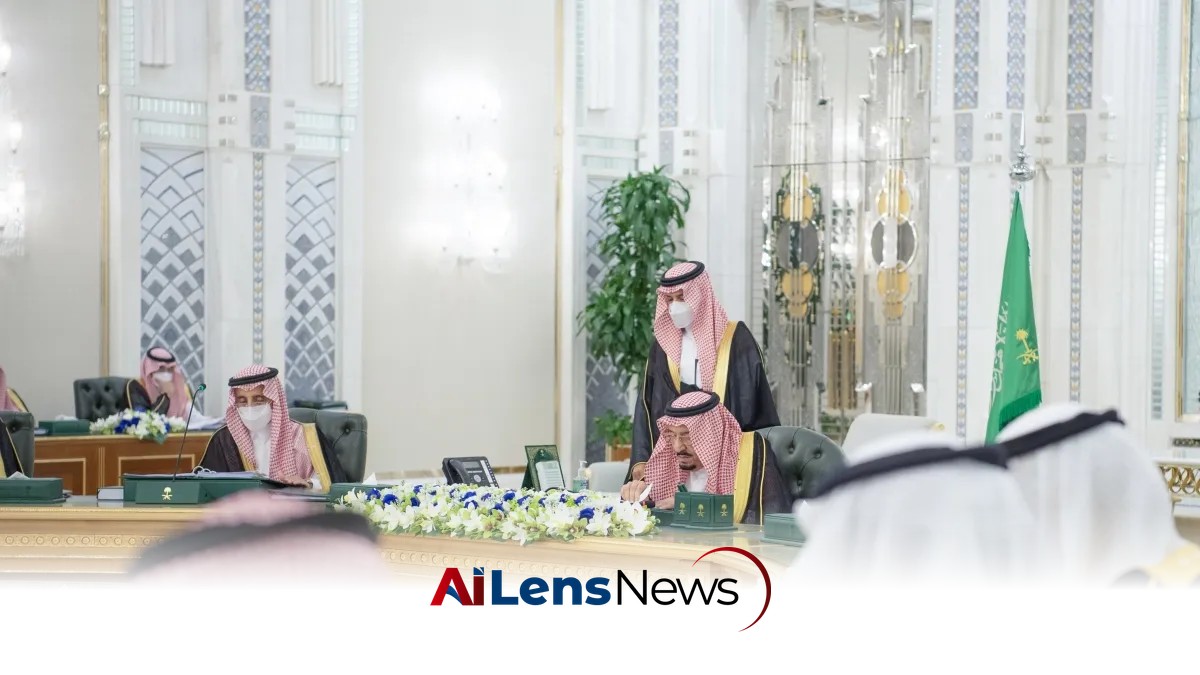


In a recent meeting, Saudi Arabia's Cabinet condemned Houthi allegations, reaffirmed support for Yemen's legitimate government, and approved agreements on space cooperation.
Riyadh, Saudi Arabia Jul 22, 2026 ALN: Saudi Arabia's Cabinet on Tuesday strongly condemned the Houthi militia's baseless allegations and false accusations against the Kingdom, pledging firm measures to safeguard Saudi security and maritime navigation. This statement comes amid ongoing tensions in the region, particularly concerning the conflict in Yemen, which has drawn in various state and non-state actors and has significant implications for regional stability.
The Cabinet, chaired by Custodian of the Two Holy Mosques King Salman in Jeddah, expressed concern over the Houthi militia's involvement in regional conflicts, which the Saudi government claims has exacerbated the humanitarian crisis in Yemen. The Houthis, who have been engaged in a protracted civil war against the internationally recognized Yemeni government since 2014, have been accused of receiving support from Iran, which further complicates the geopolitical landscape in the Middle East.
In its statement, the Cabinet emphasized that the Houthi militia's actions have not only deepened the suffering of the Yemeni people but have also posed a significant threat to regional security and stability. The conflict has led to widespread famine, displacement, and a humanitarian crisis that the United Nations has described as one of the worst in the world. The Saudi government has reiterated its commitment to supporting the Yemeni people and their legitimate government, which it views as essential for restoring peace and stability in the region.
Furthermore, the Cabinet pledged to take firm measures to protect Saudi security and maritime vessels in accordance with international law and the 1982 UN Convention on the Law of the Sea. This commitment is particularly relevant given the strategic importance of the Red Sea and the Gulf of Aden for international shipping routes, which are crucial for global trade. The Houthi militia has previously threatened maritime navigation in these waters, which could have far-reaching implications for international commerce and regional security.
The Cabinet also renewed the Kingdom's full solidarity with Kuwait, Bahrain, and Jordan over Iranian attacks that violate international law and the principles of good neighborliness. This statement reflects Saudi Arabia's broader concerns regarding Iranian influence in the region, which it perceives as a destabilizing force. The Kingdom has historically viewed Iran as a rival, particularly in the context of the ongoing proxy conflicts in Syria, Iraq, and Yemen.
In light of these tensions, the Saudi Cabinet stressed the need for an immediate halt to all forms of military escalation to preserve regional stability. This call for de-escalation is crucial, as the potential for conflict to escalate further could have dire consequences not only for the countries directly involved but also for global security and economic stability.
The Council reviewed the contents of a telephone call between Crown Prince and Prime Minister Mohammed bin Salman and Lebanese President Joseph Aoun, during which the Lebanese leader praised Saudi Arabia's support for Lebanon and its efforts to promote regional peace and stability. This indicates Saudi Arabia's ongoing commitment to its diplomatic relations in the region, even as it faces challenges from various non-state actors and geopolitical rivalries.
Additionally, the Cabinet reviewed the Kingdom's participation in international forums, commending the national efforts reflected in Saudi Arabia's Third Voluntary National Review presented at the UN High-level Political Forum on Sustainable Development. This review highlighted progress in several critical areas, including water security, renewable energy, healthcare, digital government, industrial development, and inclusive economic growth. These initiatives are part of Saudi Arabia's Vision 2030, a strategic framework aimed at diversifying the economy and reducing dependence on oil revenues.
The Cabinet also noted Saudi Arabia's achievements presented at the UN General Assembly's high-level meeting on the New Urban Agenda. This meeting focused on improvements in homeownership, public spaces, transportation, and community participation, which are essential components of sustainable urban development. The Kingdom's efforts in these areas showcase its commitment to addressing urban challenges and enhancing the quality of life for its citizens.
In terms of economic performance, the Cabinet welcomed Saudi Arabia's rise to 13th globally among the world's largest recipients of foreign direct investment in 2025, according to the UN Conference on Trade and Development. This increase in foreign direct investment (FDI) is a significant indicator of growing investor confidence in the Saudi economy, which has seen net FDI inflows increase by 53% to $32.6 billion. Such growth is largely attributed to ongoing economic reforms and initiatives aimed at fostering a more business-friendly environment.
Among its decisions, the Cabinet approved a memorandum of understanding between the Saudi Space Agency and the United Nations on cooperation in the peaceful uses of outer space. This agreement reflects Saudi Arabia's aspirations to advance its capabilities in space exploration and technology, aligning with global trends in space research and development.
Furthermore, the Cabinet approved unified Gulf Cooperation Council (GCC) rules governing jointly owned properties, which aim to streamline regulations and enhance cooperation among member states. This move is expected to facilitate investment and economic collaboration within the GCC, fostering regional integration.
The Cabinet also transferred authority for issuing import, export, re-export, and customs clearance permits for chemicals from the Ministry of Commerce to several other government bodies, including the Ministry of Interior, the Higher Commission for Industrial Security, the Ministry of Industry and Mineral Resources, and the Saudi Food and Drug Authority. This decision is part of a broader effort to enhance regulatory oversight and ensure safety standards in chemical management.
Finally, the Cabinet endorsed a mechanism to enhance coordination between the Nuclear and Radiological Regulatory Commission and the National Cancer Center to strengthen nuclear and radiological oversight. This initiative emphasizes Saudi Arabia's commitment to ensuring the safe and peaceful use of nuclear technology, particularly in healthcare and cancer treatment, while also addressing concerns related to nuclear safety and security.
To learn more about the latest developments in Politics, stay updated with our exclusive reports and analyses on AiLensNews.

