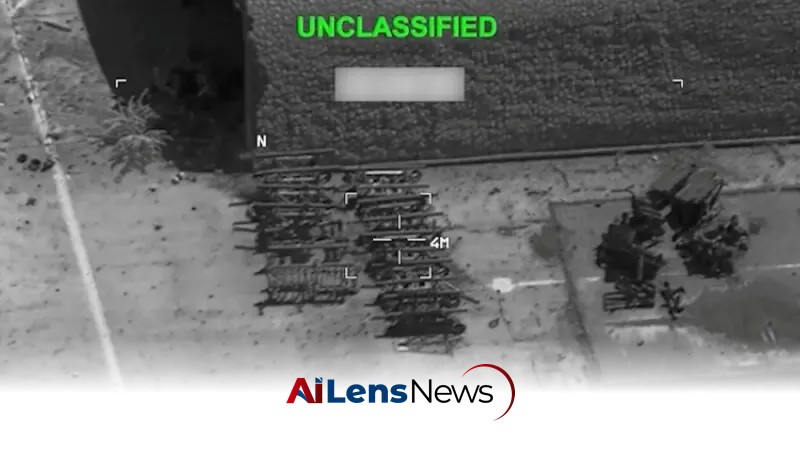


The US military has launched its eleventh consecutive night of strikes against Iran, targeting military sites amid rising tensions and threats of retaliation from Tehran.
Islamabad, Pakistan Jul 22, 2026 ALN: The ongoing conflict between the United States and Iran has escalated dramatically in recent weeks, with fresh US airstrikes targeting Iranian military infrastructure and raising alarms about the potential for a broader regional war. This latest round of hostilities comes on the heels of President Donald Trump's declaration that he is "not finished" with Iran, a statement that underscores the administration's commitment to a hardline approach against Tehran amidst rising tensions in the Middle East.
On Wednesday, US military operations reportedly triggered air defenses in Tehran, marking a significant escalation in the conflict that has already resulted in substantial financial and human costs. According to Pentagon Chief Pete Hegseth, the war has thus far cost the United States approximately $37.5 billion, a figure that has drawn criticism from various political factions, including segments of Trump's own base who are increasingly wary of prolonged military engagements overseas.
The backdrop for these military actions is the strategic Strait of Hormuz, a vital maritime passage through which a significant portion of the world's oil supply is transported. The US and Iran have engaged in a series of confrontations in this region, leading to a collapse of preliminary diplomatic agreements aimed at de-escalating tensions. The conflict has now expanded beyond the Strait of Hormuz, threatening other key chokepoints for global oil supplies, which has raised concerns among international observers about the stability of energy markets.
The US military confirmed that its latest strikes specifically targeted what it described as "military logistics infrastructure," aiming to degrade Iran's capability to threaten commercial shipping routes. Iranian state media reported that airstrikes were conducted in various locations across the country, including near Bushehr, which is home to Iran's only nuclear power plant. The targeting of such sensitive sites has heightened fears of a potential nuclear crisis, especially given the ongoing suspicions surrounding Iran's nuclear program.
In response to the US strikes, Iranian officials have issued stern warnings of retaliation. The Khatam Al-Anbiya military command declared that any attack on the underground complex known as Pickaxe Mountain, suspected of housing an undeclared nuclear enrichment facility, would be viewed as an escalation of the conflict. Such rhetoric signals Iran's willingness to respond forcefully to perceived threats, which could further complicate an already volatile situation.
As the conflict approaches its five-month mark, the political landscape in the US is also shifting, with November legislative elections looming. Trump faces mounting pressure to bring an end to the conflict, which has drawn criticism from various quarters, including those who argue that the financial burden of war is unsustainable. The administration's military funding requests have sparked debate regarding the long-term strategy in the region and the implications for US foreign policy.
In addition to the direct military confrontations, Iran has broadened its offensive against US-allied Gulf states. Reports indicate that Kuwait's military has engaged with drone attacks originating from Iran, while Bahrain has intercepted similar threats. The Iranian army claimed responsibility for targeting US assets in these regions, which include air defense systems and administrative facilities. This expansion of hostilities raises concerns about the potential for a wider regional conflict that could involve multiple countries.
Trump's comments regarding the Houthi rebels in Yemen further illustrate the complexity of the situation. The Houthis, who have threatened to blockade Saudi ports, are seen as an Iranian proxy in the region. Trump's promise to "take care of" the Houthis if they follow through on their threats reflects the administration's readiness to engage militarily if necessary. Saudi Arabia has condemned the Houthis as a "terrorist militia," indicating its commitment to countering Iranian influence in the region.
Should the Houthis execute their blockade threat, this could severely disrupt Saudi Arabia's oil exports and have significant ramifications for the global economy. Recent reports from maritime intelligence providers indicate that vessels have altered their courses in response to the heightened risks in the Red Sea, underscoring the potential for economic fallout from the ongoing conflict.
Adding another layer of complexity to the situation, the Revolutionary Guards of Iran claimed that two tankers in the Strait of Hormuz were struck by explosions, resulting in dramatic fires. Such incidents not only threaten the safety of maritime navigation but also raise alarms about the potential for further military escalation in the region.
Despite the ongoing hostilities, diplomatic channels remain open, albeit tenuously. Iranian foreign ministry spokesman Esmaeil Baqaei indicated that discussions with Washington, facilitated by intermediaries, are still taking place. Pakistan has taken a leading role in mediating these exchanges, with Prime Minister Shehbaz Sharif urging all parties to exercise restraint and avoid actions that could destabilize the region further. This diplomatic effort highlights the complexities of international relations in the context of the US-Iran conflict and the broader implications for regional stability.
In summary, the intensifying strikes by the US on Iranian targets, combined with Iran's retaliatory threats and the involvement of regional actors, illustrate the precarious state of affairs in the Middle East. As the conflict continues to evolve, the potential for a wider war remains a significant concern, with implications not only for the countries directly involved but also for global economic stability and security. The coming months will be critical in determining the trajectory of this conflict and the responses of both the US and Iran to the unfolding events in the region.
To learn more about the latest developments in Crime & Law, stay updated with our exclusive reports and analyses on AiLensNews.

