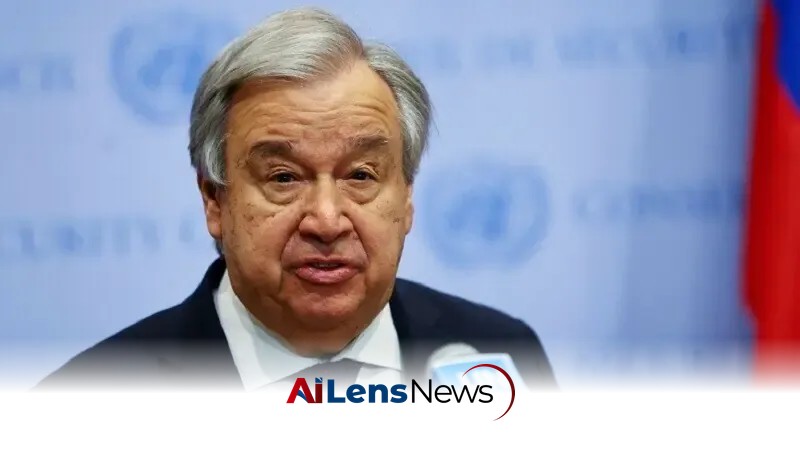


Antonio Guterres praises Pakistan's efforts to enhance diplomatic mechanisms for conflict resolution, emphasizing the need for dialogue amid escalating tensions.
Islamabad, Pakistan Jul 24, 2026 ALN: UN Secretary-General Antonio Guterres on Thursday praised Pakistan’s initiative at the UN Security Council (UNSC) to strengthen mechanisms for the peaceful settlement of disputes, saying the move was particularly important at a time when conflicts were escalating across the Middle East and beyond.
Addressing an UNSC open debate held pursuant to Pakistan-sponsored Resolution 2788 (2025), the UN chief presented recommendations aimed at making diplomacy, mediation and conflict prevention more effective tools for maintaining international peace and security. This initiative comes amidst a backdrop of increasing geopolitical tensions, particularly in the Middle East, where historical grievances and contemporary political disputes have often led to violent confrontations.
The resolution, which was presented by Pakistan during its presidency of the UNSC last year and adopted unanimously by the Council, seeks to strengthen the use of peaceful means available under the UN Charter, including negotiation, mediation, conciliation, arbitration and judicial settlement. The unanimous adoption of this resolution reflects a collective understanding among member states of the need for a robust framework to address disputes before they escalate into armed conflicts.
Pakistan had argued that diplomacy should not be used only after conflicts erupt but should serve as a means to prevent crises from escalating. This proactive approach to diplomacy is critical, especially in regions where tensions can quickly spiral out of control, leading to humanitarian crises and destabilization.
“As conflicts escalate across the Middle East and beyond, military solutions cannot deliver lasting peace,” Guterres said, calling for restraint, protection of civilians and renewed commitment to diplomacy. His statements resonate with the ongoing struggles in various parts of the world, where military interventions have often led to further violence rather than resolution.
“The situation is getting out of control. It’s teetering on the edge of the unimaginable,” the secretary-general warned, noting that the region was being “pulled into another widening circle of confrontation.” His comments highlight the interconnected nature of modern conflicts, where one crisis can trigger another, creating a cycle of violence that is difficult to break.
“One crisis feeds another. One escalation triggers the next,” he said, adding that as this dynamic spreads, “the political objectives are becoming increasingly obscured by the confrontation itself.” This observation underscores the complexity of conflict dynamics in the contemporary world, where the original causes of disputes can become lost amid the chaos of ongoing violence.
“It’s time to step back,” Guterres said, stressing that “attacks on civilian infrastructure are unacceptable” and that “there’s no military solution to the conflict.” His emphasis on the protection of civilians is particularly pertinent, as civilian populations often bear the brunt of armed conflicts, suffering from displacement, loss of life, and the destruction of their communities.
“Fighting must stop everywhere in the region,” he said, while calling for the restoration of “international navigational rights and freedoms in and around the Strait of Hormuz and Bab al-Mandab.” These strategic waterways are vital for global trade, and any disruption can have far-reaching implications for the international economy.
“Diplomacy is the only way forward,” the UN chief added, reinforcing the notion that dialogue and negotiation are essential tools for resolving disputes. The call for diplomacy reflects a growing recognition among international leaders that sustainable peace can only be achieved through cooperative efforts rather than unilateral military actions.
Recognising Pakistan’s diplomatic efforts, Guterres said: “I want to recognise the mediation of Pakistan and countries in the region working to reduce tensions and create space for dialogue.” This acknowledgment highlights Pakistan's role as a mediator in regional conflicts, which is significant given its strategic position in South Asia and its relations with neighboring countries.
“These efforts must be supported and strengthened in pursuit of a peaceful and durable settlement,” he said, indicating that international cooperation is crucial for the success of diplomatic initiatives. The need for a collaborative approach is particularly important in regions where historical animosities can complicate peace efforts.
The secretary-general also highlighted developments in the occupied West Bank, saying: “We see creeping annexation with violence, settlement expansion, extensive Israeli military operations and large-scale displacement.” The situation in the West Bank remains one of the most contentious issues in international relations, with ongoing disputes over territory, governance, and the rights of displaced populations.
Pakistan welcomed the secretary-general’s recommendations, with Ambassador Asim Iftikhar Ahmad, Islamabad’s permanent representative to the UN, expressing “profound appreciation” for what he described as “thoughtful, practical and forward-looking” proposals. His positive reception of the recommendations indicates Pakistan's commitment to engaging in constructive dialogue and supporting international peace initiatives.
Speaking at the UNSC debate, Ambassador Ahmad said sustained implementation of the recommendations would strengthen not only mechanisms for peaceful settlement of disputes but also reinforce implementation of the UN Charter itself. The UN Charter serves as the foundational document for international relations, and its principles are crucial for maintaining global order and stability.
“These recommendations carry significance far beyond today’s meeting,” he said, adding that they could help “restore conflict prevention and resolution to its rightful place, at the heart of the United Nations, and translate the promise of Chapter VI into practice.” Chapter VI of the UN Charter emphasizes the peaceful resolution of disputes, and its effective implementation is vital for the credibility of the UN as a mediator in international conflicts.
The ambassador said Resolution 2788 was conceived in the spirit that diplomacy must not be “the instrument we scramble for, after peace has failed,” but rather the means through which failure could be prevented. This proactive stance on diplomacy is essential in a world where the consequences of conflict can be devastating, not only for the countries involved but for global stability as well.
He said the challenge was not the absence of mechanisms under the Charter but their “delayed, selective and inconsistent use,” warning that the Security Council often became engaged only after positions had hardened and the space for compromise had narrowed. This critique of the UNSC's approach to conflict resolution highlights the need for timely interventions that can prevent disputes from escalating into violence.
Ambassador Ahmad said Pakistan remained committed to peaceful settlement of disputes and cited Islamabad’s recent diplomatic engagement in West Asia as an example of efforts to facilitate dialogue. He said Pakistan, together with partner countries, had played a constructive mediating role between Iran and the United States, helping create space for negotiations. This role underscores Pakistan's strategic importance in regional geopolitics and its potential as a facilitator of dialogue among conflicting parties.
He expressed regret over renewed hostilities and urged all sides to exercise restraint and return to dialogue, saying that whenever negotiations falter, “the answer is not in less but more determined diplomacy.” This assertion reinforces the belief that sustained diplomatic efforts are essential in resolving conflicts and preventing further escalation.
The Pakistani envoy called for stronger follow-up mechanisms for UNSC resolutions, greater use of fact-finding and mediation tools, increased support for the secretary-general’s good offices, and closer cooperation between the UN and regional organisations. These recommendations reflect a comprehensive approach to conflict resolution that emphasizes the importance of collaboration among various stakeholders in the international community.
He said the value of Resolution 2788 would ultimately be measured not by the unanimity with which it was adopted but by the consistency with which it was implemented. This perspective highlights the need for accountability and follow-through in international agreements, as the effectiveness of resolutions often depends on their practical application.
“History documents the wars that broke out. It rarely records the war that did not begin because a channel remained open, a mediator persisted, a leader exercised restraint or an institution acted in time,” Ambassador Ahmad said, describing prevention and peaceful settlement as diplomacy’s highest achievements. This statement encapsulates the essence of diplomacy: the ability to prevent conflict through proactive engagement and dialogue.
To learn more about the latest developments in Crime & Law, stay updated with our exclusive reports and analyses on AiLensNews.

