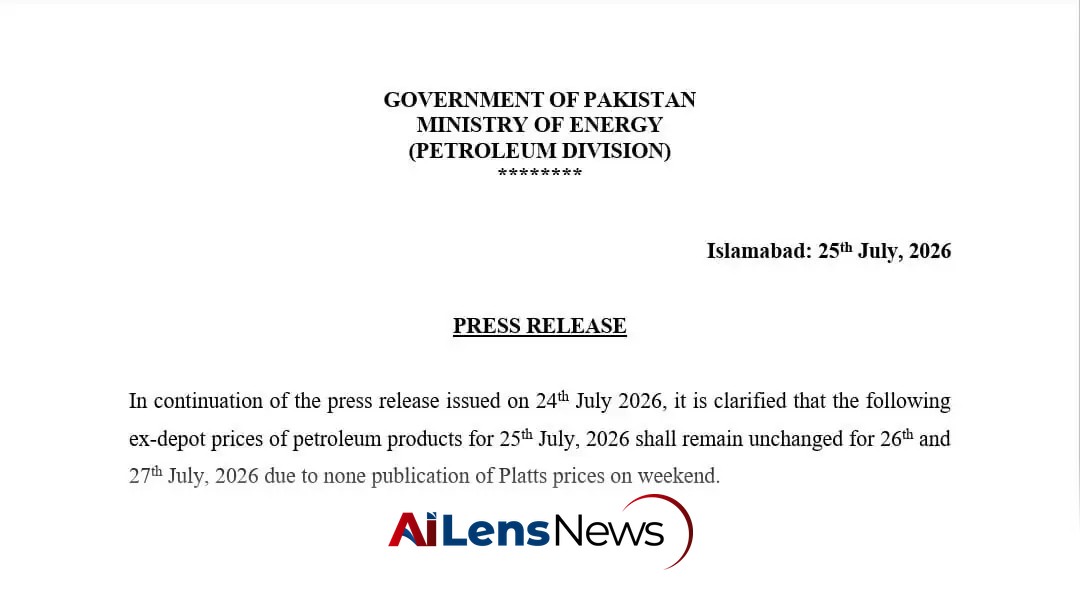


The government has decided to keep petrol and diesel prices unchanged for July 26 and 27, following a recent price increase due to international market trends.
Islamabad, Pakistan Jul 26, 2026 ALN: The government on Saturday maintained the prices of petrol and high-speed diesel (HSD) unchanged for July 26 and 27, citing the non-publication of "Platts prices on weekends" as the reason for this decision. This announcement comes in the context of a rapidly fluctuating international oil market, which has been significantly affected by geopolitical tensions, particularly between the United States and Iran. The decision to hold prices steady reflects the government's attempt to manage the economic pressures faced by consumers amid these volatile market conditions.
Just a day earlier, the government had announced an increase in the prices of petrol and HSD by Rs3.66 and Rs4.80 per litre, respectively. As it stands, the price of petrol is currently set at Rs335.18 per litre, while HSD is priced at Rs383.46 per litre. The government's taxation policies contribute significantly to these costs, with a total of Rs110 per litre in taxes and duties imposed on petrol and Rs96 on diesel. This heavy taxation on fuel has been a point of contention among consumers and transport operators alike, particularly in light of rising living costs and economic pressures. The high taxation rates have led to calls for reform and a more comprehensive approach to fuel pricing that considers the economic realities faced by ordinary citizens.
The Petroleum Division's notification confirmed that the price increases announced for July 25 would remain applicable on the following two days, indicating a temporary halt in further adjustments. The diesel price, which had reached a peak of Rs520.35 on April 3, has seen a notable decline since then. It started its upward trajectory from Rs281 per litre following the escalation of tensions due to the US-Iran conflict that began on February 28. Similarly, petrol prices had peaked at Rs458.41 on April 3 after beginning from Rs266 in the first week of March. These fluctuations highlight the sensitivity of fuel prices to international events, underscoring the interconnectedness of global markets.
In light of these fluctuations, Petroleum Minister Ali Pervaiz Malik made a significant announcement regarding the pricing strategy for fuel. He revealed that fuel prices would now be determined on a daily basis, a shift from the previous weekly revisions. This new strategy aims to better align domestic fuel prices with the volatile international market prices, which have been influenced by ongoing geopolitical events, particularly the renewed hostilities between Iran and the US. The decision to implement daily pricing reflects a broader trend of adapting to real-time market conditions, which has become increasingly necessary in the face of unpredictable oil supply and demand scenarios. Such a move could potentially lead to greater volatility in fuel prices, making it essential for consumers and businesses to stay informed about daily changes.
Since early March, the government has been actively revising fuel prices weekly, alongside implementing conservation measures aimed at mitigating the potential impact of oil supply disruptions stemming from the ongoing conflict in the Middle East. In April, the federal government also introduced targeted relief measures to provide subsidised fuel to certain segments of the population, attempting to cushion the blow of rising fuel costs on low and middle-income families. These initiatives reflect an acknowledgment of the economic strain that rising fuel prices can place on households, particularly those already struggling with inflation and other cost-of-living increases.
Following the announcement of daily pricing, the All Pakistan Dealers Association expressed strong opposition to the government's decision. The association has indicated that it is considering a protest plan this week, reflecting the discontent among fuel dealers who are concerned about the implications of daily price adjustments on their businesses and the overall market stability. Fuel dealers worry that frequent price changes could lead to confusion among consumers and disrupt their sales, potentially harming their livelihoods. This tension between the government and fuel dealers illustrates the complexities involved in managing fuel pricing in a way that balances consumer needs with the interests of businesses.
Fuel pricing is of particular importance in Pakistan, as petrol is predominantly used in private transportation, including small vehicles, rickshaws, and two-wheelers. As such, any changes in petrol prices have a direct impact on the middle and lower-middle classes, who rely heavily on these modes of transport for their daily commuting needs. In contrast, diesel is primarily used in the heavy transport sector, power generation, and large generators, making fluctuations in diesel prices equally significant for the public at large. The reliance on these fuels for transportation and energy generation underscores their critical role in the economy and the daily lives of citizens.
Additionally, petrol and high-speed diesel are crucial revenue earners for the government, with monthly sales estimated at around 700,000 to 800,000 tonnes. This is a stark contrast to the relatively low monthly demand for kerosene, which stands at just 10,000 tonnes. The reliance on petrol and diesel not only underscores their importance in the transportation and energy sectors but also highlights the broader economic implications of fuel pricing on national revenue and consumer behavior. As fuel prices rise, the government faces the dual challenge of maintaining revenue while also addressing public discontent over rising costs.
In conclusion, the government's decision to keep fuel prices unchanged for a brief period amid fluctuating market conditions reflects a cautious approach to managing a highly sensitive economic issue. The implications of these pricing strategies extend beyond immediate consumer costs and touch upon broader economic stability, public sentiment, and the operational viability of businesses reliant on fuel. As the international oil market continues to experience volatility, the government's ability to navigate these challenges will be critical in maintaining both consumer confidence and economic growth in the coming months. The situation remains fluid, and the government's ongoing adjustments to fuel pricing will likely continue to be a focal point of public discourse as citizens grapple with the realities of fuel costs in their everyday lives.
To learn more about the latest developments in Economy, stay updated with our exclusive reports and analyses on AiLensNews.

