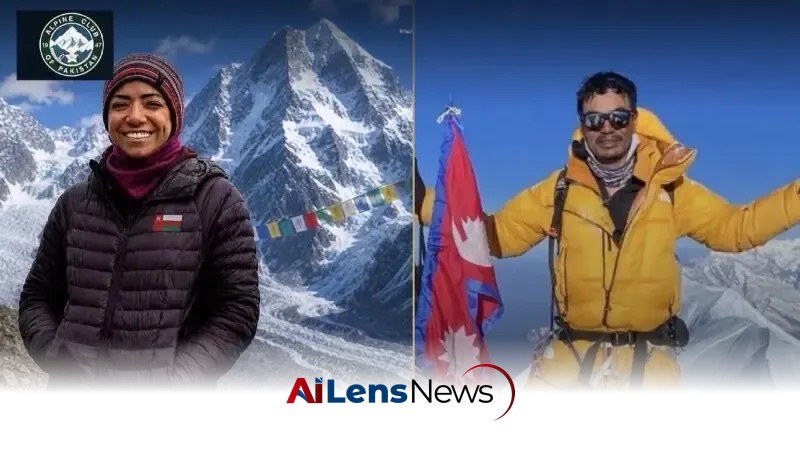


Two bodies have been recovered as search operations continue for climbers missing after an avalanche struck Broad Peak, including renowned mountaineers Nirmal Purja and Sohail Sakhi.
Islamabad, Pakistan Jul 31, 2026 ALN: The search efforts have intensified following a tragic avalanche that claimed the lives of climbers on Broad Peak, one of the highest mountains in the Karakoram range of Pakistan. On Friday, two bodies were found as part of a search operation aimed at locating climbers, including renowned Nepali mountaineer Nirmal Purja and Pakistani climber Sohail Sakhi, who went missing after the avalanche struck around midday on Thursday. The incident has sent shockwaves through the international mountaineering community, highlighting the inherent risks associated with high-altitude climbing.
The Alpine Club of Pakistan (ACP) reported that the 10-member team involved in the expedition included six Nepalese climbers, a Pakistani, an Omani, an American, and a climber from China. The climbers from Nepal were identified as Purja, Pur Bahadur Gurung, Kili Pemba Sherpa, Nima Sherpa, Nawang Thindu Sherpa, and Gyalu Sherpa. The remaining members of the team included Nadhira Ahmed Abdullah Al Harthy from Oman, Sohail Sakhi from Pakistan, Wang Zhong from China, and Mallory Geis from the United States. The diverse composition of the team underscores the global appeal of high-altitude climbing and the collaborative spirit that often characterizes such expeditions.
ACP President Major General Irfan Arshad confirmed that two bodies had been recovered from the avalanche site. He identified the deceased as Oman’s Nadhira Ahmed Abdullah Al Harthy and Nepal’s Pur Bahadur Gurung. The loss of these climbers has been met with deep sorrow from their families, friends, and the broader climbing community, who are now grappling with the reality of their loss.
In an effort to support the ongoing search and rescue operation, ACP Senior Vice President Karrar Haidri announced that two Pakistan Army Aviation rescue helicopters, equipped with specialized personnel and equipment, had been dispatched to the area. This mobilization reflects the urgent need for aerial assistance in such challenging terrain, where ground access can be severely limited by the harsh conditions typical of high-altitude environments.
The ACP has emphasized its commitment to facilitating the rescue operation, maintaining constant communication with government authorities and relevant agencies to ensure that all necessary resources are deployed swiftly. In their statement, the club indicated that every possible effort is being made to mobilize helicopter support and other rescue resources, dependent on weather and operational conditions. The challenging weather patterns in the region can greatly impact search operations, making timely and efficient responses critical.
General Secretary Ayaz Shigri highlighted that several expedition teams had begun their summit push shortly before the avalanche occurred. He noted that GPS locations received from some of the missing climbers indicated that the avalanche had swept the group approximately 1,000 meters downhill, leaving them trapped in a perilous situation. The use of technology such as GPS tracking is increasingly vital in mountaineering, allowing for more accurate assessments of climber locations during emergencies.
Shigri also expressed concerns that local high-altitude porters, who are essential to many climbing expeditions, might have been affected by the avalanche. The role of these porters is crucial in supporting climbers by carrying gear and supplies, and their safety is a top priority in rescue operations. "We pray for the safety of all the climbers. It is a big incident," he stated, reflecting the gravity of the situation.
In response to the disaster, Gilgit-Baltistan Chief Minister Amjad Hussain Advocate directed all relevant departments to remain on high alert and expedite the search and rescue operations in collaboration with the Pakistan Army. This directive underscores the local government's commitment to ensuring the safety of climbers and the importance of coordinated efforts in disaster response.
Gilgit-Baltistan Minister for Tourism, Sports and Culture Naiknam Karim also expressed his condolences over the incident, stating that the provincial government was making every possible effort to locate and safely rescue the missing climbers. His remarks highlighted the emotional toll that such tragedies take on local communities, especially in regions where mountaineering is a significant part of the culture and economy.
Purja, who is 43 years old, has made headlines in the mountaineering world for his remarkable achievements. After serving with Britain’s Brigade of Gurkhas, he joined the Special Boat Squadron of the Royal Marines before turning his focus to climbing. He has broken multiple climbing records since becoming a full-time mountaineer and tour guide. Notably, he climbed all 14 of the world’s “eight-thousanders” (peaks above 8,000 meters, or 26,000 feet) in just six months and six days between April and October 2019, setting a new record. In 2021, Purja completed the first winter ascent of K2, alongside a team of nine other Nepalese climbers, further solidifying his reputation as one of the top climbers in the world.
Sakhi, who hails from Hunza, has also established himself as a formidable high-altitude climber. Earlier in May, he successfully summited Kanchenjunga, the world's third-highest mountain, and has previously scaled K2, Nanga Parbat, Gasherbrum I, and Gasherbrum II without supplemental oxygen. His accomplishments place him among the strongest climbers in Pakistan, and his disappearance has raised concerns among the local climbing community, who recognize the risks involved in such high-stakes endeavors.
The implications of this incident extend beyond the immediate tragedy of lost lives. It serves as a stark reminder of the dangers that climbers face in the high-altitude environment of the Karakoram range, where unpredictable weather, avalanches, and technical challenges can pose significant risks. As search and rescue operations continue, it is crucial for the climbing community and authorities to reflect on safety protocols, training, and preparedness for future expeditions.
In conclusion, as the search efforts continue, the international mountaineering community watches closely, hoping for the safe recovery of all missing climbers. The incident has not only highlighted the perils of high-altitude climbing but also the solidarity and support that exists within this global community, as climbers, families, and authorities come together in the face of tragedy.
Additional input from AFP
To learn more about the latest developments in Crime & Law, stay updated with our exclusive reports and analyses on AiLensNews.

