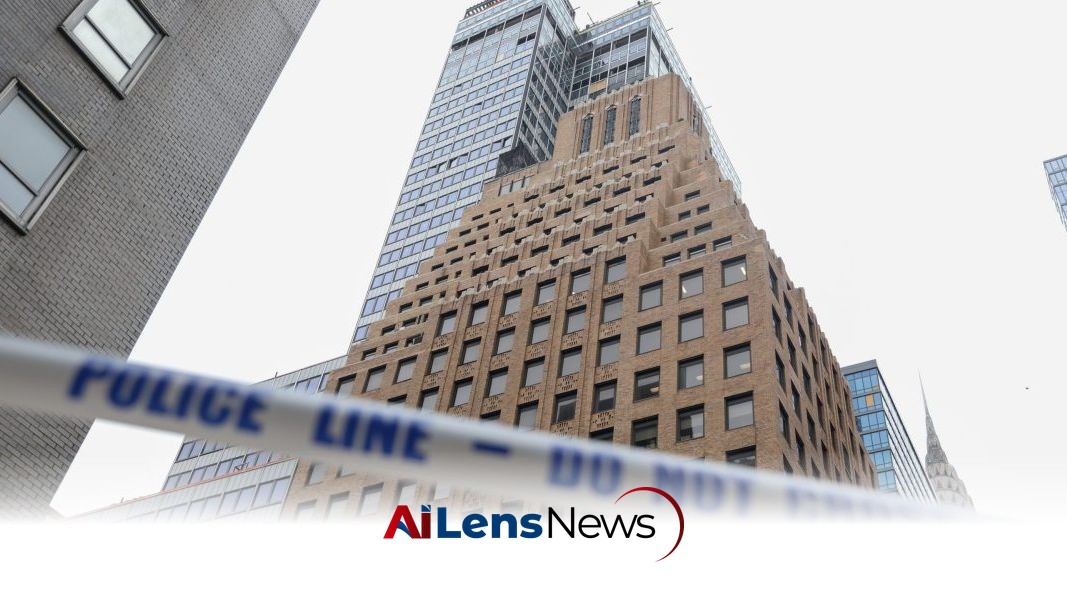


Recent structural issues at the former Pfizer HQ in NYC underscore challenges in office-to-residential conversions, raising concerns about engineering practices.
Washington DC, United States Jul 9, 2026 ALN: The recent incident involving the former Pfizer world headquarters at 235 East 42nd Street has illuminated the risks associated with the ongoing trend of converting office spaces into residential units in New York City. This 33-story tower, constructed in 1960, is at the forefront of what is being termed the largest office-to-residential conversion in U.S. history, with plans to transform it into approximately 1,600 apartments. This ambitious project is being undertaken by Metro Loft and David Werner Real Estate Investments, two prominent players in the real estate sector.
On Tuesday morning, the New York City Fire Department (FDNY) received alarming reports of bricks falling from the building. Upon inspection, firefighters discovered two support columns buckling on the 21st floor, with sagging floors extending up to the 26th. The urgency of the situation prompted the evacuation of nine surrounding buildings, and a "frozen zone" was established stretching from First to Third Avenues. By Tuesday night, emergency crews had begun the installation of shoring to stabilize the structure. Fortunately, no injuries were reported as a result of this incident.
Metro Loft's Nathan Berman attributed the buckling of the columns to the added weight from new floors being constructed as part of the conversion process. However, it is noteworthy that the site had accumulated seven violations from the Department of Buildings (DOB) over the past year, resulting in approximately $15,000 in fines primarily for issues related to falling debris. The presence of these violations raises questions about the overall safety and structural integrity of the building during the conversion process.
Forensic and structural engineer Joseph Di Pompeo, who possesses over 25 years of experience in structural engineering and forensic investigation, provided his insights into the situation. He pointed out that the type of failure observed in the building does not align with the initial explanations provided by the FDNY, which suggested a potential issue with the quality of the steel used. Di Pompeo emphasized that column buckling is not determined by material strength but is instead governed by two critical factors: the length of the column between supports and the load it is carrying.
According to Di Pompeo, this distinction suggests that the failure may have stemmed from a loading error. This could indicate that either the engineering team failed to accurately account for the increased weight being added during the conversion or that construction sequencing inadvertently placed more load on the columns than they were designed to bear. "It’s got to be one of those two things," he stated, highlighting the importance of meticulous planning and execution in construction projects of this magnitude.
Metro Loft’s narrative aligns with Di Pompeo’s assessment. Berman described the incident as a "typical construction mishap," later referring to it as a "freak accident." He asserted that despite this setback, the overall project had been "well engineered, well thought through, and well executed," with the exception of the two columns that buckled under the added weight. He further reassured that the affected area was confined to a small section of one building, suggesting that the overall integrity of the project remained intact.
The incident at 235 East 42nd Street is not an isolated case but rather part of a larger trend occurring across New York City. In 2023 alone, nearly 80 office buildings have been successfully converted to residential units, with an additional 200 buildings potentially in the pipeline. This surge in conversions has gained momentum in response to changing market dynamics, particularly in the wake of the COVID-19 pandemic, which has led to a significant reduction in demand for traditional office spaces.
Developers are now poised to initiate approximately 9.5 million square feet of new office-to-residential conversions by 2026, which represents a dramatic increase over previous years. This pace is more than double that of the previous year and nearly twice the city’s previous peak in 2008. Currently, New York City leads all U.S. metropolitan areas with over 16,000 units undergoing conversion.
However, the financial viability of these conversions remains a contentious issue. According to estimates from Goldman Sachs, office prices would need to plummet by nearly 50% for conversions to become financially feasible on a large scale. A commercial real estate veteran quoted by the Wall Street Journal expressed a stark reality, stating that approximately 30% of office buildings are "basically worth nothing" and will ultimately need to be demolished rather than converted. This sobering assessment underscores the challenges facing the real estate market in New York City, as developers grapple with the economic implications of their projects.
With a significant volume of conversion projects underway, Di Pompeo acknowledged that minor structural issues during construction are not uncommon. However, he noted that such issues typically do not attract media attention unless they result in a collapse or pose a significant danger to public safety. "A lot of failures happen during construction," he stated. "There’s a lot of failures that happen during construction that nobody hears about, because it’s not a collapse. It gets fixed, and everybody moves on." This perspective highlights the complexities and inherent risks of large-scale construction projects, particularly in a bustling urban environment like New York City.
Di Pompeo was also skeptical about the relevance of the building's prior violations in explaining the column failure. He remarked that it is common for buildings in New York City to have some form of violation, and many citations—such as those related to loose debris—are often not indicative of the structural integrity of the building. His insights suggest that while past violations may raise concerns, they do not necessarily correlate with the specific issues encountered during the conversion process.
As the city continues to navigate the challenges and opportunities presented by the conversion of office spaces into residential units, the incident at 235 East 42nd Street serves as a cautionary tale. It underscores the importance of rigorous engineering practices, thorough inspections, and adherence to safety standards in order to mitigate risks and ensure the successful transformation of urban spaces. The implications of this incident may resonate far beyond this single project, influencing future developments and the regulatory landscape governing construction in New York City.
To learn more about the latest developments in Local & Regional, stay updated with our exclusive reports and analyses on AiLensNews.

