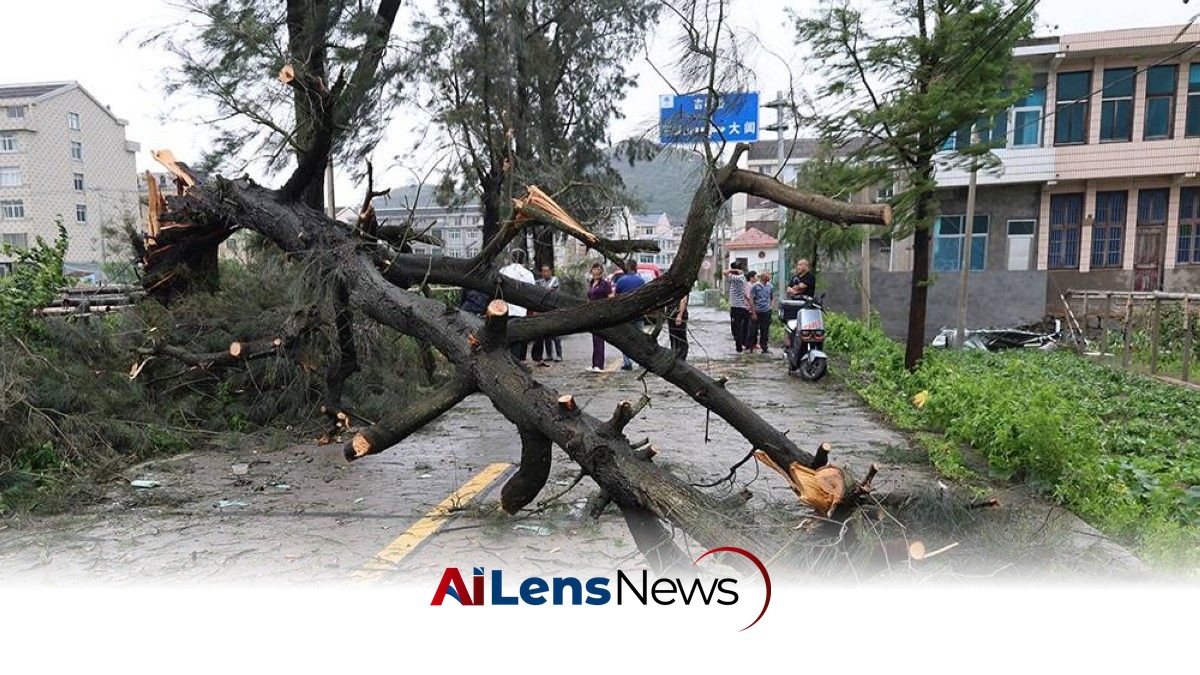


Typhoon Bavi has made landfall in eastern China, leading to mass evacuations and severe weather conditions, now downgraded to a tropical storm.
Kuwait City, Kuwait Jul 12, 2026 ALN: Typhoon Bavi was downgraded to a severe tropical storm on Sunday after making landfall in eastern China, where authorities had evacuated nearly two million people in its path. There were no immediate reports of casualties. The storm's impact highlights the increasing frequency and intensity of extreme weather events in the region, raising concerns about climate change and disaster preparedness.
Before reaching China, the storm lashed northern Taiwan and Japan’s remote southwestern islands, toppling trees and leaving tens of thousands without power. The destruction caused by Bavi is part of a broader pattern of severe weather that has affected much of East Asia in recent months, with rising temperatures in the oceans contributing to the strength of such storms.
Extreme weather had already wreaked havoc on southern and central China in the past week, with storms leaving at least 39 dead and causing dozens of rivers to overflow and a reservoir to burst. The cumulative impact of these weather events is a stark reminder of the vulnerabilities faced by communities in these regions, where infrastructure may struggle to cope with the intensity of natural disasters.
Bavi first made landfall at around 11:20 pm on Saturday (1520 GMT) in Zhejiang province with winds of 144 kilometers (90 miles) an hour, state news agency Xinhua reported, quoting the provincial meteorological observatory. The rapid intensification of the storm before landfall is a phenomenon that meteorologists are increasingly monitoring, as warmer ocean temperatures can lead to more powerful storms.
“The core impact zone experienced fierce winds and heavy rain, with rapid runoff forming on the ground and roadside trees being uprooted,” national TV station CCTV reported as Bavi struck the city of Yuhuan. Such conditions not only pose immediate threats to life and property but also have long-term implications for urban planning and disaster management in affected areas.
It then hit Yueqing city, where CCTV said firefighters, rescue workers, and municipal employees were clearing “more than 1,300 trees” that had fallen or been uprooted. The eye of the storm had moved near the Zhejiang provincial capital Hangzhou at around 10 am (0200 GMT) on Sunday with force 10 winds of around 108 km/h, the China Weather Administration said. The response from local authorities underscores the importance of emergency preparedness and rapid response mechanisms in mitigating the impact of natural disasters.
Zhejiang provincial officials forecast torrential rain in coastal regions and the possibility of flash floods, Xinhua reported, warning of transport disruptions, rivers overflowing, and farmland being inundated. Around 1.72 million people had been evacuated to safe places by Saturday, according to Xinhua. This evacuation effort reflects the proactive measures taken by local governments to safeguard residents, although it also raises questions about the adequacy of infrastructure and resources to handle such large-scale evacuations.
‘Sparing no effort’
Classes, work, transport, and outdoor activities were suspended ahead of the storm’s arrival, and more than 300 flights were cancelled in Zhejiang province. Another 684 flights and 1,620 train services have been cancelled in Shanghai, media outlet The Paper reported. The disruption to transportation networks highlights the economic impact of natural disasters, as businesses and individuals alike face significant losses due to cancellations and delays.
Images shared online on Sunday showed streets in Zhejiang’s Wenzhou city, a metropolis of nearly 10 million people, submerged in floodwaters. The Wenzhou government stated it was “sparing no effort or cost... to guard against the (worst-case) scenario.” Residents used planks to reinforce metal shutters protecting shops and taped windows, as CCTV footage showed. These actions reflect a community's resilience and adaptability in the face of adversity, though they also speak to the need for improved infrastructure to withstand such extreme weather events.
Torrential rain further north prompted the evacuation of more than 100,000 people from their homes in Beijing, the government said. More than 130,000 people have fled their homes in Fujian province and around 34,000 people from Shanghai’s coastal areas and high-risk areas, state media reported. The scale of these evacuations indicates a significant disruption to daily life and raises concerns about the long-term displacement of residents as communities work to recover from the storm.
Bavi had been downgraded to a typhoon as it moved across the Pacific Ocean after hitting Guam and the Northern Mariana Islands on Monday as a super typhoon. The storm is now forecast to move northeast while “gradually weakening,” before reaching the Yellow Sea on Tuesday and transforming into an extratropical cyclone, the Chinese weather service said. The provinces in its path across China’s east are likely to experience heavy downpours until Monday, it added. The transition of Bavi into an extratropical cyclone is a common phenomenon, but its implications for weather patterns in the region are closely monitored by meteorologists.
Warmer oceans
In the Philippines, at least 18 people were killed in landslides and other incidents triggered by heavy rains driven by Bavi, most on the southern island of Mindanao. Nearly 11,000 people across the archipelago fled their homes, and dozens of ports remain closed. The fatalities in the Philippines highlight the broader regional impacts of Bavi, underscoring the interconnectedness of weather systems and the urgent need for regional cooperation in disaster response.
In northern Taiwan, more than 14,000 people were evacuated from their homes and hundreds of flights were cancelled. More than 170,000 households across the island were hit by power outages. The widespread power outages and evacuations serve as a reminder of the vulnerabilities faced by island nations in the face of natural disasters, where geography and infrastructure can exacerbate the impact of storms.
In Japan, thousands of households and facilities across Okinawa also lost power. Oceans have experienced their hottest June on record and could set fresh highs in the months ahead, the European Union’s Copernicus Marine Service reported last week. The rising temperatures in the oceans are a crucial factor in the intensity of tropical storms, as warmer waters provide more energy for storms to develop and strengthen.
Warmer oceans intensify tropical storms and add more moisture, which can fall as heavy rain. Adding to the mix is the return this year of El Niño, a natural climate phenomenon that warms Pacific Ocean surface temperatures and typically occurs every two to seven years. The interplay between climate change, ocean temperatures, and natural climate phenomena like El Niño is a critical area of study for scientists seeking to understand and predict the future of extreme weather events. As global temperatures continue to rise, the implications for weather patterns, disaster preparedness, and community resilience become increasingly urgent.
To learn more about the latest developments in World News & International Affairs, stay updated with our exclusive reports and analyses on AiLensNews.

