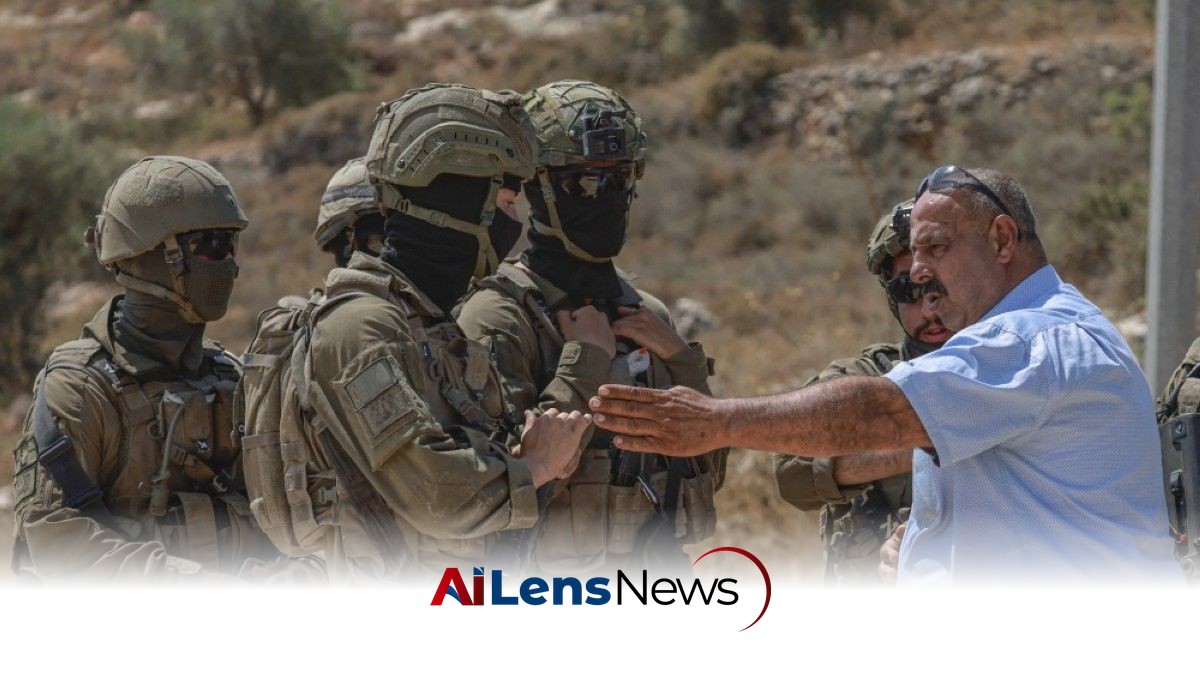


In Sinjil, West Bank, residents form grassroots groups to protect their town from escalating settler violence, amid government inaction.
Kuwait City, Kuwait Jul 12, 2026 ALN: SINJIL, West Bank: On a cool night in June, some 15 Palestinians from the town of Sinjil in the occupied West Bank gathered on a hilltop to watch the shadowed valleys below for any sign of movement that might signal an impending Zionist settler attack. They are part of a grassroots volunteer group — similar to others in the West Bank — that has stepped in to defend the town from rising settler violence that Palestinians say the Zionist military and their own government have proved unable or unwilling to prevent.
“We have been left on our own. You are facing settlers supported by their government,” said Fadi Alwan, one of the volunteers. “We have nobody. So we are forced to stay here and protect this town.”
The situation in Sinjil reflects a broader trend in the West Bank, where many Palestinian communities are increasingly feeling the need to organize their own defenses amid escalating violence and tension. Prime Minister Benjamin Netanyahu’s far-right government has approved hundreds of new settlements and settler outposts across the West Bank, with the smaller outposts often serving as staging grounds for violence that has displaced thousands of Palestinians. The expansion of these settlements has been a point of contention for decades, complicating peace efforts and undermining the viability of a future Palestinian state.
The Zionist government has said that through the strategic placement of settlements, it plans to thwart a Palestinian state with the West Bank at its heart — a Palestinian objective key to the two-state solution long backed by world powers. Most of the world considers all Zionist entity’s settlement activity in the West Bank, where the Palestinian Authority exercises limited self-rule and the Zionist military operates freely, as illegal under international law. This international perspective is often contrasted by the Zionist entity’s own legal interpretations, which assert that these settlements are lawful under their own legal framework.
Palestinians argue that when they call the Zionist police or the military, they are either late to respond or come to the aid of the settlers perpetrating the violence. The military denies this, claiming that their role is to maintain order and protect all civilians. “The army protects them and doesn’t stop them. We call the army. We call the police. It’s useless,” said Alwan. This sentiment of frustration and abandonment is echoed throughout the West Bank, where many Palestinians feel increasingly isolated and vulnerable.
Asked for comment on Sinjil and what residents describe as an escalating campaign of attacks, the Zionist entity’s military stated that troops deploy to disperse confrontations but that responsibility for civilian actions in the West Bank lies with the Zionist police. However, this division of responsibility has led to confusion and distrust among the Palestinian population, who often feel that their safety is not a priority for the authorities.
On June 26, as the men gathered around a fire on a Sinjil hilltop, one of them used a searchlight to scan the hills for settlers. Others drove on patrols around the town, all of them tuned into community WhatsApp groups where residents can alert one another to potential attacks. Towns elsewhere in the West Bank also have similar groups, but the patrols around Sinjil appear unusually organized, showcasing a community response to a dire situation.
“If they get close to the houses, we go confront them, we send (messages out) on the WhatsApp groups,” Alwan said. Just a few days earlier, Alwan said he was beaten by a settler wielding a spiked club in a daytime attack as he attempted to harvest wheat. He lifted his shirt to show his wound, still fresh. He recounted a harrowing incident from the previous year when settlers shot live bullets at a tent erected by the volunteers, narrowly missing the young men inside. He said the next day troops came and dismantled the tent, an action that has raised questions about the military's role in protecting Palestinian communities from settler violence. The Zionist entity’s military did not immediately provide comment on allegations that they dismantled the watch tent.
Alwan and other residents expressed their belief that most of the settlers perpetrating violence against their town came from the six settler outposts perched on the hills around them. The Yesha Council, an organization that represents settlers, did not immediately respond to a request for comment on events in Sinjil and what local regional councils are doing to curb violence. The lack of accountability and oversight regarding settler actions has been a recurring theme in the region, contributing to a cycle of violence and retaliation.
Sinjil sits along the main road between the Palestinian urban centers of Ramallah and Nablus, making it strategically important yet vulnerable. The hills north of the village are dotted with settlements and outposts, deepening the town’s isolation. Local officials say the Zionist entity’s military has closed off four of its five entrances and has built a metal wall around the town, cutting it off from 2,000 acres of private land. This physical barrier not only restricts movement but also exacerbates the sense of entrapment felt by the residents.
Moataz Tawafsha, the head of Sinjil’s municipality, stated that after the war in Gaza began in October 2023, settler attacks escalated, prompting the town to find a way to protect itself. “We really feel as if we are living in a collective prison,” Tawafsha said. “As a result, the municipality has taken primary responsibility for providing protection.” The escalation of violence has had dire consequences, with reports indicating that since October 2023, settler attacks have resulted in the deaths of two individuals and displaced more than 100 from the Bedouin Palestinian community living on town land, according to Tawafsha. Additionally, the violence has displaced a further 20 families from their homes in the town’s core during the same period, highlighting the urgent need for protective measures.
In response to the growing threat, some Sinjil residents have taken proactive measures to fortify their homes. Abed Foqahaa, for instance, installed metal bars over the windows of his house and built a tall metal fence around his garden after settlers threw a Molotov cocktail through his window while he and his family were inside around two years ago. “The fire broke out and we couldn’t control it. We tried to save the house, but all of us suffered from the smoke,” said Foqahaa. In a moment of desperation, he used the town WhatsApp group to call for help. Young men from the town, initially stopped by the Zionist military, eventually arrived and helped carry out Foqahaa’s wheelchair-using father, showcasing the solidarity within the community. “God bless them, they really helped us,” Foqahaa said, emphasizing the importance of community in times of crisis.
The situation in Sinjil is emblematic of the broader challenges facing Palestinian communities in the West Bank, where rising settler violence, government policies favoring settlement expansion, and a lack of effective protection from authorities create a volatile environment. As grassroots efforts to defend their communities continue, the implications for the future of the region remain uncertain. The ongoing conflict over land, resources, and rights underscores the need for a renewed commitment to dialogue and peace efforts, as the cycle of violence threatens to engulf both Palestinian and Israeli civilians.
To learn more about the latest developments in World News & International Affairs, stay updated with our exclusive reports and analyses on AiLensNews.

