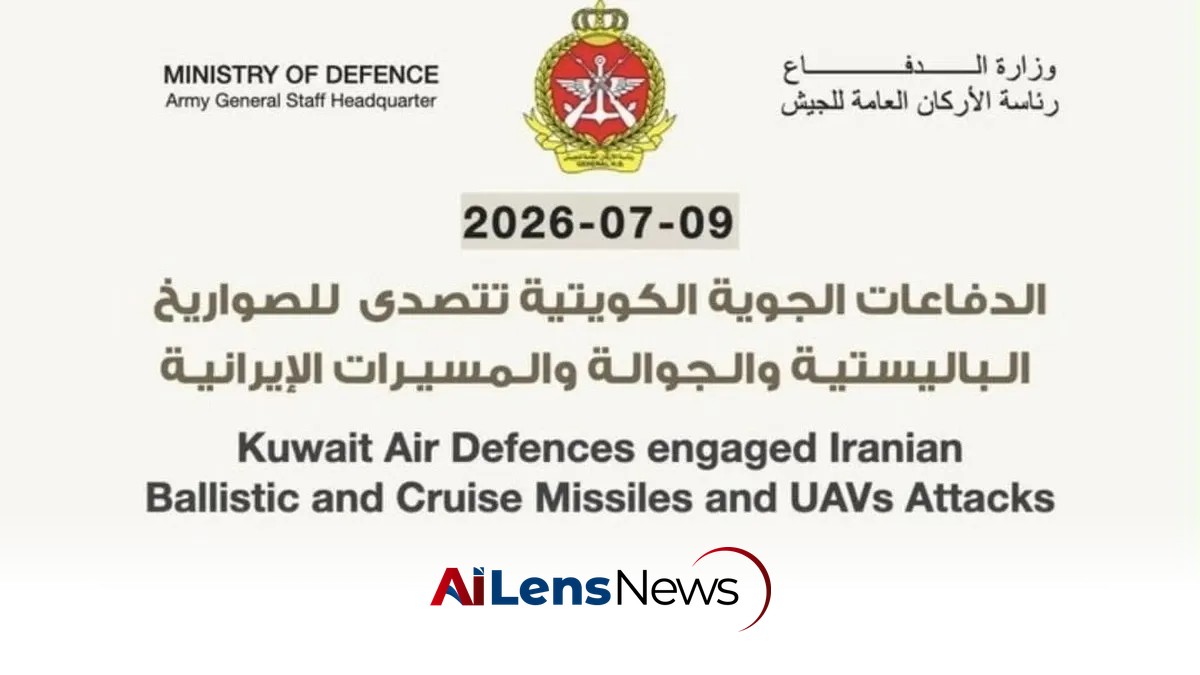


Kuwait's armed forces successfully intercepted 14 hostile aerial threats, including ballistic missiles and drones, with one injury reported from falling debris.
Kuwait City, Kuwait Jul 12, 2026 ALN: Kuwait's armed forces intercepted and destroyed 14 hostile aerial threats early Thursday after they entered the country's airspace, the Ministry of Defense announced.
In Statement No. 69, the ministry said air defense systems detected and successfully neutralized three ballistic missiles, one cruise missile, and 10 drones that had penetrated Kuwaiti airspace. This incident underscores the growing tensions in the region, where various state and non-state actors have increasingly utilized aerial threats as a means of warfare and intimidation.
The interception operation resulted in material damage after missile fragments fell in several locations across the country. One person was injured by the falling debris and is receiving medical treatment. Authorities said the individual's condition is stable. The injury and property damage highlight the risks associated with aerial attacks, even when they are intercepted successfully. The debris from intercepted missiles can pose a significant hazard to civilian populations, leading to injuries and property destruction.
The Explosive Ordnance Disposal (EOD) team of the Land Forces Engineering Corps also responded to multiple reports involving remnants of the intercepted missiles and drones, safely handling the hazardous debris. This response is indicative of the military's preparedness to deal with the aftermath of such incidents, showcasing their ability to manage and mitigate potential threats to public safety.
The Ministry of Defense said the armed forces remain on constant alert and continue to carry out their duties with high readiness and professionalism to safeguard the country's security and protect citizens and residents. This statement reflects Kuwait's commitment to maintaining national security in an increasingly volatile geopolitical landscape.
In recent years, the Middle East has seen a rise in the use of drones and missile technology, particularly among non-state actors. Countries such as Iran have been accused of supplying advanced weaponry to proxy groups in the region, which has led to an escalation in conflicts. The use of drones for reconnaissance and attack purposes has become more prevalent, allowing for precision strikes that can bypass traditional air defenses.
Kuwait, strategically located at the tip of the Persian Gulf, has historically been at the center of regional conflicts, most notably the Gulf War in the early 1990s. As a small nation with limited military resources, Kuwait relies heavily on its alliances, particularly with the United States and other Gulf Cooperation Council (GCC) members, to bolster its defense capabilities. The interception of these aerial threats demonstrates Kuwait's investment in air defense technology and its commitment to protecting its sovereignty.
This incident also raises questions about the broader implications for regional security. The ability of Kuwait's armed forces to intercept such threats may deter future attacks, but it also highlights the need for continued vigilance and preparedness. As tensions remain high in the region, particularly with ongoing conflicts in neighboring countries, Kuwait's military must remain proactive in its defense posture.
Moreover, the incident could prompt discussions among GCC nations regarding collective defense strategies. The shared threat of missile and drone attacks has the potential to unify member states in their efforts to enhance regional security frameworks. Joint military exercises and intelligence sharing could become more prevalent as nations seek to bolster their defenses against such aerial threats.
In addition to military responses, there is a growing recognition of the importance of diplomatic efforts to address the underlying causes of conflict in the region. Engaging in dialogue with potential adversaries, while simultaneously strengthening defense capabilities, may provide a more comprehensive approach to ensuring long-term stability.
The reaction from the international community will also be critical in the aftermath of this incident. Countries with vested interests in the stability of the Gulf region, including the United States, European nations, and regional powers, will likely monitor the situation closely. Their responses could range from diplomatic condemnations of the attacks to increased military support for Kuwait and other Gulf states.
As Kuwait continues to navigate its security challenges, the events of Thursday serve as a reminder of the complex and often dangerous environment in which it operates. The successful interception of aerial threats is a testament to the capabilities of the Kuwaiti armed forces, but it also emphasizes the need for ongoing investment in defense and security measures to protect the nation and its people.
In conclusion, the interception of ballistic missiles, cruise missiles, and drones serves as a critical incident in Kuwait's ongoing efforts to secure its airspace and protect its citizens. The implications of such threats extend beyond immediate security concerns, touching on broader regional stability and the need for collective defense mechanisms among Gulf nations. As the geopolitical landscape continues to evolve, Kuwait's commitment to safeguarding its sovereignty and maintaining peace remains paramount.
To understand the significance of this incident, it is essential to consider the broader context of military engagements in the Middle East. The region has been marked by a complex web of alliances and rivalries, with countries like Iran, Saudi Arabia, and Israel often at odds with each other. The proliferation of missile technology and drones has changed the dynamics of warfare, enabling actors to engage in conflicts from a distance while minimizing direct confrontation.
In the case of Kuwait, its geographical position makes it particularly vulnerable to aerial threats. The country is bordered by Iraq to the north and Saudi Arabia to the south, both of which have their own military capabilities and regional ambitions. Furthermore, the ongoing tensions in Iraq, Syria, and Yemen have created a volatile security environment that can spill over into neighboring states.
Kuwait's military strategy has increasingly focused on modernizing its defense systems, including air defense technologies. The interception of the missiles and drones on Thursday illustrates the effectiveness of these systems, which are designed to detect and neutralize threats before they can cause harm. Kuwait has invested in advanced radar systems and missile defense platforms, often in collaboration with international partners, to enhance its capabilities.
Additionally, the incident may have implications for Kuwait's domestic politics. The government's ability to protect its citizens from external threats is crucial for maintaining public confidence and support. A successful interception can bolster the government's standing, while any failures could lead to criticism and calls for increased military spending or strategic partnerships.
The incident also highlights the importance of civil defense measures. The injury caused by falling debris serves as a reminder that even successful military operations can have unintended consequences for civilian populations. Kuwait may need to enhance its public awareness campaigns and emergency response protocols to ensure that citizens are prepared for potential aerial threats.
In the aftermath of this incident, Kuwait may seek to engage in discussions with its neighbors regarding regional security cooperation. The shared threat posed by aerial attacks could serve as a catalyst for deeper collaboration among GCC nations, fostering a sense of unity in the face of common challenges. Such cooperation could include joint exercises, intelligence sharing, and coordinated responses to threats.
Finally, the international community's response to this incident will play a crucial role in shaping the future security landscape of the region. Countries that support Kuwait's right to defend itself may increase their military presence or engage in joint training exercises. Conversely, any perceived aggression from adversarial states could lead to escalated tensions and further military buildups.
In summary, the interception of these aerial threats serves as a critical moment in Kuwait's efforts to secure its airspace and protect its citizens. The implications extend beyond immediate security concerns, encompassing regional stability, collective defense mechanisms, and the need for a multifaceted approach to addressing the underlying causes of conflict in the Middle East. As Kuwait navigates these challenges, its commitment to national security and regional cooperation will remain essential in ensuring a stable future for the nation and its people.
To learn more about the latest developments in World News & International Affairs, stay updated with our exclusive reports and analyses on AiLensNews.

