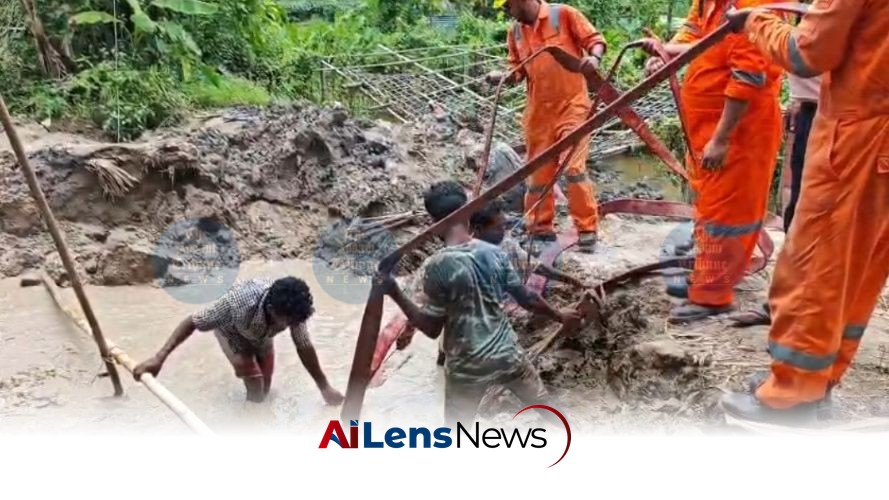


As the gas leak at ONGC's Geleki oilfield continues into its fifth day, efforts to identify the source remain unsuccessful, raising public safety concerns.
Shillong, India Jul 11, 2026 ALN: The underground gas leak at ONGC's Geleki oilfield in Assam's Sivasagar district has entered its fifth consecutive day, with the state-owned oil major yet to identify the source of the emission despite intensive efforts. This incident has raised significant concerns regarding the safety of local residents and the environmental implications of such leaks.
The leak was first reported at Bishnupur Adarsha Gaon under Geleki. Since its initial detection, the gas leak has spread to multiple locations, prompting authorities to take precautionary measures to safeguard public health. Local officials have advised residents against lighting any fire due to the escaping gas, which poses a potential risk of explosion or fire. This precaution is particularly important in densely populated areas where the presence of gas can create hazardous conditions.
Despite the deployment of technical experts from multiple ONGC departments, efforts to trace and contain the leak have so far failed to identify its source. The complexity of the situation is compounded by the geological conditions in the region, which may contribute to the difficulty in pinpointing the exact location of the leak. Geleki is known for its oil and gas reserves, and the presence of numerous oil wells nearby adds layers of complexity to the investigation.
"Currently, we are trying to find the source of the leak as we have several oil wells nearby. We are constantly checking wellheads but so far we have found no pipeline linked to the leak," an ONGC official involved in the operation said. This statement reflects the ongoing challenges faced by the ONGC teams as they navigate the intricacies of the oilfield's infrastructure.
In an effort to locate the source, teams have excavated pits up to 10-12 feet deep in the affected area. However, as of now, they have yet to locate either the source of the gas emission or any connected pipeline. The excavation process is not only labor-intensive but also time-consuming, particularly in adverse weather conditions. "Yesterday's rainfall has posed a challenge as the pits we had dug have now filled with rainwater," the official added, indicating that weather can significantly impact the progress of the operation.
What initially surfaced at a broiler farm owned by local resident Basanta Duara was later detected in a nearby oil pit and has since been observed emerging from agricultural fields, indicating that the leak has spread beyond its original location. This spread raises alarm about the potential impact on local agriculture and livestock, which could have long-term consequences for the community's livelihood.
"We are living in an environment filled with fear, anxiety, and uncertainty. We have not been able to sleep or eat properly because we have been instructed not to light gas stoves or any fire," said Basanta Duara. His statement encapsulates the emotional and psychological toll that such incidents can take on local populations. Residents are understandably anxious about the implications of living in proximity to a gas leak, particularly given the health risks associated with exposure to natural gas.
Duara also alleged that the gas was now emanating from several locations spread across nearly a kilometer from the original site, further complicating containment efforts. The situation has led to a growing sense of frustration among villagers, who are questioning the delay in identifying the source despite the deployment of specialized technical teams. They are left wondering about the efficacy of the response and the measures being taken to ensure their safety.
As the leak continues, many residents have reported experiencing burning sensations in their eyes and on their skin, symptoms that are concerning and indicative of possible gas exposure. In light of this, there has been a growing call for immediate health advisories and support for those affected. "There has been no relief support or compensation so far," Duara claimed, highlighting the need for prompt action from ONGC to address the health and safety concerns of the local population.
The continuing leak has fueled concerns among villagers, who are increasingly vocal about their grievances. On Friday, the Assam Jatiyatabadi Yuva Chatra Parishad (AJYCP) demanded immediate intervention by ONGC to ensure the safety of local residents and protect their livelihoods. The organization warned of public agitation if the issue remains unresolved, indicating that community patience is wearing thin and that residents are prepared to take action to protect their interests.
Responding to concerns over health advisories and compensation, the ONGC official stated that the company was monitoring the situation closely. "The management will definitely look after public grievances," the official said, suggesting that ONGC is aware of the seriousness of the situation and is committed to addressing the concerns of the affected community.
With the leak entering its fifth day and no indication of when it will be brought under control, uncertainty continues to grip Bishnupur Adarsha Gaon and neighboring areas. The ongoing situation raises broader questions about the safety protocols in place for oil and gas operations, particularly in regions where such industries intersect with residential areas. It highlights the need for robust emergency response strategies and transparent communication with affected communities.
This incident serves as a reminder of the potential risks associated with oil and gas extraction, particularly in environmentally sensitive regions. As the situation develops, it will be crucial for ONGC and local authorities to work collaboratively to address the leak, ensure the safety of residents, and restore confidence in the management of natural resources in the area. The implications of this leak extend beyond immediate safety concerns; they also touch on the long-term relationship between oil companies and local communities, which can be strained in the wake of such incidents.
In conclusion, as the community of Bishnupur Adarsha Gaon awaits resolution, the incident at the Geleki oilfield underscores the importance of effective risk management in the oil and gas industry. The health and safety of residents must remain a priority, and the lessons learned from this incident could inform future practices to prevent similar occurrences in the future.
To learn more about the latest developments in Health & Public Safety, stay updated with our exclusive reports and analyses on AiLensNews.

