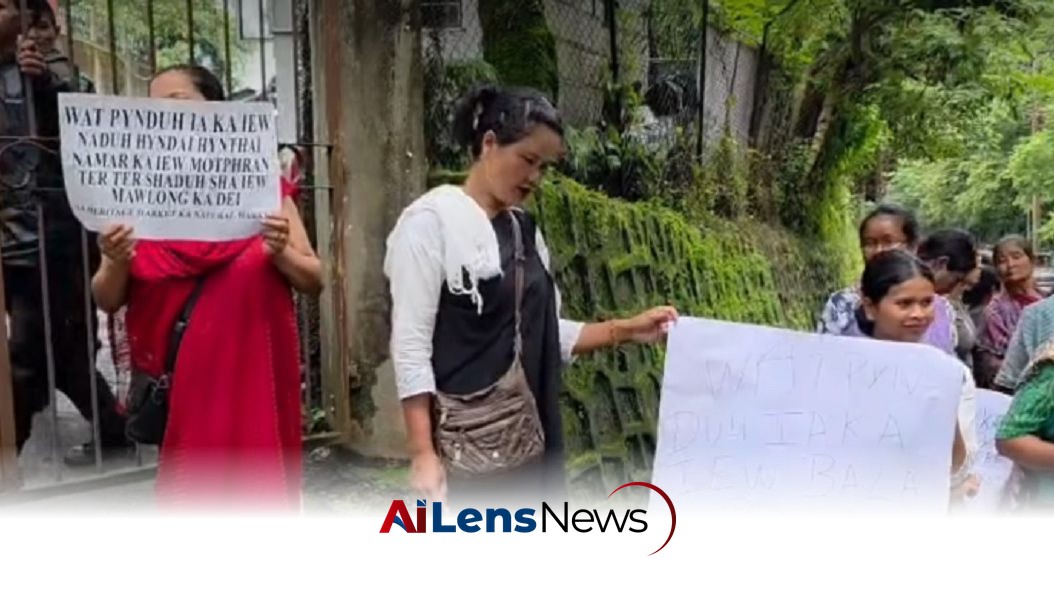


Members of the Greater Shillong Progressive Hawkers and Street Vendors Association protested for the establishment of a full Town Vending Committee, citing arbitrary decisions affecting vending zones.
Shillong, India Jul 10, 2026 ALN: SHILLONG, JUL 10: Members of the Greater Shillong Progressive Hawkers and Street Vendors Association staged a protest here on Friday, demanding immediate constitution of a full-fledged Town Vending Committee (TVC) and alleging arbitrary decisions by authorities regarding vending zones.
The protest reflects growing tensions between street vendors and local authorities in Shillong, a city known for its vibrant street markets and rich cultural heritage. Street vending has been an integral part of Shillong's economy, providing livelihoods for many families and contributing to the local culture.
General Secretary of the Association, Shane Thabah, articulated the frustrations of the vendors, stating that the protest was triggered by the expiry of the Provisional Town Vending Committee (PTVC) and unilateral decisions being taken without consultation. The PTVC was initially established to facilitate the regulation of street vending in compliance with the Street Vendors (Protection of Livelihood and Regulation of Street Vending) Act, 2014, which aims to protect the rights of street vendors while ensuring that public spaces are managed effectively.
“The public outcry today is because we all know that the Provisional Town Vending Committee (PTVC) was constituted. As per the law, the PTVC is valid only for one year and its term has already expired,” Thabah said. The expiration of the PTVC has left vendors in a precarious situation, as they are now operating without a governing body that can advocate for their rights or provide them with the necessary support and infrastructure.
“We have come here to demand a full-fledged Town Vending Committee because what I have observed is that during the PTVC meetings, once the term ended, they did not take collective decisions. Instead, one senior person in the PTVC would take decisions alone. This is illegal because they are no longer respecting the PTVC that exists,” he added. This lack of collective decision-making raises concerns about transparency and accountability in the management of street vending in Shillong.
Thabah emphasized the significant impact these decisions have had on traditional markets in the city. “Because of this, the public has come out onto the streets. First and foremost is Iewduh, Iew Mawlong, Motphran etc. These are markets that have existed for many, many years since ancient times. They are known as Heritage Markets and Natural Markets, and the law clearly states that you cannot abolish markets,” he said. The preservation of these markets is not only vital for the economic well-being of vendors but also for maintaining the cultural fabric of the city.
He alleged that vending zones were being de-notified and Certificate of Vending (COV) holders were being relocated without proper consultation. Citing the example of Laitumkhrah, he said, “During our discussions with the localities, we had also gone for inspection of places for street vendors. Even though it was not yet sufficient, we said ‘okay’ because we are not people who come out to create chaos in the town. We came out so that we can work together with the government officials and as per the law. Even though we were not fully satisfied, we said let us try. But after a few days, that same place was de-notified by their own decision. They said that place is no longer a vending zone. This is something that is being done arbitrarily and it kills hope and saddens the public.”
This situation underscores the broader challenges faced by street vendors in urban areas across India, where rapid urbanization and changing city landscapes often lead to conflicts between vendors and city planners. Street vendors are often seen as encroaching on public spaces, but they also provide essential services and products to local communities.
On the relocation of vendors from the Transport Corporation (MTC) area, Thabah alleged that decisions were taken without the Committee’s approval. “When we discussed the MTC, we discussed with different markets — from Iewduh, Laitumkhrah, GS Road. Iewduh is a wholesale and retail market, but now just to complete the work, things are being shoved in together. That is not right. They said they would shift to the SMB parking lot. We discussed this in the Committee and said it is not a place to sell clothes. We discussed shifting those who sell food items instead. But now, while issuing COVs, even those selling clothes have been shifted to Polo without any discussion in the Committee. The decision was simply taken from the Municipal Office. This is something where they do not even respect the Committee that exists,” he said.
Thabah's comments highlight a significant issue: the need for adequate consultation and participation of street vendors in decision-making processes that affect their livelihoods. The Street Vendors Act emphasizes the importance of involving vendors in the planning and management of vending zones, which is crucial for fostering a cooperative relationship between vendors and local authorities.
Thabah further articulated the association's position, stating, “We understand that the law exists, but it should only be used to work together and to regulate. When the places for street vendors are not yet ready, where are you giving COVs and telling them to go and set up?” His statement reflects the frustrations of many vendors who feel that the lack of proper infrastructure and planning has resulted in unjust treatment and displacement.
He concluded by reiterating the association’s core demand: “So now here we are demanding that a full-fledged Town Vending Committee be put in place immediately, and that elections be held so that matters related to street vendors are not biased and the work can proceed properly.” This call for a fully functional TVC is not merely about governance; it is about ensuring that the voices of street vendors are heard and respected in the urban landscape of Shillong.
The protestors urged the state government and Shillong Municipal Board to act urgently to constitute the TVC as mandated under the Street Vendors Act. The implications of this protest extend beyond the immediate concerns of the vendors; they touch on broader issues of urban governance, the rights of informal workers, and the need for sustainable urban development that accommodates diverse economic activities. As cities evolve, the challenge remains to find a balance between urban planning and the livelihoods of those who contribute to the vibrancy and dynamism of urban life.
To learn more about the latest developments in Society & Social Issues, stay updated with our exclusive reports and analyses on AiLensNews.

