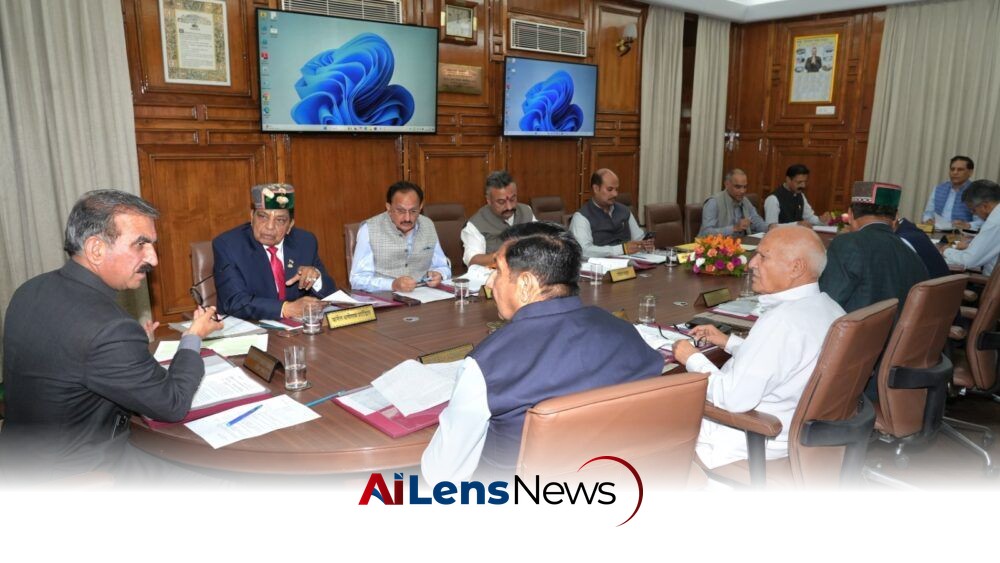


The Himachal Pradesh Cabinet has approved OBC reservation for Urban Local Bodies elections and sanctioned the formation of a Backward Classes Commission.
New Delhi, India Jul 31, 2025 ALN: SHIMLA|July 31 2025 – The Himachal Pradesh Cabinet, chaired by Chief Minister Thakur Sukhvinder Singh Sukhu, has approved the introduction of OBC reservation in the upcoming Urban Local Bodies (ULB) elections. This significant decision is aimed at ensuring equitable representation for the Other Backward Classes (OBC) in local governance, which has been a longstanding demand from various social groups within the state. To facilitate this initiative, the Cabinet also sanctioned the formation of a Backward Classes Commission tasked with compiling accurate population data to prepare the reservation roster effectively.
The move to reserve seats for OBCs in ULB elections is part of a broader effort to enhance political representation for marginalized communities in Himachal Pradesh. The OBC population in the state has historically faced challenges in terms of political representation and access to resources. By instituting a reservation system, the government aims to empower these communities and ensure their voices are heard in local governance. The establishment of the Backward Classes Commission is a critical step toward achieving these goals, as it will provide the necessary data to inform policy decisions and allocation of seats.
Additionally, the Cabinet recommended that the Monsoon Session of the Himachal Pradesh Vidhan Sabha be held from August 18 to September 2, 2025. This legislative session is expected to address various pressing issues, including the implementation of the newly approved OBC reservation policy and other matters of public interest.
| Area | Decision |
|---|---|
| ULB Elections | OBC reservation approved; Backward Classes Commission to be established |
| Legislative Session | Monsoon Session proposed from August 18 to September 2, 2025 |
| Age Relaxation | Two-year upper age limit relaxation for TGT and JBT exam aspirants |
| Orphan Reservation | One seat per course reserved for orphans in all technical institutions |
| Healthcare | Engagement of 290 additional ASHA workers in remote and tribal areas |
| Legal Appointments | Recruitment of 5 Law Officers and 2 Law Officers (Hindi) in the Secretariat |
| Tribal Development | Three Research Officer posts created for ITDP offices in Bharmour, Pangi, and Spiti |
Among other notable decisions, the Cabinet approved a two-year upper age limit relaxation for candidates aspiring to take the Trained Graduate Teacher (TGT) and Junior Basic Training (JBT) examinations. This decision is expected to benefit a significant number of candidates, particularly those who may have faced age-related barriers in the past. Such measures are crucial in promoting equal opportunities in education and employment within the state.
Furthermore, in an effort to support vulnerable populations, the Cabinet has reserved one seat per course for orphans in all technical institutions. This initiative aims to provide educational opportunities for orphans, who often face significant challenges in accessing quality education and vocational training. By ensuring that these individuals have a dedicated pathway to education, the government seeks to promote social equity and uplift marginalized communities.
In the healthcare sector, the Cabinet has decided to engage 290 additional Accredited Social Health Activists (ASHA) workers in remote and tribal areas. This move is essential for improving healthcare delivery in regions that are often underserved. ASHA workers play a vital role in community health by facilitating access to healthcare services, promoting health education, and mobilizing communities for health interventions.
In terms of legal appointments, the Cabinet approved the recruitment of five Law Officers and two Law Officers (Hindi) in the Secretariat. This decision underscores the importance of legal expertise in governance and administration, ensuring that the state government is well-equipped to handle legal matters effectively.
For tribal development, three Research Officer posts have been created for Integrated Tribal Development Project (ITDP) offices in Bharmour, Pangi, and Spiti. These positions are expected to enhance the capacity of these offices to address the unique challenges faced by tribal communities, including socio-economic development, cultural preservation, and access to resources.
In response to the extensive damage caused by torrential rains, the Cabinet granted ex post facto approval for financial assistance in the form of rent support for families living in relief camps. Under the Direct Benefit Transfer (DBT) mechanism, affected families will receive ₹5,000 per month in rural areas and ₹10,000 per month in urban areas. This assistance is aimed at alleviating the immediate financial burdens faced by families displaced by the monsoon and will be available for a maximum period of six months.
The impact of the recent monsoon rains has been devastating for many families across the state, leading to loss of homes and livelihoods. By providing financial support, the government aims to ensure that these families can secure basic necessities while they work to rebuild their lives. The use of the DBT mechanism also ensures that the assistance reaches the intended beneficiaries directly, minimizing bureaucratic delays and inefficiencies.
To curb illegal operations in liquor manufacturing units, the Cabinet approved the deployment of two Home Guards and a State Taxes and Excise Officer at each distillery, bottling plant, and brewery. The officers will be rotated periodically within the district to enhance oversight and compliance with legal regulations. This action is part of the government's broader strategy to regulate the liquor industry effectively and ensure that all operations are conducted legally and transparently.
In addition to regulatory measures, the Cabinet authorized the auction of 10 minor mineral quarries in Kangra and the re-auction of 11 quarries in Bilaspur, with expected revenue of ₹18.82 crore. This initiative aims to boost state income, create employment opportunities, and prevent illegal mining activities that can harm the environment and local communities. By formalizing the mining sector, the government hopes to ensure sustainable practices while generating revenue for development projects.
The Cabinet approved the formation of a Tourism Investment Promotion Council, chaired by the Chief Minister, to process proposals involving investments exceeding ₹50 crore. This council is expected to streamline the approval process for large-scale investments in the tourism sector, which is a significant contributor to the state's economy. By ensuring that all proposals are cleared within 30 days, the government aims to attract more investors and enhance the state's tourism infrastructure.
In a bid to streamline travel for eligible beneficiaries, the HIM BUS CARD will be issued by the Himachal Road Transport Corporation (HRTC). This initiative is designed to facilitate concessional travel, making public transport more accessible and affordable for those who rely on it for their daily commutes.
The Cabinet also announced that Phase II of the Himachal Pradesh Sadbhawana Legacy Cases Resolution Scheme will run from September 1, 2025, for three months. This scheme aims to settle around 30,000 pending cases, including Value Added Tax (VAT) disputes related to petroleum products up to FY 2020–21. By resolving these legacy cases, the government hopes to improve the business environment and enhance compliance among taxpayers.
Furthermore, a one-time legacy policy was approved to regularize unregistered construction equipment vehicles. Owners can register by paying the due one-time tax and 50% of the applicable penalty in lump sum. This policy is expected to encourage compliance among vehicle owners and improve the regulation of construction activities in the state.
The Cabinet accepted recommendations from a Cabinet Sub-Committee led by the Technical Education Minister to optimize the use of vacant government buildings. A nodal agency will be designated to allocate available spaces to government departments, boards, and corporations, ensuring that public resources are utilized efficiently.
In a significant move to standardize water tariffs, the Cabinet approved a decision to implement uniform water tariff rates in the Municipal Corporation Solan, applying the standard rates of the Jal Shakti Vibhag across all service providers. This decision is expected to enhance transparency and fairness in water billing, benefiting consumers.
Finally, the boundaries of the Municipal Council Nadaun in Hamirpur district were revised to exclude Stadium Amatar and Panchayat Ghar Bela (Ward No. 8). This administrative adjustment may reflect changing demographic or infrastructural needs within the council's jurisdiction.
In addition to these initiatives, the Cabinet also granted approval to initiate the operation of lotteries in the state. The introduction of lotteries can serve as a source of revenue generation while also providing entertainment options for residents and visitors alike. The government’s approach to managing the lottery system will be critical in ensuring that it is operated in a responsible manner, with proceeds potentially directed toward public welfare projects.
To learn more about the latest developments in Politics, stay updated with our exclusive reports and analyses on AiLensNews.

