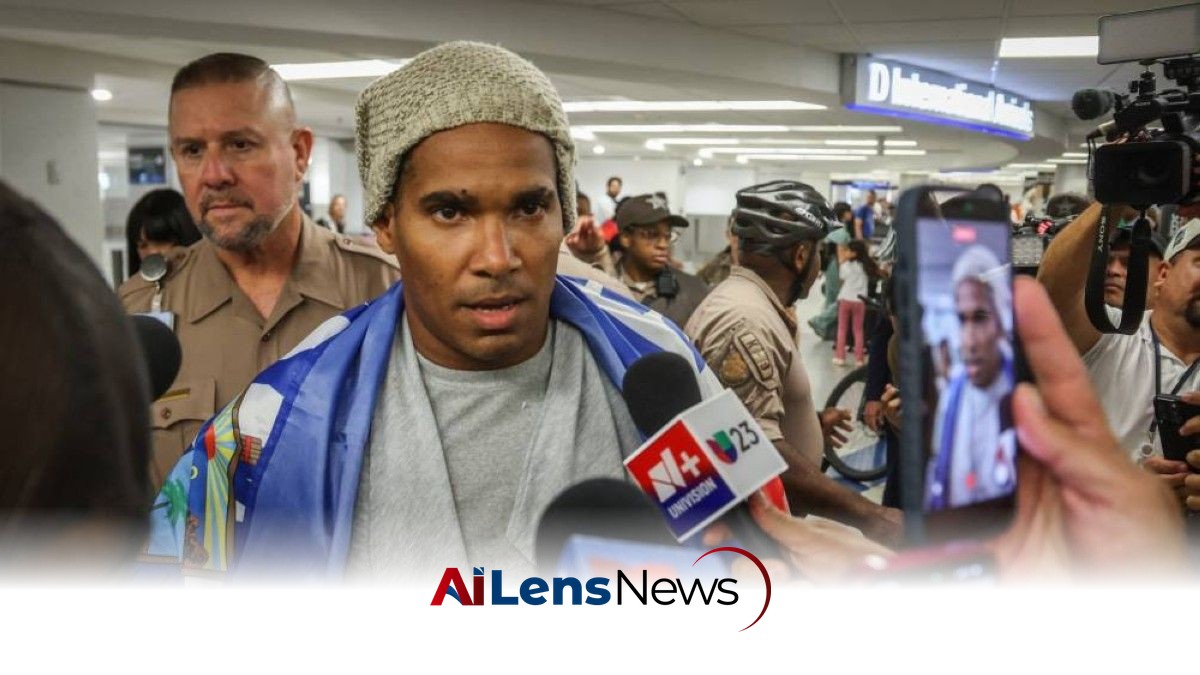


Cuban dissident artist Luis Manuel Otero Alcantara has arrived in the U.S. after serving five years in prison, vowing to continue his fight for freedom in Cuba.
Kuwait City, Kuwait Jul 20, 2026 ALN: Prominent Cuban dissident artist Luis Manuel Otero Alcantara flew Saturday to exile in the United States after serving a five-year sentence on the island, as Washington urged Havana to release more than 700 political prisoners. Otero Alcantara, designated a prisoner of conscience by Amnesty International, was sentenced to five years in prison in 2022 for insulting national symbols, contempt, and disturbing the public order.
He landed in Miami, the capital of the Cuban diaspora, after a short flight from Havana, according to a video of Otero Alcantara at the airport that was shared with AFP by his friend, activist Anamely Ramos. His arrival in the U.S. marks a significant moment not only for the artist himself but also for the broader context of Cuban dissidence and the ongoing struggle for human rights on the island.
Otero Alcantara, a self-taught performance artist, sculptor, and painter, rose to prominence in 2020 as leader of the San Isidro protest movement of artists and intellectuals. This movement was pivotal in voicing the frustrations of many Cubans regarding the government's oppressive policies, particularly in the cultural sector. Authorities detained him in July 2021 as he left his Havana home to join unprecedented mass protests that erupted across the island, driven by a combination of economic hardship, food shortages, and a lack of basic freedoms.
On Saturday, upon his arrival, he expressed his commitment to continue advocating for a free Cuba. "What’s really happening right now is the result of all of our efforts," he told members of the Cuban exile community that had gathered with him as he visited a Miami shrine featuring the patron saint of Cubans. His statement reflects a broader sentiment among Cuban exiles and dissidents who have long fought against the authoritarian regime in Havana.
“What I really want is to work... Every minute I lose is one more minute of dictatorship,” said the artist, who has begun to restore a statue he brought from Cuba. This restoration symbolizes not only his personal journey but also the resilience of the Cuban people in the face of oppression. Washington hailed Otero Alcantara’s arrival in the U.S. and stated that Havana imprisoned him “for daring to imagine a free Cuba.”
U.S. Secretary of State Marco Rubio commented on the situation, stating that “Otero Alcantara’s only ‘crime’ was refusing to stay silent and using his art to demand the basic freedoms everyday Cubans have been denied for almost seven decades.” This comment underscores the long-standing tensions between the United States and the Cuban government, particularly regarding human rights violations and the treatment of political dissidents.
Rubio also called for Cuba to release the more than 700 political prisoners “unjustly detained” and held by Havana. “The international community must stop turning a blind eye to the human rights abuses of the Cuban regime and join us in demanding an end to their repression,” he said. This call to action resonates with numerous human rights organizations that have documented systematic abuses by the Cuban government against its citizens, particularly those who dare to dissent.
No ‘martyr’
Otero Alcantara is among the most prominent Cuban dissidents. He was awarded the Norwegian Rafto Prize for Human Rights in 2024 “for his fearless opposition to authoritarianism through art.” This recognition highlights the role of artists and intellectuals in the fight for human rights and social justice in Cuba. His Facebook account, operated by his friends, states that he was held in Cuba in a maximum security prison, and that a condition of his release was that he never return to the country, which has accused him of acting on behalf of Washington to destabilize the communist-run island.
On July 7, he was transferred from a prison to a state security force facility, two days before completing his term. Authorities provided no information about his whereabouts after that. His release comes amid major Havana-Washington tensions, with U.S. President Donald Trump mounting a pressure campaign against Cuba. The U.S. has historically imposed sanctions on Cuba in response to its human rights abuses, and the situation has only intensified in recent years.
During a recent UN General Assembly debate on U.S. sanctions against Cuba, U.S. Ambassador Mike Waltz held up a portrait of Otero Alcantara to denounce the island’s repressive policies. This act symbolizes the international attention that the plight of Cuban dissidents is receiving, as well as the ongoing struggle to hold the Cuban government accountable for its actions.
The dissident’s departure to Miami confirms the Cuban government’s strategy of silencing its most critical voices through exile. According to a tally of human rights organizations, between 700 and 1,000 political prisoners remain jailed in Cuba. This statistic highlights the ongoing repression faced by those who oppose the regime and raises questions about the future of dissent in Cuba.
In October, another dissident figure, 55-year-old Jose Daniel Ferrer, went into U.S. exile. This trend of dissidents seeking refuge abroad underscores the dire situation in Cuba, where many feel that their safety and freedom are at risk. Friends say Otero Alcantara is embracing his newfound freedom. “Today, Luis wants to live again, resume his projects, and reclaim the time that was stolen from him,” reads one of the Facebook posts. This sentiment reflects the hope and determination that many Cuban exiles feel as they continue to fight for a better future for their homeland.
“He also wants to continue envisioning and working toward freedom for Cuba.” Shortly after the artist arrived in the United States, he told supporters that there are “a whole range of tools” to help people “understand what freedoms are and take to the streets for that reason.” This statement emphasizes the importance of education and awareness in the struggle for human rights and democracy in Cuba, as well as the role that art can play in this process.
In April, Otero Alcantara dictated a guest essay by telephone from jail to a friend, who delivered it to The New York Times. “I’m allowed to paint. It’s what’s kept me alive,” he said. “If I couldn’t make art, I would die,” he added. “That’s why the guards let me do it—so I don’t turn into a martyr.” This poignant reflection on the power of art in the face of oppression encapsulates the spirit of many Cuban artists and dissidents who continue to fight for their rights and freedoms, both within Cuba and in exile.
To learn more about the latest developments in Society & Social Issues, stay updated with our exclusive reports and analyses on AiLensNews.

