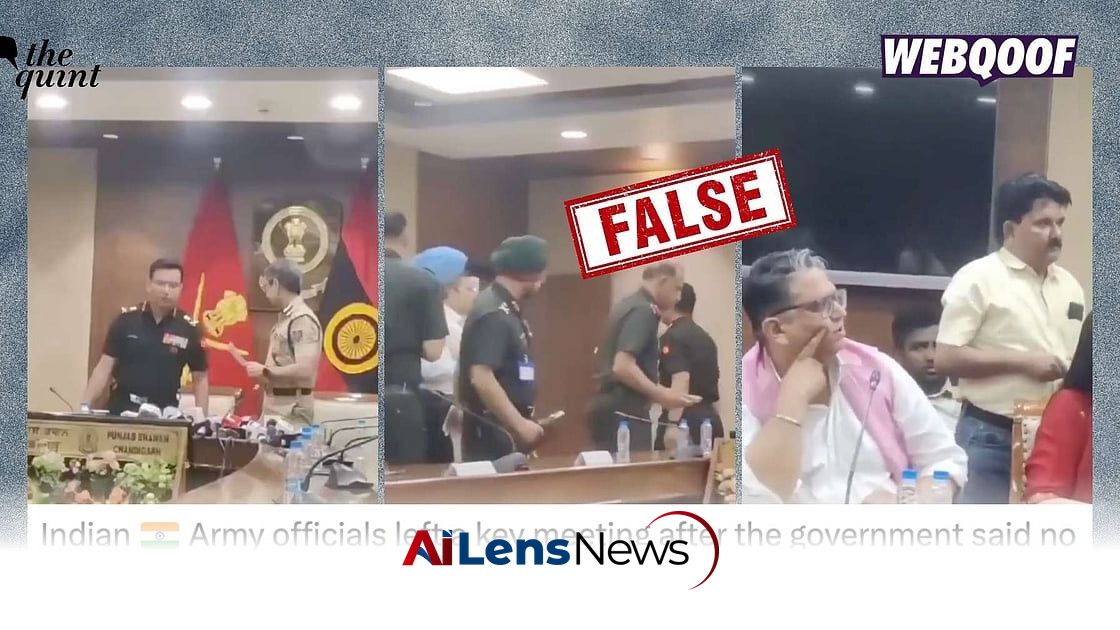


A video claiming Indian Army personnel walked out of a meeting over funding issues is misleading; it actually pertains to a past incident involving a journalist's questioning.
New Delhi, India Jul 16, 2026 ALN: A video showing Indian Army personnel walking out of a meeting while a person questions them has gained significant traction on social media platforms. This video has been misinterpreted and is being circulated with the claim that Indian Army officials left the meeting due to being denied necessary funding to address ongoing challenges posed by neighboring countries, specifically Pakistan and China. However, this assertion does not hold true upon closer examination.
The claim: The viral video is being shared with the assertion that Indian Army officials walked out after their funding requests were denied, suggesting a breakdown in communication and support for the military's operational needs.
Is it true?: No, the claim is false. The context surrounding this video is crucial in understanding its true significance.
The viral video actually dates back to March 2025 and features a journalist who is questioning Army representatives regarding the Colonel Bath assault case, rather than any funding issues related to military operations.
How did we find out the truth?: Through a thorough investigation involving a reverse image search, we traced the origins of the video back to a post made by former Punjab minister Bikram Singh Majithia on 25 March 2025. In this post, Majithia expressed gratitude to journalist Man Aman Singh Chhina for his persistent questioning, which was aimed at ensuring justice for Colonel Pushpinder Singh Bath and his family.
A keyword search based on this clip on Chhina's X account revealed that he shared the same video on 25 March 2025. In his post, he mentioned that Lieutenant General Mohit Wadhwa, the Chief of Staff of the Western Command, had left a press conference after reading a statement regarding the Colonel Bath case without taking any questions from the media.
Chhina also pointed out that while the Director General of Police of Patiala had made a statement and subsequently departed, he had at least engaged with the media and answered questions in the days leading up to the incident.
In fact, similar questions can be heard at the 03:28-minute mark in the video of the press conference, which was shared on the Government of Punjab's YouTube channel on 25 March 2025. This further reinforces the context that the video is not related to funding issues but rather to accountability in the handling of a serious assault case involving an Army officer.
About the Colonel Bath case: Colonel Pushpinder Bath and his son Angad were assaulted during a parking dispute on the night of 13-14 March in Patiala, Punjab. The incident escalated to a significant level, leading to public outcry and media attention.
Colonel Bath accused 12 Punjab Police personnel of assaulting him and his son, which resulted in the suspension of all 12 officers involved, as reported by NDTV. This highlights the severity of the allegations and the implications for law enforcement accountability.
Initially, the case was managed by the Punjab police, but due to the high-profile nature of the incident and the involvement of an Army officer, it was later transferred to the Central Bureau of Investigation (CBI) to ensure a more impartial investigation.
In March 2026, four of the accused were granted bail, a decision that the prosecution opposed due to concerns about potential intimidation of witnesses and the ongoing investigation, as reported by Hindustan Times. This aspect of the case underscores the complexities and challenges involved in ensuring justice in cases that involve both military personnel and law enforcement officers.
The misrepresentation of the video serves as a reminder of the power of social media in shaping narratives and the importance of verifying information before sharing it. In an environment where misinformation can spread rapidly, it is vital for individuals to seek out credible sources and understand the context behind the content they encounter online.
Implications: The implications of this viral video misinterpretation are manifold. Firstly, it reflects a growing trend where critical issues related to national security and military funding are conflated with unrelated incidents, potentially undermining public trust in the military and government institutions. Misleading narratives can divert attention from pressing matters, such as the need for adequate funding and resources to address security concerns posed by neighboring countries, particularly in a region with ongoing tensions.
Furthermore, the misrepresentation of the Colonel Bath case also highlights the challenges faced by military personnel and their families in seeking justice when involved in incidents with civilian authorities. The public's perception of the military's operational needs and the complexities of law enforcement accountability can be skewed by such misinformation, leading to a lack of understanding of the real issues at play.
In conclusion, this old video of a journalist questioning Army and police personnel regarding the handling of an Army man's assault case is being shared with misleading claims that distract from the actual events and their significance. It is essential for the public to critically evaluate the information they encounter and to understand the broader context surrounding such incidents to foster a more informed discourse on national security and justice.
In addition to the misinformation surrounding the video, it is important to consider the broader implications of how narratives are constructed in the digital age. Social media platforms have become a primary source of news and information for many, but they also serve as breeding grounds for misinformation. The ease with which videos and images can be edited, taken out of context, or manipulated poses significant challenges for journalists, fact-checkers, and the general public.
Moreover, the phenomenon of viral misinformation can have real-world consequences. In this case, the misrepresentation of the video could potentially lead to a misunderstanding of the Indian Army's operational challenges and funding needs, which are crucial for national security. The military's relationship with civilian authorities, particularly in a democratic setup, is complex and requires transparency and accountability to maintain public trust.
As discussions surrounding national security and military funding become more prevalent, it is essential for citizens to engage with credible sources and seek comprehensive understanding rather than relying on sensationalized or misleading narratives. This is particularly true in the context of India, where geopolitical tensions with neighboring countries like Pakistan and China continue to shape public discourse.
Furthermore, the case of Colonel Bath serves as a reminder of the challenges faced by military personnel in navigating the legal and judicial systems when involved in incidents with civilians. The complexities of such cases often highlight the need for reforms in how law enforcement agencies operate, particularly in relation to military personnel, to ensure accountability and justice.
In light of these developments, it is crucial for media outlets, journalists, and the public to prioritize fact-checking and responsible reporting. The dissemination of accurate information not only serves to inform the public but also plays a vital role in upholding democratic values and the rule of law. As the digital landscape continues to evolve, fostering a culture of critical thinking and media literacy will be essential in combating the tide of misinformation and ensuring that public discourse remains grounded in fact and reason.
To learn more about the latest developments in Crime & Law, stay updated with our exclusive reports and analyses on AiLensNews.

