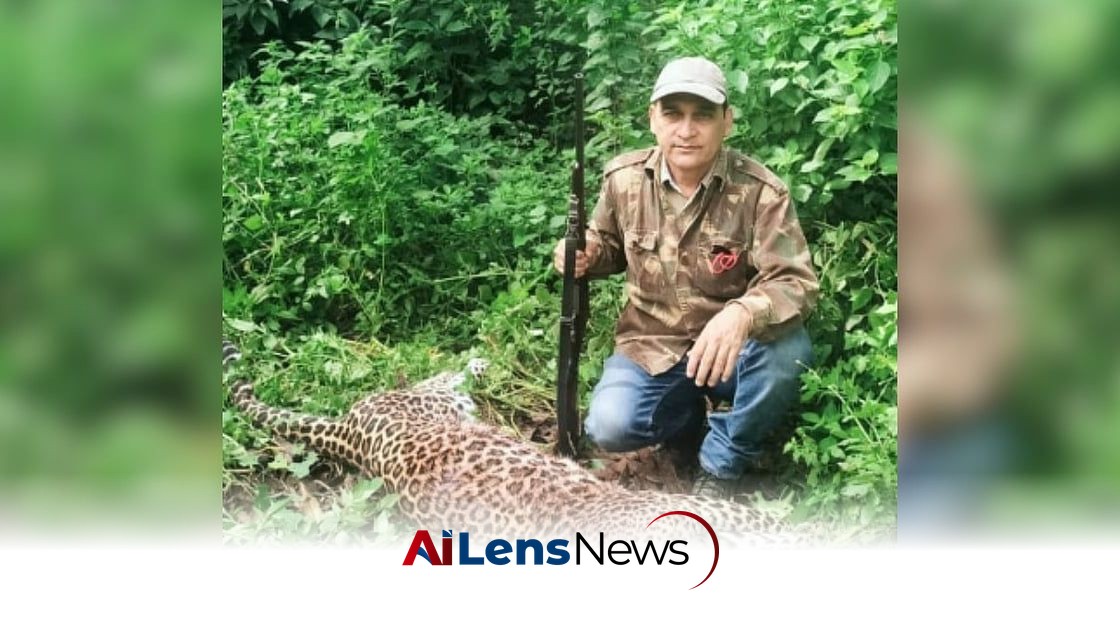


Meet Joy Hukil, a skilled shooter from Uttarakhand, who has eliminated 50 man-eating leopards over 19 years, bringing relief to local villagers plagued by wildlife conflicts.
Dehradun, India Jul 18, 2026 ALN: Joy Hukil’s arrival often brings a sense of relief and hope to frightened villagers inhabiting areas affected by human-wildlife conflict. Armed with his rifle and rucksack, the middle-aged shooter they believe, will put an end to their troubles.
They have good reason to feel that way. Over the past 19 years, Joy has completed numerous operations to eliminate leopards that had become a threat to human life. So far, he has killed 50 man-eating leopards across Uttarakhand, bringing relief to hundreds of affected villages. His latest was on June 9, at a village called Wadiyun in his home district of Pauri in Uttarakhand. With that, he joined the rare league of shooters who have crossed the half-century mark.
The history of human-animal conflict in Uttarakhand is as old as the hills. It is also complex. The most famous shooter associated with the region remains the legendary author, conservationist, and shikari, Jim Corbett. Corbett became part of local folklore after eliminating notorious man-eaters such as the Rudraprayag man-eating leopard and the Champawat man-eating tiger.
During his career, Corbett shot down 33 man-eating tigers and leopards. However, in Uttarakhand, only three shooters have crossed the 50-kill milestone: Thakur Dutt Joshi, Lakhpat Singh Rawat, and now Joy Hukil. Forest department guard and skilled shikari Thakur Dutt Joshi, who died in 2016, enjoyed a Corbett-like image and was even known as ‘Mini Corbett’. He was from Devi Rampur village in Nainital.
The Hukil family traces its roots to the Chinese tea workers who arrived in Pauri Garhwal during British rule in the 1850s. A contractor and businessman by profession, Joy was born in Pauri and studied in several towns, including Pauri, Almora, and Lucknow. His fascination with shooting began during his school days as a cadet of the National Cadet Corps (NCC).
“I was in the NCC during my school years. In the 1970s, I attended an NCC camp in Dehradun and was adjudged the best shooter. Even during my college years, I continued practising shooting,” he recalls. At the time, he never imagined that the skills learned at NCC camps would one day be used to shoot man-eating leopards.
His first assignment came in 2007 when a man-eating leopard terrorised Silkakhal Bandasa and adjoining villages in Tehri district. The leopard was responsible for 11 human deaths and this created a curfew-like situation in the region. Villagers were afraid to leave their homes, work in their fields, or move about freely. Several shooters were invited by the Forest Department, but none succeeded in tracking the elusive animal.
Under mounting pressure from residents, authorities allowed villagers with licensed firearms to participate in the operation. Joy read about the decision in a newspaper and requested the forest department to allow him to join the operation.
“I had a shotgun and convinced the forest department that I was a capable shooter. They permitted me, and on the fifth day I eliminated the leopard. It was an unforgettable experience. The villagers celebrated the kill and treated me like a hero. Those memories remain fresh even today, although I had to wait another two years before receiving my next assignment.”
Human-wildlife conflict was equally severe during the British era. Garhwal and Kumaon were then part of the United Provinces. Between 1920 and 1924, tiger attacks claimed 243 lives, while leopard attacks killed another 221 people in the United Provinces. It was during this period that Corbett travelled from village to village, tracking and eliminating notorious man-eaters. He enjoyed immense respect among the highlanders for bringing relief to villages affected by wild animals.
When the man-animal conflict turned grave, even the army was deployed to assist in operations. The government also rewarded successful shooters. In 1880, shooter Bertram Beresford Osmaston received Rs 500 for killing a man-eating tiger at Chakrata in Dehradun. Similarly, when Corbett shot the infamous Rudraprayag leopard in 1926, he was offered a reward of Rs 500, which he politely declined.
Being a shooter in modern times is far from glamorous. The days of cash rewards and official honours are long gone. Today, a shooter receives only official permission to neutralise a man-eater. He travels to the affected village at his own expense and uses his own firearm and ammunition. Basic accommodation and food are generally provided by villagers or the forest department.
The work itself is demanding. Patrols typically begin in the evening and continue until dawn. There is little opportunity for rest because reports of leopard sightings can come at any hour. Some operations stretch beyond a month, severely disrupting a shooter’s personal life and profession.
Identifying the actual man-eater is often the most difficult task. Several leopards may be found in the affected area, making it challenging to determine which one is responsible for attacks. Shooters rely on pugmarks, camera traps, injury patterns, and behavioural observations. One traditional clue remains particularly useful: a man-eater often returns to its kill to consume what is left of the body.
Although Joy began with a shotgun, he later upgraded to a 1910 Mannlicher-Schoenauer rifle, which has accompanied him on many successful operations. According to fellow shooter Lakhpat Singh Rawat, Joy’s greatest strengths extend beyond marksmanship. “Joy never loses his calm. He is a crack shot. The Forest Department should use our experience and expertise to train its staff in identifying and eliminating man-eaters,” says Lakhpat.
Joy’s record spans nearly the entire state of Uttarakhand. He has eliminated 20 man-eaters in Pauri, 15 in Tehri, 6 in Almora, 3 in Pithoragarh, 2 in Bageshwar and one each in Rudraprayag, Uttarkashi, Chamoli, and Nainital. Besides killing 50 man-eaters, he has helped capture seven leopards alive. Trapping a man-eater requires extensive planning and includes monitoring its movement patterns and strategically placing cages.
Once a shooter receives official permission to eliminate a man-eater, he immediately proceeds to the affected village. In most cases, he arrives within hours of a leopard or tiger claiming a human life.
The first step is a thorough inspection of the site where the attack occurred. Camera traps and cages are strategically installed to monitor the animal’s movement. To track the feline, forest personnel create “pressure impression pads” by laying soft sand or mud at selected locations. When an animal passes over these pads, its footprints are recorded, allowing officials to identify and track it through pugmark impressions.
Identifying, tracking, and finally eliminating or trapping the animal are the three major components of any man-eater control operation.
After evading forest staff and shooters for more than seven months, the notorious man-eater of Pauri claimed another victim — a 60-year-old woman, Prabha Rawat, of Wadiyun village. The attack occurred at around 11 am, when she had gone to her field to collect fodder. The leopard dragged her body into a dilapidated house nearby.
Joy, who was already operating in the affected region, immediately rushed to the village along with Forest Department personnel. The team instructed villagers to stay away from the area, as the leopard’s roars could be heard from the nearby forest.
Positioning themselves near the abandoned house, the team waited patiently for the predator to return to its kill. At around 3 pm, the leopard reappeared to feed on the body. Seizing the opportunity, Joy took careful aim and fired, bringing down the man-eater of Pauri. With a single shot, he ended an eight-month-long reign of terror.
Among all his encounters, one leopard stands out in Joy’s memory — the Hawal Bagh man-eater in Almora. “The leopard had remained elusive for a long time. I was sitting on a machan and had tied a dog nearby as bait. I heard what sounded like a dog barking from a bush. But something about the bark felt unusual. One day, I was moving around the affected village; a woman told me that the leopard imitated dog barks to lure dogs before killing them. She claimed that two of her dogs were killed by the leopard. I was stunned. Eventually, I eliminated the leopard by identifying it with this peculiar habit.”
The latest man-eater he killed at Wadiyun village in Pauri displayed equally unusual behaviour. According to Joy, the male leopard regularly brought a female companion to its kills. Camera traps repeatedly captured the pair feeding together. During separate operations, two female leopards were killed, and post-mortem examinations revealed human remains in their stomachs. “I named it the ‘Casanova of Pauri’ because of its habit of taking female companions along for hunts and sharing kills with them,” Joy said.
Human-wildlife conflict continues to claim many lives in Uttarakhand. According to the Forest Department, nearly 30 per cent of all wildlife-related deaths and injuries in the state are caused by leopards. In 2022, the National Tiger Conservation Authority and the Wildlife Institute of India released the report ‘Status of Leopards in India.’ The report indicated that Uttarakhand’s leopard population had declined from 839 in 2018 to 652 in 2022. However, the assessment covered only potential tiger habitats, including Corbett Tiger Reserve and Rajaji Tiger Reserve. No comprehensive census has yet been conducted across the entire state. A proper and scientific census will present the actual position.
Joy believes leopard numbers have increased significantly. On controlling the man-animal conflict, he states, “First, a proper leopard census should be conducted throughout Uttarakhand. Second, whenever a human casualty occurs in a leopard attack, immediate action should be taken to capture or neutralise the responsible animal. Third, the state must assess how many leopards its forests can realistically support. Surplus animals could be relocated to other states seeking leopards for safaris or zoos. Conservation is important, but we must also focus on wildlife management.”
Almost every village in Uttarakhand reports leopard sightings. The hill state has more than 16,800 villages, and rural life remains closely tied to forests. Villagers depend on forests for fodder, fuelwood, and other daily necessities. Agricultural fields are often located close to forest boundaries, increasing the likelihood of encounters with wildlife.
Social activist Vijay Jardhari, founder of the Beej Bachao Andolan, explains, “Village economies depend on agriculture and animal husbandry. When a man-eater becomes active, it disrupts the entire local economy. People move in groups and live in constant fear, which severely affects their livelihoods.”
Between January 2021 and June 2026, leopard attacks claimed 111 lives and injured 579 others. Despite government efforts, the conflict continues. Whether the problem will ever be fully resolved remains uncertain. But everyone is concerned about the significant increase in the leopard population in Uttarakhand.
Recently, Joy ventured into tourism. He has established a homestay called Hunter’s Home in Pauri district. Nestled amidst dense mixed forests and far from urban crowds, the property offers visitors an opportunity to hear firsthand accounts of his career. Despite reaching the landmark of 50 man-eaters, he is not focused on chasing the 100-kill milestone. “I have trained many young shooters who have accompanied me on different operations. Now they will share my load,” he says.
To learn more about the latest developments in Society & Social Issues, stay updated with our exclusive reports and analyses on AiLensNews.

