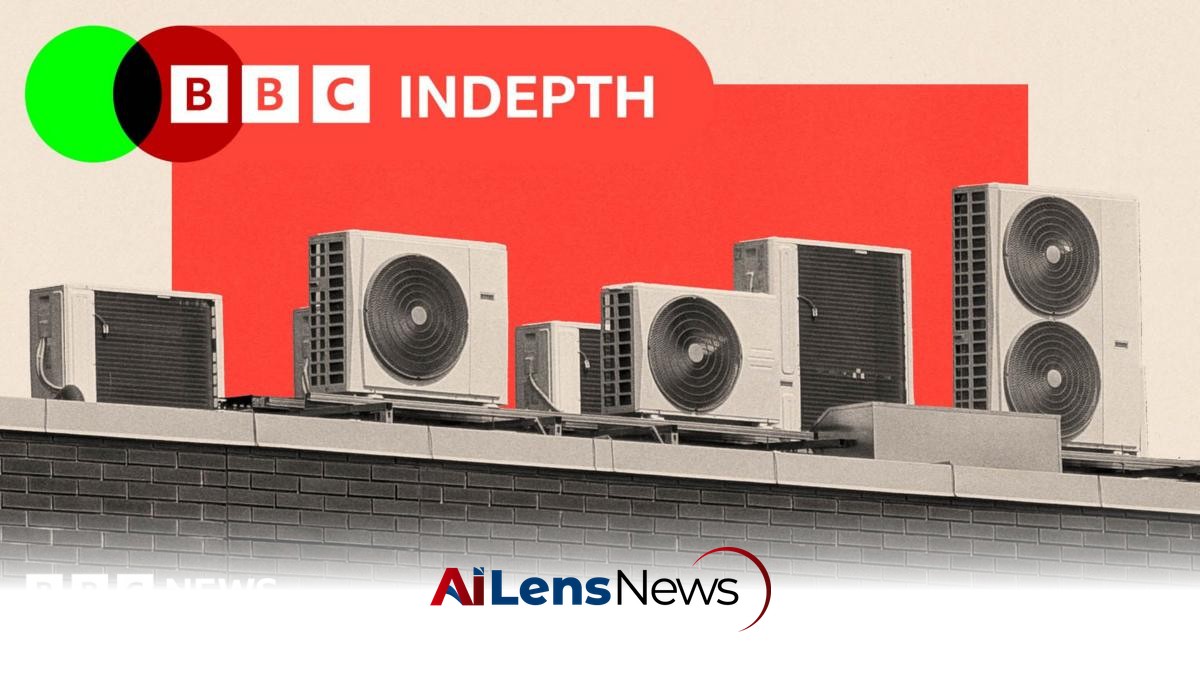


As heatwaves intensify, the UK faces critical decisions on air conditioning versus home adaptation. Should we invest in cooling solutions despite their costs?
New Delhi, India Jul 30, 2026 ALN: Mandy Bourne lives with her 80‑year‑old mum in a top‑floor social housing flat in the West Midlands. Both struggle with health conditions exacerbated by the recent heatwaves.
For Mandy, temperature shifts can trigger flare-ups of her chronic lung condition. "I've got COPD and sometimes I can't breathe," she explains.
Across the UK, solid brick homes like theirs quietly absorb heat the way they have for decades. Charged‑up walls radiate warmth back into rooms that never get the chance to cool.
Mandy says she is constantly reaching for her inhaler as her flat overheats. "It's red hot in the flat. The sun is just beaming in."
That retained warmth can push night‑time temperatures in urban centres up to 7C higher than the surrounding countryside. This is the urban heat island effect and it is at its most dangerous in the early hours when bodies need cooler air and cannot find it. Modelling of a previous West Midlands heatwave by researchers from the University of Birmingham reached the bleak conclusion that the heat island impact alone accounted for roughly half the 130 heat-related deaths.
Jo Shields, head of sustainability for Mandy's housing association Walsall Housing Group, known as whg - which owns 23,000 homes across Walsall and the Midlands - hears the same complaint time and again. "The heat gain stays within the concrete or the brick," she says, "so the night-time cooling becomes harder."
Last summer, as the region baked, the residents of Ellum Pointe - a whg scheme for the over-55s - began telling their landlords they simply could not cool their flats. The response was improvised.
"We took the community room, closed all the windows and doors, and we put a mobile air-conditioning unit in there," Shields says. "And basically, we created an internal cool room." She likens it to the warm spaces opened during the pandemic for people who couldn't afford to heat their homes.
Shields' job has previously focused on decarbonising - reducing the emissions from the housing stock - but she now has to balance those pressures with the need to adapt homes to rising heat. Across the country, landlords are facing similar choices.
As Britain enters a new kind of summer, with homes built to trap warmth and heatwaves intensifying, two questions loom: should we embrace air conditioning despite its costs and consequences, and how much should we spend on adapting homes versus cutting carbon?
For 40 years, wealthy countries have focused heavily on cutting the carbon emissions that cause climate change, known as mitigation. Adaptation such as designing housing so it is more resilient to hotter temperatures and installing air conditioning has not always had the same focus.
Reducing emissions was seen as morally right because richer nations produced most of the gases that have warmed the planet. And with that focus came a funding imbalance.
In 2023, $1.8trn was given to mitigation, whilst adaptation did not secure even 5% of that – it scraped $65bn globally.
Spending too much on adaptation was seen by many as giving up on the fight against climate change. But this mainstream view has now been challenged.
In a memo published last year, Bill Gates - a man who has poured billions into clean technology - argued that the climate movement's "doomsday" fixation on temperature targets had diverted money from the things that most improve lives in a warming world.
Climate change is serious, he wrote, but "will not lead to humanity's demise". Governments, he added, should be investing in cooling for the countries that need it.
The publication sparked backlash from climate scientists who accused Gates of making arguments based on "false dichotomies" - pitting mitigation and adaptation against each other.
Some, including US President Donald Trump, saw it as sign that the billionaire was "finally" supporting the belief that climate change was a hoax.
Gates insisted he was not arguing against cutting emissions, but rather for spending money where it saves the most suffering.
The row that followed exposed the real fault line that's coming to the surface this summer: not whether to cut carbon or adapt to the heat – but how much to spend on each.
There's another reason that muddies the waters and helps explain why cutting carbon became the prime focus – it was investable. Heat pumps and EVs can be sold. Spending on shade, ventilation and cooler hospitals and homes all produce little in the way of bankable returns - even if it reduces costs of climate change long term.
Baroness Brown - also known as the engineer Julia King, who chairs the adaptation committee of the government's Climate Change Committee - argues this imbalance is written into UK law.
Under the Climate Change Act, the mitigation half of her committee recommends legally binding carbon budgets that ministers must deliver and are marked on every year.
Adaptation has no such teeth: the government writes its own risk assessment and its own plans.
"Essentially, the government writes an essay, and our job is to say, is it doing the things it said would do in its essay. It's not actually to say, are these things any good."
Her committee has spent, she says, "almost 20 years pulling our hair out" - but this year has been different. With exquisite timing it produced a report just as the first heatwave was striking Britain in May - urging lawmakers to set hard adaptation targets.
"We've actually looked at the difference that providing some sort of support with cooling for the 30% of most vulnerable homes, and cooling in our hospitals, [with] preventive care visits. The modelling we've done suggests that that would reduce 40% of the increase in heat-related deaths that are predicted for 2050."
"We're saying these are the actions that can make a big difference."
One of the most controversial ideas in the report is on air conditioning. Right now, only 5% or so of English homes have a cooling unit. The Committee recommends fitting these devices in hospitals and care homes within 10 years, and schools in 25 years.
This goes against years of government advice that passive cooling was the preferred method - using shade, ventilation and other design features to bring down temperatures, not mechanical means.
Prof Mat Santamouris from the University of New South Wales, is the world's most-cited researcher on urban overheating.
Machines, he argues, should be the last line of defence: reflective roofing alone, in one of his studies, dragged indoor temperatures from around 43C towards 30C, while a ceiling fan gives comfort for a fraction of the cost.
Putting up unshaded glass towers in cities, he says, is "crazy". "We cannot air-condition our way out of climate change."
Santamouris is scathing about who is driving the air con demand - the industry, he says, is "extremely powerful" – adding that passive cooling adds its own economic growth, as money is spent on plumbers and builders.
Against him stand those who think Britain's hostility to cooling has curdled into a type of masochism.
David Lawrence, of the Centre for British Progress think tank, puts it plainly: we don't tell people to insulate their homes in winter and then skip the radiators. So why insist shade and shutters are enough in summer?
He points out that air conditioning is standard now in offices, hotels and shops, "but we don't expect it for schools and hospitals - which is kind of odd, because those are places where millions of people are every day", and where heat measurably dents concentration, learning and health.
This dispute over the pros and cons of the technology is becoming political.
Some London councils, following a planning "cooling hierarchy", say low‑energy ways of keeping homes cool should be prioritised over air conditioning and in a small number of cases have ordered property owners to remove them; the Conservative front bench calls it "dark ages" miserabilism; other MPs and political commentators demand an "air-con revolution".
Since April, in England and Wales the Boiler Upgrade Scheme has offered £2,500 towards a reversible air-air heat pump: a machine that warms a home in winter and cools it in summer. It is, in all but name, Britain's first air-conditioning subsidy - but it is badged as a heat pump, and only worth a third of the £7,500 for a heating-only model.
Such has been the silence around this grant, that in its first month only around 45 households claimed it. By comparison, the numbers claiming a heating-only model ran into the thousands.
In Scotland homeowners can also get a £7,500 grant for a heat pump via its Home Energy scheme - but for air-air versions that could offer cooling there is no funding at all. And in Northern Ireland there is no universal heat pump grant offered for households.
Under the terms of the England and Wales scheme, some people cannot apply at all. It is closed to social housing and newbuilds - which many argue shuts out the very people most exposed.
Take Woolwich, in south-east London, where a resident called Keisha says her top-floor flat reaches 43C in a heatwave.
She calls the building "inhumane"; she and around twenty neighbours in Canada Court and Clifton Lodge are taking their landlord, the housing association PA Housing, to court over homes they say are unfit to live in.
To learn more about the latest developments in Science & Environment, stay updated with our exclusive reports and analyses on AiLensNews.

