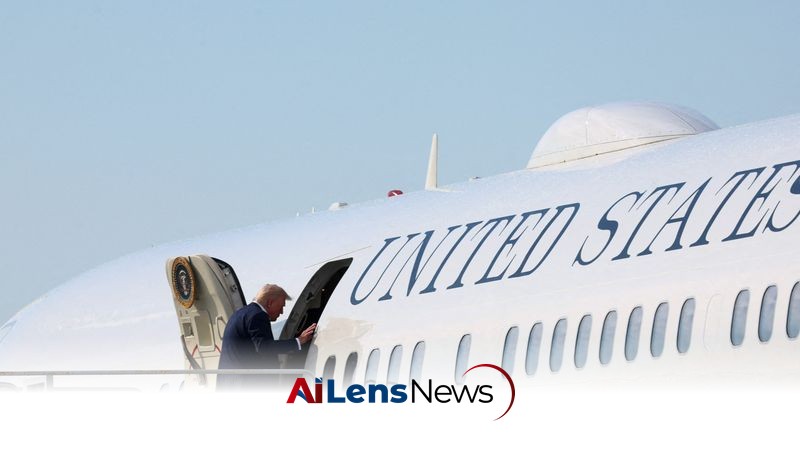


US President Donald Trump disclosed that he changed planes secretly after the NATO Summit in Turkiye due to a potential threat, as advised by the Secret Service and military.
New Delhi, India Aug 12, 2026 ALN: In a surprising revelation, US President Donald Trump has confirmed that he secretly switched planes while returning from the NATO Summit held in Turkiye last month. This decision was made in response to a potential threat against him, as advised by both the Secret Service and military officials.
The incident came to light following a report from the Washington Post, which detailed the circumstances surrounding Trump's flight. According to Trump, the switch was a precautionary measure to ensure his safety during the return journey.
Trump's acknowledgment of the plane switch highlights the heightened security measures that are often taken during international travel, particularly for high-profile leaders. The NATO Summit, attended by various world leaders, is a significant event where security concerns are paramount. The summit typically involves discussions on critical issues such as defense spending, military cooperation, and geopolitical stability, making it a focal point for both diplomatic engagement and potential threats.
While the specific nature of the threat has not been disclosed, Trump's comments suggest that the Secret Service and military are continuously assessing risks to ensure the safety of the President. The decision to switch planes is indicative of a broader security protocol that involves thorough risk assessments and contingency planning for a variety of scenarios that may arise during international travel.
In the past, there have been instances where security threats have prompted similar actions. For example, during high-profile events, leaders often have multiple layers of security, including advance teams that scout locations, secure transportation, and establish communication protocols. These measures are designed to mitigate risks and respond swiftly to any potential dangers.
The Secret Service, tasked with protecting the President, employs a range of strategies to ensure the safety of the leader during domestic and international travel. These strategies include thorough background checks on individuals who will come into contact with the President, coordination with local law enforcement agencies, and the use of specialized equipment to detect threats.
In the context of international travel, the complexity of security increases significantly. Factors such as the political climate of the host country, the presence of protests or opposition groups, and the potential for terrorism must all be taken into account. The NATO Summit, being a gathering of multiple heads of state, can also attract attention from various extremist groups, making it essential for security measures to be heightened.
Moreover, the logistics of securing a flight for the President involve numerous considerations. The aircraft used must be equipped with advanced communication systems, medical facilities, and defensive capabilities. The choice of flight paths, airports, and even the timing of departure and arrival are meticulously planned to minimize risks.
The revelation has sparked discussions regarding the security protocols in place for the President during international engagements. Critics have raised questions about the transparency of such security measures and the potential implications for diplomatic relations. Some argue that while the safety of the President is paramount, the lack of transparency can lead to speculation and concern among the public and international community.
Furthermore, this incident underscores the complexities involved in protecting a sitting president, especially in a global context where threats can emerge from various sources. The balance between ensuring security and maintaining diplomatic relations can be delicate, as excessive security measures may be perceived as a sign of distrust or hostility by the host nation.
Political analysts have pointed out that the decision to switch planes, while prudent from a safety perspective, may also reflect the current political climate in which President Trump operates. His administration has faced numerous challenges, including heightened tensions with various countries and ongoing scrutiny regarding his foreign policy decisions. Such dynamics can exacerbate security concerns, leading to more cautious approaches during international engagements.
Historically, the security of U.S. presidents has been a topic of significant concern, particularly in the wake of past assassination attempts and attacks. The assassination of President William McKinley in 1901 and the attempted assassination of President Ronald Reagan in 1981 are stark reminders of the vulnerabilities faced by leaders. As a result, the Secret Service has evolved its protocols over the years, adapting to new threats and technologies to better protect the President.
The establishment of the Secret Service in 1865 originally focused on combating currency counterfeiting, but following the assassination of President McKinley, the agency's role expanded to include the protection of the President. This evolution reflects the changing landscape of security threats and the need for a proactive approach to safeguarding national leaders.
In recent decades, the nature of threats has transformed, with the rise of global terrorism and cyber threats adding layers of complexity to the security landscape. The attacks on September 11, 2001, marked a pivotal moment in U.S. security protocols, prompting a comprehensive overhaul of protective measures for the President and other high-profile officials.
As the details surrounding the incident continue to unfold, it serves as a reminder of the challenges faced by leaders in maintaining security while engaging in international diplomacy. Trump's decision to switch planes reflects the ongoing commitment to safeguarding the President, even in seemingly routine travel situations. The implications of this incident may reverberate beyond just security concerns, influencing how future administrations approach international travel and the protocols they establish to protect the President.
In an increasingly interconnected world, the need for robust security measures will likely remain a priority for U.S. leadership, particularly as geopolitical tensions persist. The ability to navigate these challenges while fostering diplomatic relationships will be crucial for the effectiveness of U.S. foreign policy moving forward. The ongoing assessment of threats and the development of adaptive security strategies will play a vital role in ensuring the safety of national leaders and, by extension, the stability of international relations.
To learn more about the latest developments in Politics, stay updated with our exclusive reports and analyses on AiLensNews.

