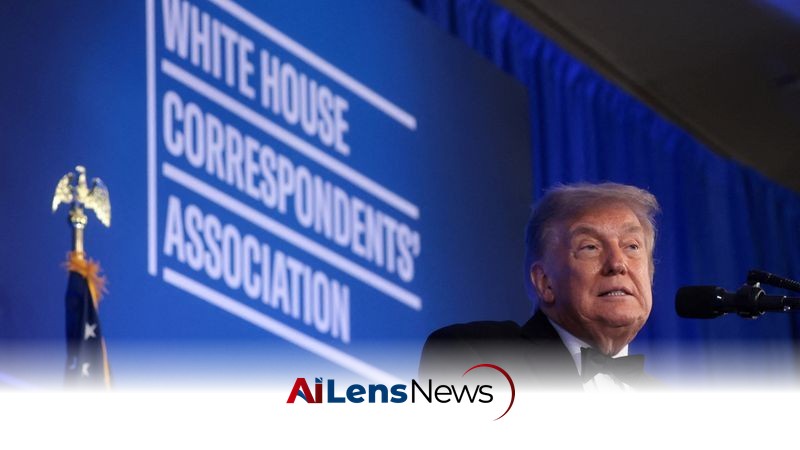


During the White House Correspondents’ Association Dinner, President Trump humorously acknowledged the challenges of the evening, referencing awards for critical journalism about his administration.
New Delhi, India Jul 26, 2026 ALN: US President Donald Trump addressed the audience at the rescheduled White House Correspondents’ Association (WHCA) Dinner on Friday, humorously remarking that it had "not been an easy evening" for him. His comments came as he acknowledged the journalism awards presented that evening, which honored coverage critical of his administration. This annual event, known for its blend of humor and serious discourse, has historically served as a platform for journalists to celebrate their work while also holding political figures accountable.
Trump's speech was marked by a blend of humor and defiance, a characteristic response he often employs when faced with critical media coverage. The WHCA Dinner, which dates back to 1921, has evolved over the decades from a simple gathering of journalists to a high-profile event attended by political leaders, celebrities, and influential figures in the media. The evening typically features a mix of light-hearted roasts, entertainment, and serious acknowledgments of the role of journalism in democracy.
In his remarks, Trump reflected on the complex relationship between the media and the presidency, acknowledging the challenges that come with critical reporting. He noted that while the evening was meant to honor journalistic achievements, it also served as a reminder of the contentious relationship he has had with the press throughout his presidency. This relationship has been characterized by frequent clashes, particularly over issues related to the accuracy of reporting, allegations of 'fake news,' and broader discussions about media bias.
The dinner, attended by journalists, politicians, and celebrities, is an annual event that highlights the importance of a free press in a democratic society. Trump's comments, while humorous, also underscore the ongoing debates about media bias and the role of journalism in politics. The press has played a crucial role in scrutinizing government actions, exposing corruption, and informing the public, which is essential for a functioning democracy. However, the perception of media bias has led to a growing mistrust among segments of the population, particularly among Trump’s supporters, who often view mainstream media as adversarial.
In recent years, the WHCA Dinner has also become a venue for discussions about the state of journalism in the digital age, where misinformation can spread rapidly through social media platforms. The challenges faced by traditional news outlets, including declining revenues and shifts in audience consumption habits, have prompted discussions about how journalism can adapt to remain relevant and trustworthy. Trump's light-hearted jabs at the critical coverage he receives reflect a broader narrative about the relationship between the media and political leaders, emphasizing the importance of accountability and transparency in governance.
The WHCA Dinner serves not only as a celebration but also as a reminder of the vital role that journalism plays in society. In an era where political polarization is rampant, the dinner offers a rare opportunity for members of the press and politicians to come together, albeit in a somewhat satirical context. The humorous exchanges and speeches are designed to lighten the mood but also to provoke thought about the serious issues at hand, including the responsibilities of the press and the accountability of those in power.
Trump's remarks at the dinner were likely intended to resonate with his base, reinforcing the narrative that he is a fighter against a biased media landscape. This approach has been a hallmark of his communication strategy, where he often positions himself as an outsider taking on established institutions. By addressing the critical coverage in a humorous fashion, he seeks to diminish its perceived impact while simultaneously rallying his supporters around a common cause: the defense of his presidency against what he characterizes as unfair treatment.
As the evening progressed, attendees enjoyed a mix of entertainment and speeches, with Trump’s remarks serving as a focal point for discussions about the current state of journalism and its impact on governance. The interplay of humor and seriousness at the WHCA Dinner exemplifies the dual role of the press as both a watchdog and a participant in the political process. The event's significance extends beyond mere entertainment; it highlights the ongoing struggle for a free and independent press in the face of challenges posed by political rhetoric and public sentiment.
In conclusion, Trump's light-hearted jabs at the critical coverage he receives reflect a broader narrative about the relationship between the media and political leaders. His comments at the WHCA Dinner underscore the importance of accountability and transparency in governance, as well as the need for journalists to continue their work in an increasingly complex media landscape. The dinner serves as a reminder of the essential role that a free press plays in a democratic society, fostering dialogue, encouraging accountability, and ultimately contributing to the public's understanding of the political landscape.
To further understand the implications of Trump's remarks and the WHCA Dinner, it is essential to consider the historical context of the event. The WHCA Dinner has traditionally been a gathering that promotes camaraderie between the press and the government, but in recent years, it has become a battleground for ideological clashes. The relationship between the media and the presidency has always been fraught with tension, but Trump's presidency has intensified this dynamic, leading to a climate where journalists often feel under attack.
Moreover, the dinner's significance extends beyond the immediate interactions among attendees. It represents a broader commentary on the state of media in America. As the nation grapples with issues of misinformation, polarization, and declining trust in institutions, events like the WHCA Dinner serve as critical reminders of the media's role in democracy. The gathering not only celebrates journalistic achievements but also emphasizes the need for a robust and independent press that can challenge power and inform the public.
In the wake of Trump's presidency, the WHCA Dinner has also prompted discussions about the future of political comedy and satire in journalism. The blending of humor with serious commentary serves as a reflection of the current political climate, where satire has become a tool for critique and social commentary. As comedians and satirists increasingly engage with political issues, the dinner provides a platform for them to showcase their work while also addressing the serious implications of their craft.
Furthermore, Trump's approach to the media—characterized by mockery and confrontational rhetoric—has influenced the way politicians interact with journalists. This shift has led to a more adversarial relationship, where press briefings and public statements are often laden with tension. The implications of this dynamic are profound, as they raise questions about the future of press freedom and the ability of journalists to hold those in power accountable.
In summary, the WHCA Dinner, through Trump's remarks and the overall atmosphere of the evening, highlights the intricate and often contentious relationship between the media and political leaders. It serves as a reminder of the importance of a free press in safeguarding democracy, while also illustrating the challenges that journalists face in an increasingly polarized environment. The dinner encapsulates the ongoing struggle for truth, accountability, and transparency in governance, emphasizing the need for a continued commitment to journalistic integrity and the vital role of the press in a democratic society.
To learn more about the latest developments in Politics, stay updated with our exclusive reports and analyses on AiLensNews.

