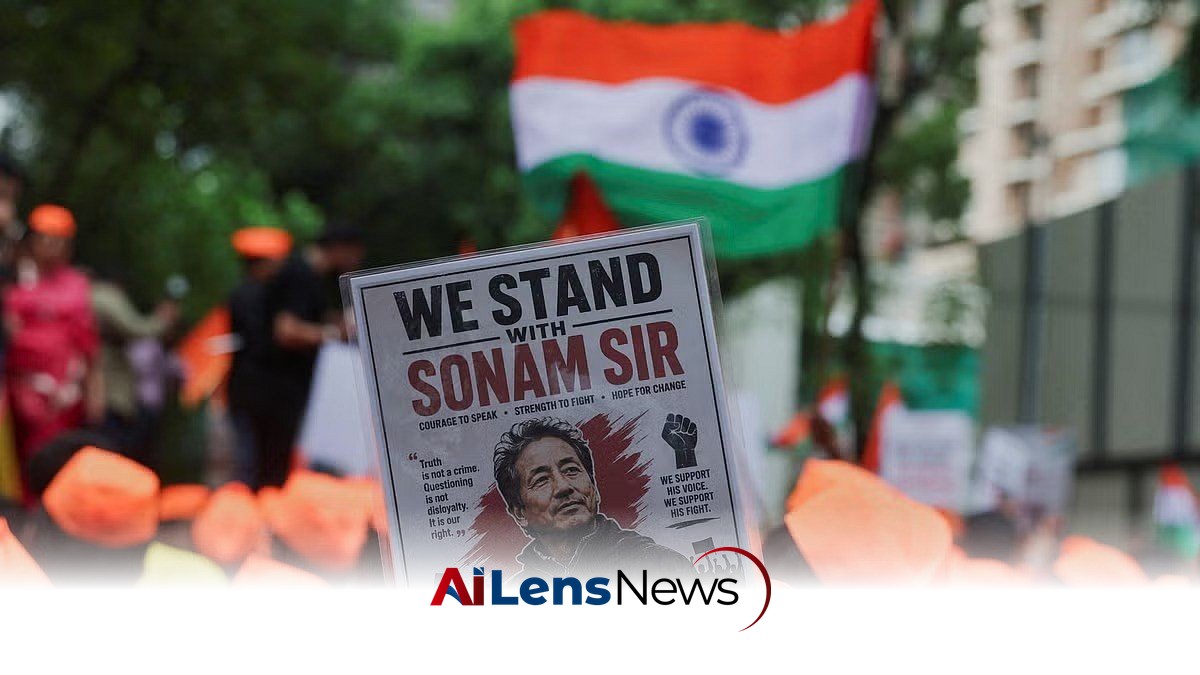


Protests in London show international solidarity for Sonam Wangchuk's movement against NEET irregularities, demanding accountability from Indian authorities.
New Delhi, India Jul 21, 2026 ALN: Guwahati: Support for environmentalist Sonam Wangchuk's movement has reached the United Kingdom, with hundreds of Indians and members of the diaspora gathering outside the Indian High Commission in central London to express solidarity with the activist and the CJP. The demonstration comes as protests continue across India and the Centre holds talks with CJP representatives over the ongoing agitation.
The protest, held on Monday evening, saw Non-Resident Indians (NRIs), students, and activists rally in support of those protesting against alleged irregularities in the NEET and the police action against demonstrators in New Delhi. NEET, or the National Eligibility cum Entrance Test, is a highly competitive examination in India that determines admission to medical colleges. In recent years, the exam has been marred by controversies, including allegations of corruption, mismanagement, and unfair practices. These issues have prompted widespread frustration among students and their families, leading to calls for reform.
Similar demonstrations were also held in Manchester, Glasgow, and Edinburgh, where protesters called for greater accountability in India's education system and demanded the resignation of Union Education Minister Dharmendra Pradhan. The protests reflect a growing discontent among students and their supporters regarding the perceived failures of the Indian government to address systemic issues within the education sector. Participants argue that the current structure not only hampers access to quality education but also perpetuates inequalities.
Addressing the gathering, Somiha Chatterjee, Secretary of the Students' Federation of India (SFI) UK, expressed solidarity with students in India who are on hunger strike and condemned what she described as continued police brutality against protesters. The hunger strikes, initiated by students and activists, are a form of civil disobedience aimed at drawing attention to their demands for justice and reform. Chatterjee's remarks highlight the solidarity felt by the diaspora, as many see the struggles faced by students in India as part of a larger fight for democratic rights and freedoms.
Among those participating was Ishita, a UNICEF employee based in London, who said she joined the protest in support of friends in Delhi. "I have friends who are students, and I'm a recent graduate myself. The idea that if you're not a student you should stay out of it is a very flawed argument," she said. Ishita's perspective underscores the shared nature of the struggle, as many in the diaspora feel a connection to the issues at hand, regardless of their current status as students or professionals.
Reflecting on the freedom to protest abroad, she added, "I'm safe here in London. I know I can return home safely after the protest. But my friends in India have put everything at risk to raise their voices." This sentiment speaks to the contrasting realities faced by those who are able to advocate from a distance and those who are on the frontlines of the protests in India. The safety of protesters abroad allows them to express their views without fear of immediate repercussions, which is not the case for their counterparts in India.
She said she hoped the demonstrations overseas would reassure protesters in India that they were not alone in their struggle. This sense of international solidarity is crucial, as it can amplify the voices of those who feel marginalized or ignored by their government. The presence of diaspora communities at these protests serves to highlight the global implications of local issues, demonstrating that the fight for justice transcends borders.
Another participant, a 23-year-old student from New Delhi who requested anonymity, said he had earlier participated in the anti-CAA-NRC protests before moving to the United Kingdom. He added that the current movement reflected a broader demand for justice and accountability in India. The anti-CAA-NRC protests, which erupted in late 2019, were sparked by the introduction of the Citizenship Amendment Act and the National Register of Citizens, both of which were criticized for being discriminatory against certain religious groups. The ongoing movements today are often viewed as an extension of that earlier struggle, as students and activists continue to demand systemic change.
The protest was jointly organized by the South Asia Solidarity Group, SFI-UK, and the India Workers' Association (GB) under the slogan, "Cockroaches of London Unite, Rise in Protest." This slogan reflects a sense of urgency and collective action, calling on individuals to unite against perceived injustices both in India and abroad. The collaboration between various organizations demonstrates a multifaceted approach to activism, as different groups come together to address shared concerns.
Gathering outside India House in central London, demonstrators demanded the resignation of Dharmendra Pradhan over the NEET controversy. They also expressed solidarity with Sonam Wangchuk and others observing a hunger strike, calling for justice, transparency, and structural reforms to India's education system. The call for Pradhan's resignation highlights the accountability that many citizens expect from their leaders, especially in light of the controversies surrounding the NEET examination.
The protest echoed with slogans such as "Inquilab Zindabad" and "Pradhan Istifa Do," as demonstrators urged the Indian Government to ensure transparency, accountability, and fairness in the conduct of public examinations. These slogans resonate with historical movements in India that have called for revolutionary change and justice, reflecting a long-standing tradition of protest in the country.
Organizers also announced that a similar demonstration will be held in Leeds on 26th July, signaling growing international support for the movement. The continuation of these protests indicates that the issues at stake are not only relevant to those in India but also resonate with the diaspora, who are increasingly vocal about the need for reform and justice in their home country. The implications of these protests extend beyond immediate demands, as they contribute to a larger discourse on democracy, rights, and accountability in India.
- Delhi Police Register Five FIRs, Investigation Alleged Conspiracy Behind Jantar Mantar Violence
In addition to the protests abroad, the situation in India remains tense as Delhi police have registered five FIRs (First Information Reports) in connection with the violence that erupted during a recent protest at Jantar Mantar, a prominent site for demonstrations in the capital. The police have launched an investigation into what they are describing as an alleged conspiracy behind the violence, suggesting that authorities are taking the situation seriously and are looking to identify those responsible for inciting unrest. The outcome of these investigations may have significant implications for the ongoing protests and the broader political landscape in India.
The juxtaposition of protests in India and abroad illustrates the interconnectedness of social movements in the age of globalization. As information flows rapidly across borders and communities become more engaged with issues affecting their homeland, the potential for solidarity and collective action grows. The actions of Sonam Wangchuk and the students protesting against the NEET controversy serve as a reminder of the power of grassroots movements and the importance of holding governments accountable to their citizens.
As the protests continue, both in India and internationally, the call for justice, transparency, and reform remains at the forefront of public discourse. The international community's response to these movements may play a crucial role in shaping the future of activism and governance in India, as well as influencing the strategies employed by both protesters and the government in the months to come.
To learn more about the latest developments in Crime & Law, stay updated with our exclusive reports and analyses on AiLensNews.

