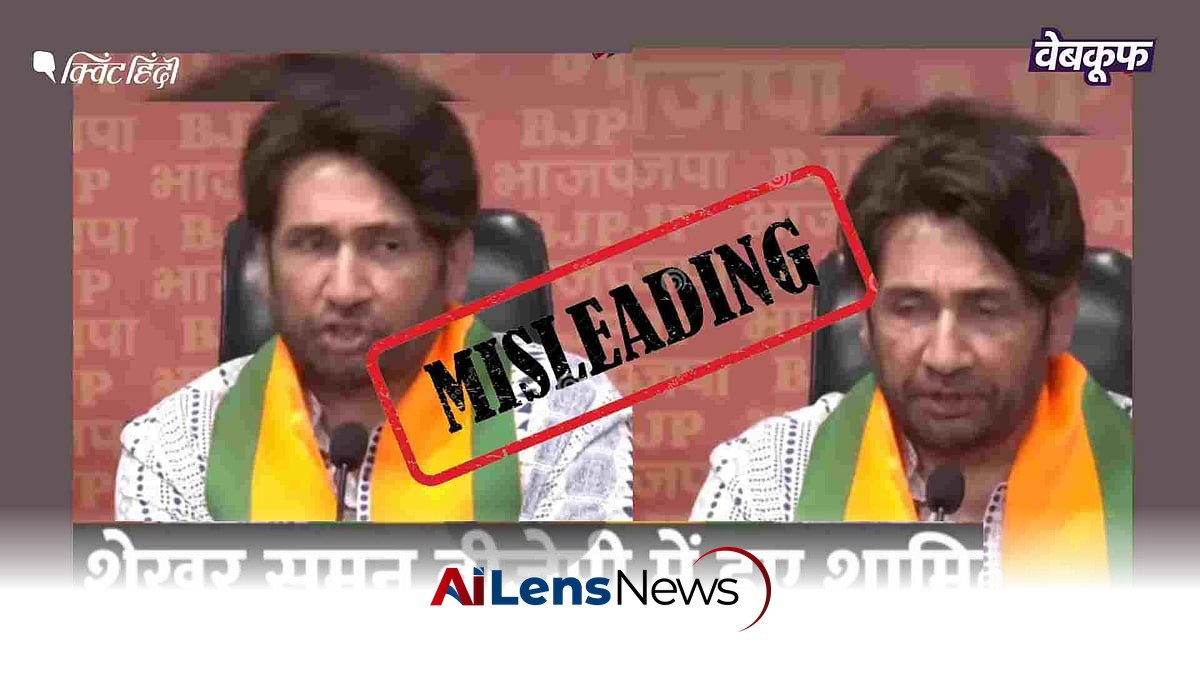


A video claiming Shekhar Suman recently joined BJP is misleading; it dates back two years without any recent affiliation.
New Delhi, India Jul 14, 2026 ALN: In the age of social media, misinformation and the rapid spread of false narratives have become increasingly prevalent. One recent example is the viral video featuring Shekhar Suman, a well-known Indian actor, comedian, and satirist, which has resurfaced on platforms like Twitter and Facebook. In this video, Suman is seen addressing a press conference at the Bharatiya Janata Party (BJP) office, where he expresses his gratitude towards several prominent BJP leaders, including Amit Shah, the former Home Minister of India. This video has been shared widely with claims that it depicts a recent event where Suman has officially joined the BJP.
Claim: The video is being circulated as a current event, suggesting that Suman has recently made a political move to join the BJP.
Is it true? Upon investigation, it has been confirmed that the video is not a recent occurrence but is, in fact, two years old. There are no credible reports or announcements regarding Shekhar Suman's recent affiliation with the BJP.
How did we find out? To verify the authenticity and age of the video, a search was conducted using Google Lens, which led to the discovery of a longer version of the video on The Tribune's official YouTube channel. This version was uploaded on May 7, 2024, thus confirming that the video is indeed two years old. Furthermore, the complete press conference was live-streamed on the official BJP YouTube channel on the same date, solidifying the timeline of the event.
The implications of such a viral misrepresentation are significant. In a democratic society, political affiliations and endorsements carry weight, influencing public perception and voter behavior. The misrepresentation of Shekhar Suman's political stance could lead to confusion among his fans and the general public, who may interpret his past expressions of gratitude towards BJP leaders as an indication of current political support. This blurring of timelines can create a false narrative that may affect public opinion and political discourse.
Shekhar Suman has had a long and varied career in the entertainment industry, known for his work in both film and television. He has also been a prominent figure in Indian comedy, often using satire to address social and political issues. Given his popularity, any association with a major political party like the BJP could have substantial implications for both his career and public perception. However, it is essential to note that he has not publicly declared any political allegiance recently, and any claims to the contrary should be viewed with skepticism.
This incident also sheds light on the broader issue of misinformation in the digital age. With the rapid dissemination of information on social media, it has become increasingly challenging for individuals to discern fact from fiction. The spread of outdated or misrepresented content can lead to a misinformed public, which is detrimental to the democratic process. The responsibility lies not only with the consumers of information to verify sources but also with platforms to ensure that misleading content is addressed and corrected.
The phenomenon of misinformation is not limited to India; it is a global issue that has been exacerbated by the rise of social media. Various studies have shown that false information spreads faster than the truth on social media platforms. This is partly due to the algorithms that prioritize engagement over accuracy, leading to sensational content being more widely shared. As a result, individuals are often exposed to misleading narratives that can shape their beliefs and opinions.
In the context of Indian politics, where public figures like Shekhar Suman hold significant sway over public opinion, the ramifications of misinformation can be particularly pronounced. Celebrities and influencers often have large followings, and their statements or perceived affiliations can influence voter behavior. This makes the accurate representation of their political positions crucial for maintaining informed public discourse.
Furthermore, the rise of deepfakes and manipulated media adds another layer of complexity to the issue of misinformation. Videos can be altered or taken out of context to create misleading narratives, making it even more challenging for the public to discern the truth. In this environment, it is essential for individuals to cultivate critical thinking skills and media literacy to navigate the complex landscape of information.
Conclusion: The video of Shekhar Suman purportedly joining the BJP is being shared out of context as if it were a recent event, while it is actually two years old. This serves as a reminder of the importance of verifying information before sharing, particularly in politically charged environments. As consumers of media, it is crucial to approach sensational claims with a critical eye and seek out credible sources to confirm the authenticity of such information.
In response to the growing concern about misinformation, various organizations and fact-checking entities have emerged to help the public navigate the complex landscape of news and information. These organizations play a vital role in promoting media literacy and encouraging individuals to question the validity of the content they encounter online. By fostering a culture of skepticism and inquiry, society can better combat the spread of misinformation and ensure that public discourse remains grounded in reality.
As we continue to navigate the digital landscape, it is essential to remain vigilant and proactive in our consumption of information. Engaging with credible sources, questioning sensational claims, and promoting discussions around media literacy can empower individuals to make informed decisions and contribute positively to the democratic process. In the end, the responsibility for ensuring accurate information lies with both the individual and the platforms that facilitate the sharing of content.
Ultimately, the Shekhar Suman video incident serves as a case study in the potential for misinformation to distort public perception and the importance of fact-checking in maintaining the integrity of political discourse. As the landscape of information continues to evolve, so too must our approaches to understanding and engaging with the world around us. The stakes are high, as the spread of misinformation can lead to polarization, distrust in institutions, and a disengaged electorate, all of which are detrimental to the health of a democracy.
In conclusion, the incident surrounding Shekhar Suman's video highlights the need for a collective effort to address the challenges posed by misinformation. It calls for individuals to be proactive in their engagement with media, to question narratives that seem sensational or outlandish, and to seek out verified information. Educational initiatives aimed at enhancing media literacy can empower citizens to navigate the digital landscape more effectively, ensuring that they are not easily swayed by false narratives. As we move forward, the importance of maintaining an informed public cannot be overstated, as it is foundational to the functioning of a healthy democracy.
To learn more about the latest developments in Politics, stay updated with our exclusive reports and analyses on AiLensNews.

