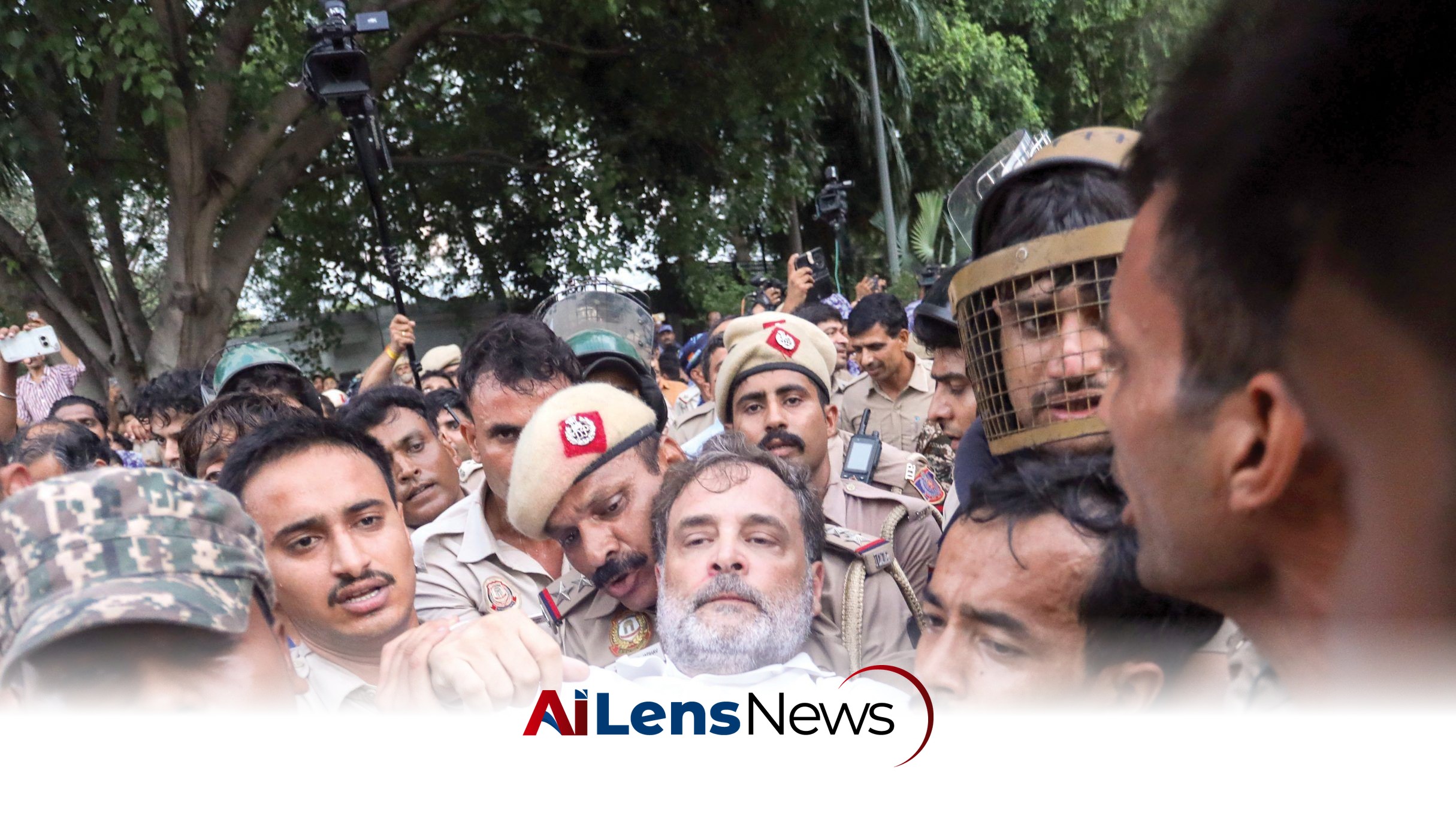


Opposition leaders, including Rahul and Priyanka Gandhi, were forcibly removed by police during a protest demanding Prime Minister Modi's resignation, leading to dramatic scenes outside his residence.
New Delhi, India Jul 22, 2026 ALN: New Delhi
In a dramatic turn of events, prominent leaders of the Indian Opposition, including Congress’ Rahul Gandhi and Priyanka Gandhi Vadra, along with Samajwadi Party’s (SP) Akhilesh Yadav, were forcibly removed by police on Tuesday after they staged a dharna outside Prime Minister Narendra Modi’s residence in New Delhi, demanding his resignation. This incident has reignited discussions about the state of democracy in India and the rights of citizens to protest against government actions.
The sit-in protest occurred in a high-security zone, a location that typically sees stringent security measures due to its proximity to the Prime Minister's residence. The unexpected gathering of opposition leaders sent the government into a tizzy, prompting immediate action from officials. Minister of State in the Prime Minister’s Office (PMO), Jitendra Singh, along with Union Home Secretary Govind Mohan, were dispatched to the scene in an attempt to persuade the opposition leaders to vacate the sensitive site. This intervention highlights the government's concern over maintaining order and control in the capital, particularly during politically charged events.
Gandhi’s discussion with the minister lasted only a few minutes, after which Singh and the Home Secretary departed, leaving the situation unresolved. Soon after their departure, police moved in to forcibly remove and detain Gandhi and other leaders. Congress officials later reported that Gandhi was taken to the Chhatrasal stadium in Model Town following his detention, a location often used for such purposes when large numbers of individuals are detained during protests.
As police descended on the protest site, Gandhi, who is the Leader of Opposition in the Lok Sabha, was seen lying on the ground in a bid to resist removal. This act of defiance drew significant media attention, with Gandhi reportedly sustaining injuries in the process. An aide of the former Congress chief stated that Gandhi suffered an injury below the eye, as well as minor injuries on his hands and legs. The physicality of the police response has raised questions about the appropriateness of such actions against political figures, particularly in a democratic context.
Later, Gandhi took to social media platform X, sharing images of the police removing him from the protest site. He expressed his determination by stating, "Modiji, try every pressure, exert all your might – this fight for justice for students will not stop now." This statement underscores the ongoing tensions between the opposition and the ruling government, particularly regarding issues affecting students and educational policies.
Amidst the chaos, dramatic scenes unfolded as Priyanka Gandhi was seen clinging to the door of a police bus even after it began to move, a poignant image that resonated with many who viewed it. Congress President Mallikarjun Kharge voiced his outrage on social media, questioning the state of democracy in India by stating, "Leader of the Opposition Shri Rahul Gandhi has been forcibly removed. What kind of democracy is this?" Kharge's comments reflect a broader sentiment among opposition leaders who feel that their rights to protest and express dissent are being increasingly curtailed by the current government.
During the encounter, Singh attempted to convey the government’s willingness to discuss the contentious issue of the National Eligibility cum Entrance Test (NEET) and related matters in Parliament. He urged Gandhi to end the protest, but the Congress leader remained steadfast in his demands, with several of his party colleagues chanting slogans calling for Modi’s resignation. This refusal to back down from the protest indicates a strategic decision by the opposition to remain visible and vocal in their dissent against government policies.
Singh later accused Gandhi of "backtracking" on his earlier demand for a debate, asserting that the Congress leader was now calling for the Prime Minister's resignation. He remarked that such behavior does not befit a leader of Gandhi’s stature, suggesting that it is unfortunate for a senior leader to deviate from established norms of democratic discourse. This accusation could be seen as an attempt to undermine Gandhi’s credibility and position within the opposition.
In his statements, Singh emphasized the government's readiness to discuss all issues related to NEET and the associated movement in Parliament. He criticized Gandhi's actions as contrary to democratic principles, indicating a growing rift between the government and opposition on how to handle dissent and political discourse.
The sit-in protest was initiated by Gandhi and other Congress leaders, including the chief ministers of Karnataka and Kerala, along with several Members of Parliament (MPs), around 3:30 PM. This action was a direct response to police actions taken against students protesting the NEET examination the previous day. The unprecedented scenes unfolded shortly after Rahul and Priyanka Gandhi visited injured students at a local hospital, signaling their solidarity with the affected youth and their families.
During the protest, Gandhi, along with Kharge, Priyanka Gandhi, Karnataka Chief Minister D K Shivakumar, and Kerala Chief Minister V D Satheesan, raised slogans against Prime Minister Modi, highlighting their collective discontent with the government’s handling of student issues. The presence of multiple state leaders at the protest reflects a united front among opposition parties, which may signal a strategic alliance against the ruling Bharatiya Janata Party (BJP).
In a symbolic gesture, the protesting leaders tied their hands together as a form of protest against what they described as restrictions on people's freedoms imposed by the BJP-led government. This act of tying hands has historically been used in protests to signify oppression and a lack of agency, further emphasizing the leaders' claims of governmental overreach and authoritarianism.
Rahul Gandhi articulated a sentiment that resonates with many families across India, stating that an attack on students is an attack on every Indian family. He accused Prime Minister Modi of believing he could evade accountability and consequences for his actions, asserting that this time would be different. Such statements are designed to galvanize public support and mobilize citizens around the issues affecting students and the education system.
In the aftermath of the protest, several MPs voiced their concerns about the Delhi Police's use of force during the removal of the opposition leaders. Among those detained were former Punjab Chief Minister Charanjit Singh Channi, Congress’ chief whip in the Lok Sabha K Suresh, and MP Sukhjinder Randhawa. The involvement of such high-profile leaders in the protest raises the stakes for the government and emphasizes the depth of opposition to its policies.
As the situation continues to unfold, the implications of this protest extend beyond the immediate demands of the opposition. It raises critical questions about the state of democracy in India, the rights of citizens to protest, and the government's approach to dissent. The events of this day may serve as a catalyst for further mobilization among opposition parties and could influence public opinion as the country approaches future elections. The ongoing discourse surrounding these events is likely to shape the political landscape in India and may have lasting effects on the relationship between the government and its citizens.
To learn more about the latest developments in Crime & Law, stay updated with our exclusive reports and analyses on AiLensNews.

