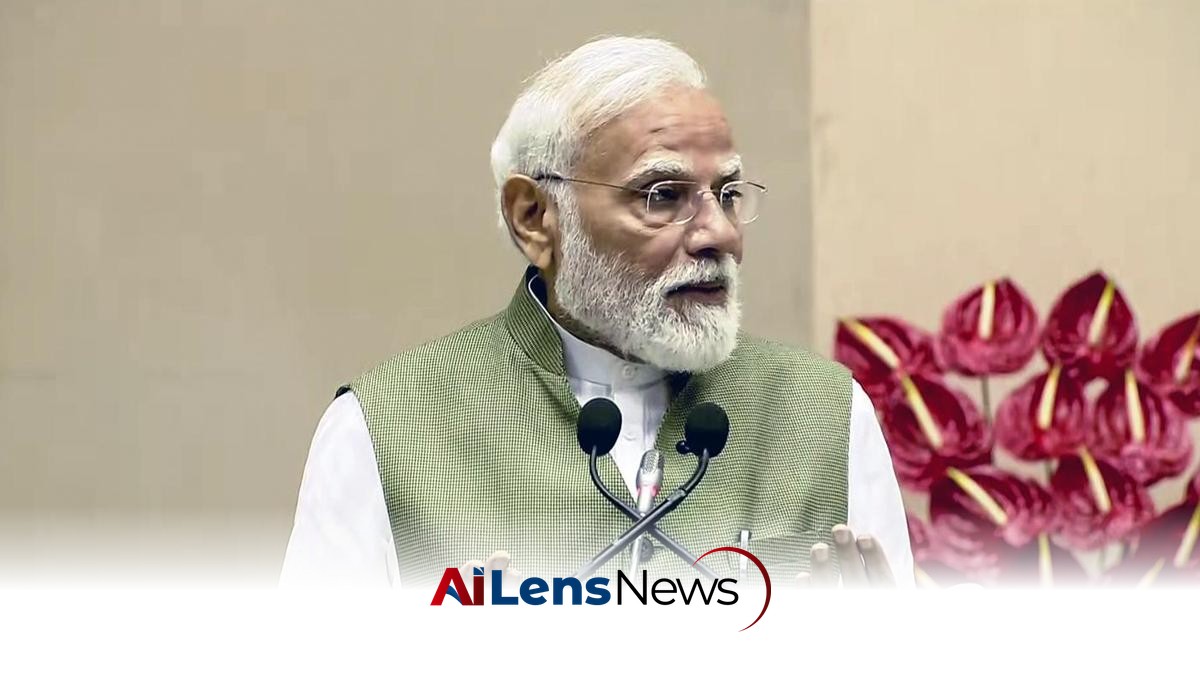


On Partition Horrors Remembrance Day, PM Modi pays tribute to victims, emphasizing resilience, while BJP blames Congress for the division of India.
New Delhi, India Aug 15, 2026 ALN: Prime Minister Narendra Modi on Friday, August 14, 2026, paid tribute to individuals and families affected by the Partition of India, a historical event that led to the division of British India into two independent dominions: India and Pakistan. This momentous occasion, which has left a lasting impact on the subcontinent, is observed annually to honor the memory of those who suffered during this tumultuous period. Modi emphasized the resilience of those who faced immense adversity, stating that they not only rebuilt their lives but also made significant contributions to the progress of the nation.
In a heartfelt message shared on social media platform X, Modi remarked, "Today we mark #PartitionHorrorsRemembranceDay. We recall the courage of all those who were impacted by Partition. It was a moment in history that tore apart several lives… families were uprooted, loved ones were lost, and immense suffering was endured." He went on to highlight the strength of the human spirit, noting how individuals transformed their hardships into achievements that benefitted the nation. Modi concluded his message by calling for a collective commitment to harmony and brotherhood, urging citizens to work towards a developed India, referred to as a 'Viksit Bharat.'
The observance of Partition Horrors Remembrance Day has sparked significant political discourse, particularly within the ruling Bharatiya Janata Party (BJP). The party's official X handle shared a visually striking AI-generated video that depicted a handshake between Jawaharlal Nehru, India's first Prime Minister, and Muhammad Ali Jinnah, the founder of Pakistan. This symbolic representation has been interpreted as a critique of the historical leadership during the Partition and the decisions that led to the division of the nation.
During an event in Gurugram, BJP president Nitin Nabin highlighted the staggering figures associated with the Partition, noting that over 1.5 crore families were displaced and more than 30 lakh individuals lost their lives as a result of communal violence and chaos. He attributed the blame for this historical tragedy to the Congress party and the Nehru-Gandhi family, stating that those who sought political power during that era secured their own futures at the expense of millions of Indians who desired freedom and stability.
Nabin articulated his views, saying, "Those who had dreamed of political power for themselves attained power, but millions of Indians who had dreamed of freedom were forced to witness a bloody chapter. Those who, in one way or another, advanced the transfer of power believing that they saw an opportunity and their future in Partition, secured their own future while putting the future of millions of Indians at stake." His remarks reflect a broader narrative within the BJP that seeks to hold the Congress accountable for the events surrounding the Partition.
Delving into the historical context, Nabin referenced the tragic events that unfolded on August 16, 1946, known as 'Direct Action Day,' which marked the beginning of widespread communal violence in Kolkata and subsequently across the country. This day is often cited as a pivotal moment in the lead-up to Partition, leading to a significant loss of life and deepening communal divides. The BJP president characterized this period as a "bloody chapter" in Indian history that was marked by violence and suffering.
In his address, Nabin praised Prime Minister Modi's observance of Partition Horrors Remembrance Day as an effort to educate the younger generations about the past and to ensure that the lessons learned from history are not forgotten. He accused previous leaders of attempting to downplay or obscure the darker aspects of this historical period to protect their own legacies. According to Nabin, "Those who divided the country solely for political power have still not changed their mindset; they divided the country then and are working to divide society today, with no change in their methods or policies." He further alleged that the Congress party had never publicly apologized to the families who suffered during the Partition, suggesting a lack of accountability for past actions.
In a pointed critique, Nabin asserted that the Congress party, which played a significant role in India's struggle for independence, could not have laid the groundwork for the Partition. He claimed that the actions of a few individuals led to the division of the country, effectively burying the Congress party of that time. This perspective aligns with a larger BJP narrative that seeks to frame the Congress party as complicit in the historical injustices of Partition.
Nabin further emphasized that the individuals who viewed the situation solely through the lens of political power imposed restrictions and failed to recognize the spirit of service demonstrated by organizations such as the Rashtriya Swayamsevak Sangh (RSS) during that tumultuous period. He accused Congress leaders of hypocrisy, suggesting that those responsible for the horrors of Partition were now attempting to portray themselves as advocates for unity while simultaneously welcoming elements that he claimed sought to undermine the integrity of India.
In a specific attack on Congress leader Rahul Gandhi, Nabin expressed concern over the language used by Gandhi in his public addresses, stating, "the world is watching the insulting words he uses against the head of the country, even as India’s diplomacy and foreign policy strengthen its global position." This remark reflects the ongoing political rivalry between the BJP and Congress, with both parties vying for public support and attempting to shape the narrative around India's historical and contemporary challenges.
The observance of Partition Horrors Remembrance Day serves as a reminder of the complex and often painful history of India. It highlights the need for reflection on the past while also addressing the current socio-political landscape. Modi's tribute, along with the BJP's political messaging, underscores the ongoing relevance of Partition in contemporary discourse, particularly as India navigates its identity and unity in a diverse society.
As the nation reflects on the legacies of Partition, it is crucial to recognize the multifaceted narratives that exist and the importance of fostering dialogue and understanding among different communities. The events of 1947 continue to resonate, shaping not only the historical consciousness of the nation but also its present and future trajectories.
To learn more about the latest developments in Politics, stay updated with our exclusive reports and analyses on AiLensNews.

