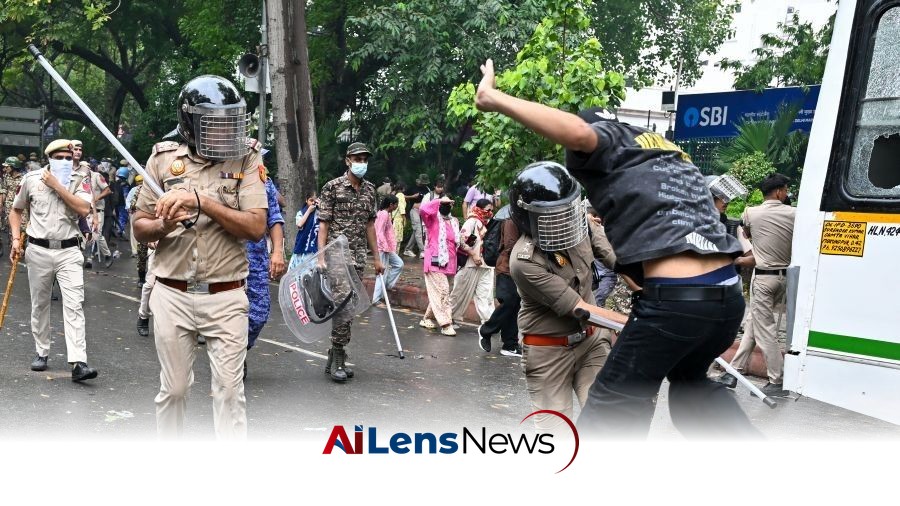


The Samajwadi Party and Congress criticize the BJP-led government for police brutality against NEET protesters, likening actions to Hitler and the Jallianwala Bagh massacre.
Kohima, India Jul 21, 2026 ALN: The ongoing protests surrounding the National Eligibility cum Entrance Test (NEET) paper leak have escalated tensions between opposition parties and the ruling Bharatiya Janata Party (BJP)-led National Democratic Alliance (NDA). On the second day of the Monsoon Session of Parliament, the Samajwadi Party (SP) and the Congress party vehemently criticized the government, questioning its accountability and handling of the situation. The protests, which have seen demonstrators marching towards Parliament demanding the resignation of Union Education Minister Dharmendra Pradhan, have been marked by allegations of excessive police violence.
The protests were organized by the Cockroach Janta Party (CJP), a group representing students and their grievances, particularly focusing on the May 3 NEET paper leak. This incident has raised serious concerns about the integrity of the examination process in India, leading to widespread calls for reform and accountability within the education system.
In the context of these protests, Samajwadi Party MP Akhilesh Yadav expressed his outrage over the police's response to the demonstrators. He stated, "Since Independence, no one could have imagined such kind of a behaviour by an elected government. People got injured on their heads and had to receive stitches, even got inflicted with fractures and tear gas was also used." His remarks underscore a growing frustration among opposition leaders regarding the treatment of peaceful protesters and the perceived authoritarianism of the current government.
Yadav’s comments included a shocking comparison, linking the police actions to the historical atrocities committed by Adolf Hitler. He stated, "Hitler used to carry out such things, and now we are witnessing it under the BJP-led regime. It is unacceptable in a democracy." This comparison reflects a deep concern about civil liberties and human rights in India, especially in the wake of increasing reports of police brutality during peaceful protests.
Congress MP Jebi Mather also drew historical parallels, likening the police violence to the infamous Jallianwala Bagh massacre of 1919. She articulated, "In 1919, the Jallianwala Bagh massacre happened, where the British tried to suppress the voices of Indians through bullets. The British left, but their methods continue to this day. Our students came out for a peaceful protest, but in 2026, at Jantar Mantar, they faced barricades, lathi charges, and tear gas. This is not how it should happen. Students should not be afraid to raise their voices, speak, or ask questions. They have the right to ask questions." Mather’s remarks highlight the historical context of student protests in India and emphasize the importance of protecting the rights of citizens to express dissent.
Another Congress MP, Karti Chidambaram, raised serious questions regarding the government's accountability in overseeing the NEET-UG examination process. He remarked, "It is the nation’s responsibility to run a robust, efficient, and honest examination system. But the examination system does not seem to be honest, which is why we are seeing consistent paper leaks. The government is not fixing accountability on anyone. The Minister, Secretary, and the National Testing Agency (NTA)—no one is being held responsible. You cannot run military-style operations every time an examination is conducted." Chidambaram's comments point to a systemic issue within the examination framework that has led to repeated failures and student distress, further fueling the protests.
Deepender Hooda, another Congress MP, commented on the broader implications of the government's approach to youth engagement, stating that the patience and restraint of the country’s youth have now "broken." He criticized the government for failing to engage constructively with the youth, stating, "The government should have taken the youth into confidence, but it did not. The brutality shown by the Delhi Police yesterday cannot be condemned enough. The Delhi Police Commissioner must answer on whose orders such an extent of lathi-charge and tear gas were unleashed." This sentiment reflects a growing discontent among young people in India, who feel increasingly marginalized and unheard by their government.
Congress MP K.C. Venugopal also held the BJP-led Centre responsible for the police actions against the protesters. He questioned, "How many students are in the hospital now? What crime have they committed? Only peaceful protest, is that also not allowed in this country?" His remarks resonate with a broader concern regarding the right to protest in India, especially in light of recent events where peaceful demonstrations have been met with aggressive police responses.
Praniti Shinde, another Congress MP, called the police action against students "unacceptable." She emphasized the importance of recognizing the students as citizens of the country, stating, "The students were saying that they were peaceful protesters. These are people from our own country; they are not outsiders. If you treat the people of your own country in this manner, do you really have the right to remain in power?" This statement encapsulates the notion that the government has a responsibility to protect its citizens, particularly those who are exercising their democratic rights.
In a related development, Congress MP Pawan Khera accused ruling coalition MPs of obstructing the Leader of the Opposition in the Rajya Sabha, Mallikarjun Kharge, from addressing the issue of violence against the youth in the House. Khera stated, "Kharge 'sahab' was raising the issue of yesterday's violence. Our demand is that the Home Minister (Amit Shah) should address both Houses regarding the brutal action on the youths by Delhi Police." This incident reflects the ongoing tensions within Parliament and the challenges faced by opposition parties in raising critical issues affecting the populace.
The NEET paper leak incident and the subsequent protests have not only sparked outrage among students and opposition parties but have also raised significant questions about the integrity of the examination system in India. The implications of these protests extend beyond immediate concerns about police violence; they touch upon broader issues of governance, accountability, and the state of democracy in India. As the situation unfolds, it remains to be seen how the government will respond to these challenges and whether it will take meaningful steps to address the concerns raised by students and opposition leaders alike.
In conclusion, the events surrounding the NEET protests serve as a potent reminder of the ongoing struggles for civil rights and democratic freedoms in India. The historical parallels drawn by opposition leaders highlight the critical need for the government to engage constructively with its citizens, especially the youth, who are increasingly vocal about their rights and expectations. As the Monsoon Session of Parliament continues, the focus will remain on how these issues are addressed and whether the government will take accountability for its actions in the face of growing dissent.
To learn more about the latest developments in Crime & Law, stay updated with our exclusive reports and analyses on AiLensNews.

