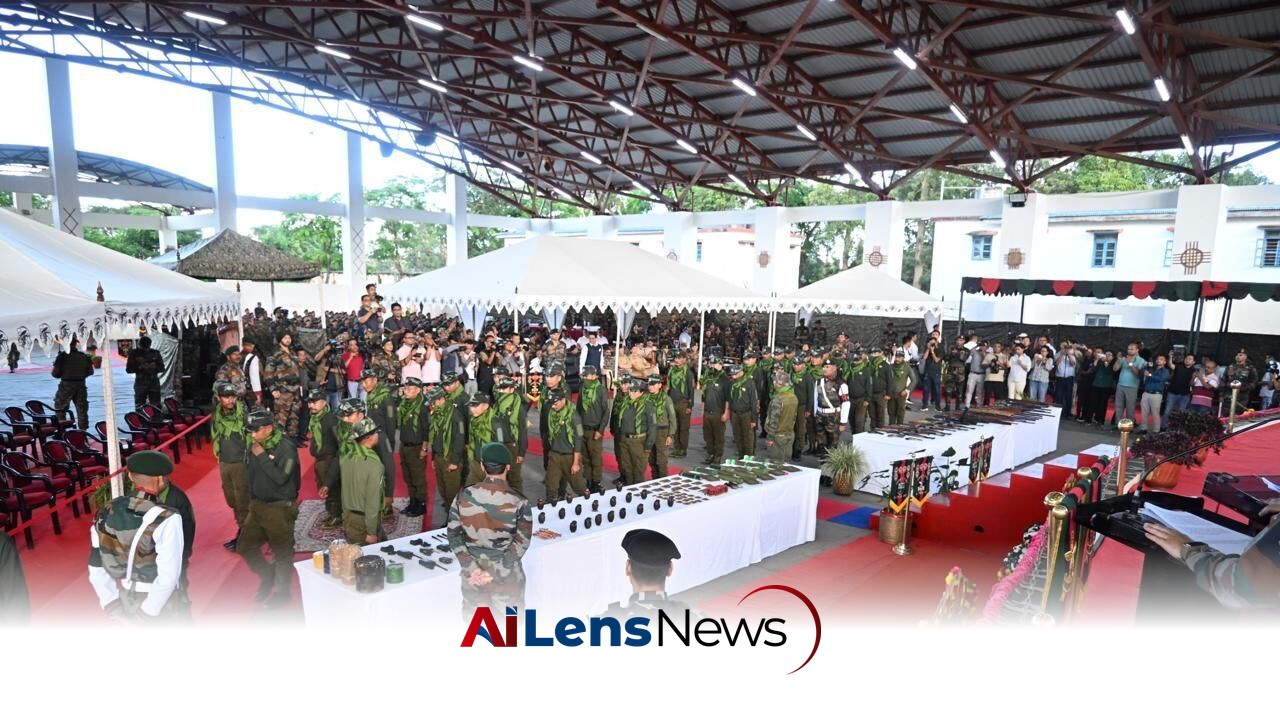


In a significant move towards peace, 46 cadres of the Kangleipak Communist Party (People's War Group) surrendered, handing over 28 firearms and seeking rehabilitation.
Shillong, India Jul 21, 2026 ALN: Cadres cited years of hardship and disillusionment, choosing peace over militancy to rebuild lives through skill development programmes.
In one of the largest mass surrenders by the proscribed Kangleipak Communist Party (People's War Group), KCP (PWG), in recent years, 46 active cadres, including four women, laid down arms on Tuesday at a "homecoming ceremony" held at the Mantripukhri Garrison, in Imphal East district. This event marks a significant moment in the ongoing efforts to bring peace to the region, as it reflects a broader trend of disillusionment with militant activities among youth in the area.
The surrendered militants handed over a substantial cache of arms and explosives, including 28 firearms, among them three AK-series rifles, four AK-56 rifles, an INSAS Ex-Calibur rifle, a Self Loading Rifle (SLR), a 9 mm carbine, three .303 rifles, a Rocket Propelled Grenade (RPG) launcher, three pistols and 11 country-made guns. The sheer volume of arms surrendered underscores the seriousness of the situation and the potential for further violence if such groups continue to operate unchecked.
In addition to the firearms, security forces recovered 16 magazines, nine RPG shells, 23 hand grenades, seven Improvised Explosive Devices (IEDs) weighing around 15 kg, detonators, communication devices and 342 rounds of ammunition. This cache not only highlights the military capabilities of the KCP (PWG) but also raises concerns about the security environment in Manipur, where such weapons could have been used to perpetuate violence and unrest.
Officials described the surrender as unprecedented for the outfit, noting that previous surrender events typically involved only five to 12 cadres. This larger-than-usual surrender indicates a possible shift in the dynamics of militancy in Manipur, where the socio-political landscape has been complicated by ethnic tensions and violence. The KCP (PWG) has been active for several decades, advocating for the rights and autonomy of the Manipuri people, but the recent years have seen a decline in public support for armed struggle.
Representing the surrendered cadres, the outfit's chairman, Laishram Ranjit Meitei, said years of hardship and growing disillusionment with armed struggle had prompted the decision to return to the mainstream. "Our cadres had become deeply frustrated and faced numerous hardships. We decided to return in the interest of peace and for the welfare of our society and community. We hope the government will support us with vocational training, machinery and financial assistance for self-employment," he said. This statement reflects a significant ideological shift, as former militants are now prioritizing community welfare over armed conflict.
Chief Minister Yumnam Khemchand Singh, Home Minister Govindas Konthoujam, senior Army and Assam Rifles officers, top civil and police officials, and representatives of various security agencies attended the ceremony. Their presence underscores the importance of this event in the broader context of state governance and security policy in Manipur. Addressing the gathering, the Chief Minister emphasized that the return of the cadres marked an important step towards restoring peace in Manipur, which has witnessed prolonged ethnic violence since May 2023.
"Guns and violence can never bring development. Today's homecoming is a significant step towards restoring lasting peace and strengthening the reconciliation process in the state," Singh said. His remarks highlight the government's stance on the futility of violence as a means to achieve political or social objectives, advocating instead for dialogue and rehabilitation.
Highlighting the rehabilitation measures available to the surrendered militants, Home Minister Konthoujam explained that the Centre's surrender and rehabilitation policy aims to help former insurgents reintegrate into society through financial assistance and skill development. The policy is designed to address the root causes of militancy, such as unemployment and lack of opportunities, which often drive individuals towards armed groups.
"Each surrendered cadre will receive Rs 4 lakh, which will remain in a fixed deposit for three years. This is not a loan but a rehabilitation grant. While the government cannot promise employment, we will extend support for self-employment and skill development so that they can begin a new life," he said. This financial assistance is critical for the reintegration process, as it provides former militants with the resources needed to start anew and contribute positively to their communities.
Under the Revised Scheme for Surrender-cum-Rehabilitation of Militants in the North East States, 2018, each surrendered cadre will receive a one-time rehabilitation grant of Rs 4 lakh, which will remain in a fixed deposit for three years, along with a monthly stipend of Rs 6,000 during the rehabilitation period. This structured support system is aimed at ensuring that former militants do not revert to violence out of desperation or economic necessity.
The People's War Group emerged as a splinter faction of the KCP following ideological differences within the parent organisation. This division highlights the complexities within the militant landscape in Manipur, where differing ideologies and strategies often lead to fragmentation and conflict. The existence of multiple factions complicates efforts to achieve peace, as each group may have its own objectives and methods of operation.
In recent years, the state of Manipur has been grappling with a resurgence of ethnic violence, particularly between the Meitei and Kuki communities, which has exacerbated existing tensions and led to a cycle of retaliatory violence. The mass surrender of KCP (PWG) cadres could be seen as a potential turning point in this ongoing crisis. By choosing to abandon armed struggle, these former militants may inspire others to reconsider their paths and seek peaceful avenues for addressing grievances.
The implications of this mass surrender extend beyond the immediate security concerns in Manipur. It may signal a shift in public sentiment towards militancy, as more individuals recognize the futility of violence in achieving social and political goals. Furthermore, the successful reintegration of these former militants could serve as a model for future rehabilitation efforts across the region, where similar challenges persist.
As the government moves forward with its rehabilitation plans, it will be crucial to monitor the outcomes of these initiatives. The success of this program will depend on the government's ability to provide meaningful support that addresses the underlying issues that drive militancy, such as poverty, lack of education, and limited economic opportunities. Ensuring that these former militants can successfully reintegrate into society will not only contribute to peace in Manipur but could also set a precedent for addressing similar challenges in other conflict-affected areas across India.
In conclusion, the historic surrender of 46 KCP (PWG) cadres is a significant development in the ongoing quest for peace in Manipur. It reflects a growing disillusionment with armed struggle and a desire among former militants to contribute positively to their communities. The government's response, including financial assistance and skill development programs, will be critical in determining the long-term success of this initiative and the overall stability of the region.
To learn more about the latest developments in Crime & Law, stay updated with our exclusive reports and analyses on AiLensNews.

