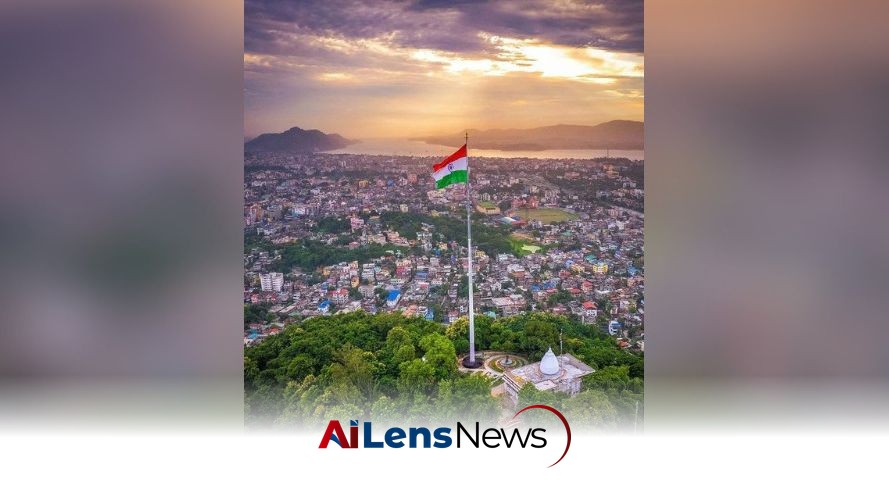


Residents of Guwahati question the prolonged half-mast status of the National Flag atop Sarania Hills, while GMDA cites weather-related damages as the cause.
Shillong, India Jul 26, 2026 ALN: The 319.5-foot high Indian National Flag atop Sarania Hills has remained at half-mast for the past few days, drawing the attention of residents across the city. This situation has raised concerns among the public regarding the appropriate display of the National Flag, a symbol of national pride and identity.
Several residents who spoke to local media questioned why the National Flag has been left in such a state. The half-mast position of a flag is traditionally associated with mourning, leading many to wonder if there has been a significant loss that warranted such a display. Kaustabhi Nath, a resident of Dispur, voiced her concerns regarding the flag's maintenance. The flag was installed to commemorate the 150th birth anniversary of Mahatma Gandhi, a pivotal figure in India's history and independence movement.
“I have been noticing this for the past two or three days and kept wondering whether some important personality had passed away. A flag is not supposed to fly at half-mast unless it is being lowered as a mark of mourning,” she stated, articulating the confusion and concern among the local populace. Nath emphasized that a symbol of the nation's independence and democracy should not be managed based on circumstances, as it reflects the country’s pride and dignity.
Another resident, Rantu Seel, shared similar sentiments, noting that the sight of the half-mast flag carries a particular emotional weight. “It is the first thing I look at every morning, and when I see it at half-mast, my heart feels heavy because I associate it with the loss of someone important,” he explained. Seel's remarks highlight the deep emotional connection that many citizens have with the National Flag, which goes beyond its physical presence. The flag is not merely a piece of fabric; it is a representation of the sacrifices made for the country's freedom and the values it stands for.
“If there is a maintenance issue, leaving the flag at half-mast should not be the first solution. A half-mast flag has a specific meaning, and that should be kept in mind,” he added, underscoring the importance of adhering to the protocols surrounding the National Flag. The emotional and symbolic significance of the flag is intertwined with the collective national identity, making its proper display a matter of public interest.
When contacted, officials of the Guwahati Metropolitan Development Authority (GMDA) provided an explanation for the flag's current state. They cited strong winds as the primary reason for their inability to fully hoist the flag. The weather conditions have reportedly caused the flag to suffer tears, necessitating repairs. “Each repair costs us around Rs 3,000, and the flag has been torn several times over the past few weeks,” a GMDA official stated, indicating the logistical challenges involved in maintaining such a large flag in adverse weather conditions.
The official further elaborated on the financial implications of the flag's maintenance, revealing that the flag itself cost more than Rs 1 lakh. This figure underscores the investment made in the symbol of national pride, and the authorities expressed an understanding of the flag's value and significance. They noted that if the flag were to be fully hoisted under the current weather conditions, it could sustain extensive damage, which would only exacerbate the situation.
“The flag is expected to be fully hoisted within three to four days after the strong winds subside,” the official added, providing a timeline for when residents might expect to see the flag restored to its proper position. This timeline offers some reassurance to the public, but it also highlights the ongoing challenges faced by authorities in maintaining national symbols amid changing weather conditions.
It is important to note that the display of the National Flag is governed by specific rules and regulations. In the landmark case of Union of India v. Naveen Jindal (2004), the Supreme Court of India held that flying the National Flag with respect and dignity is an expression of a citizen’s fundamental right under Article 19(1)(a) of the Constitution, which guarantees the right to freedom of speech and expression. However, this right is subject to the provisions of the Flag Code of India and other applicable laws, which outline the proper usage and display of the flag.
The Flag Code of India stipulates that the National Flag may be flown at half-mast only as a mark of State mourning on the death of specified dignitaries. This provision is designed to ensure that the flag is treated with the respect it deserves, and any deviation from these guidelines can lead to public confusion and concern, as seen in Guwahati.
As the flag remains at half-mast, the juxtaposition of the official explanation and the public's perception raises important questions about the management of national symbols. While the GMDA has provided a rationale for the flag's condition, the emotional and cultural significance of the National Flag cannot be overlooked. It serves as a reminder of the sacrifices made for freedom and the values that bind the nation together.
The emotional weight of the flag is not just a personal sentiment; it connects to a broader historical context. The Indian National Flag, adopted in its current form on July 22, 1947, symbolizes the struggle for independence and the unity of the diverse Indian populace. The flag's tricolor design represents the saffron for courage and sacrifice, white for peace and truth, and green for faith and chivalry. Each color is imbued with meaning, and the flag itself is a testament to the values that the nation aspires to uphold.
Moreover, the significance of the flag extends to various cultural practices and rituals associated with it. For instance, the flag is prominently displayed during national holidays, such as Independence Day and Republic Day, serving as a focal point for celebrations and ceremonies that evoke national pride. The emotional connection many citizens feel towards the flag is therefore not just a matter of personal sentiment but is tied to the collective memory of the nation’s history and achievements.
In light of this, the current situation in Guwahati serves as a reminder of the need for sensitivity in managing national symbols. The flag is not merely a decorative element; it is a living symbol of the nation’s ethos. As such, its display should be handled with care and respect, ensuring that it reflects the dignity of the nation and resonates with the citizens’ sentiments.
In conclusion, the situation in Guwahati serves as a poignant example of the complexities surrounding the display of national symbols. As residents await the return of the flag to its full height, it is essential for authorities to consider the emotional weight that such symbols carry for the public. The flag stands not only as a representation of the nation’s sovereignty but also as a source of pride and unity for its citizens. Ensuring its proper display is a responsibility that reflects the values of the nation and honors the legacy of those who fought for its freedom. The need for clear communication from authorities regarding the flag’s status, as well as proactive measures for its maintenance, will be crucial in preventing further misunderstandings and ensuring that the flag continues to be a source of pride for all citizens.
To learn more about the latest developments in Crime & Law, stay updated with our exclusive reports and analyses on AiLensNews.

