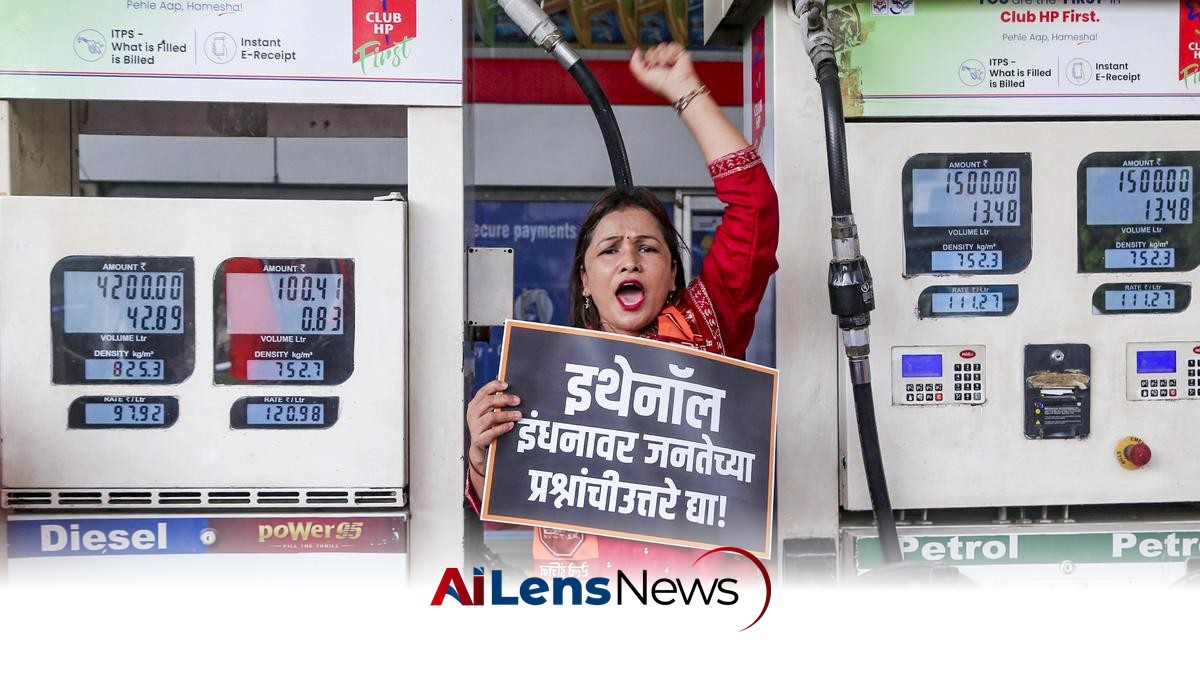


At a recent rally in Mumbai, participants celebrated a political victory while voicing concerns over E20 fuel, calling for action against Union Minister Gadkari.
Mumbai, India Jul 27, 2026 ALN: On a rainy Sunday morning (July 26, 2026), Shubham Shyam, 32, held a dafali (traditional hand drum) and stood outside Mumbai’s iconic Shivaji Park, celebrating the resignation of Union Minister Dharmendra Pradhan. “It is time to rest, reset, and then take down Union Transport Minister Nitin Gadkari,” he declared. This rally was not just a celebration of political change; it was a manifestation of growing discontent regarding the government's recent policies, particularly the implementation of E20 fuel, a blend of 20% ethanol with traditional petrol.
The E20 fuel initiative was introduced by the Indian government as part of its broader strategy to reduce dependence on fossil fuels and promote renewable energy sources. However, this policy has faced significant backlash from various segments of society, particularly among vehicle owners and environmental activists. Critics argue that E20 fuel can damage internal combustion engines not designed for it, leading to increased maintenance costs and potentially dangerous situations on the roads. Furthermore, the economic implications are significant; many consumers claim that while E20 is marketed as a cheaper alternative, the reality is that it often leads to reduced fuel efficiency, thereby negating any perceived cost benefits.
“We will party for two weeks, then we will play the sugarcane game,” Mr. Shyam added, hinting at the criticism faced by Mr. Gadkari over the implementation of E20. Mr. Shyam’s thoughts were echoed by other protesters. Aarsh, 25, a content writer, and Rohan, 19, a B. Tech. student, both said, “E20 kills vehicles and people’s pockets.” Rohan elaborated, “Since 10th grade, I have seen fuel prices skyrocket, and now vehicle mileage is poor, and pure petrol is expensive. Why give us a cheaper E20 option? Make petrol cheaper.” This sentiment reflects a broader frustration among the youth regarding the rising cost of living and the perceived inadequacy of government responses to their economic struggles.
The rally was called by Shiv Sena (UBT) chief Uddhav Thackeray and Maharashtra Navnirman Sena (MNS) chief Raj Thackeray, who have both been vocal critics of the central government's policies. Thousands of Gen Z and millennials gathered at the rally to celebrate the success of the protest spearheaded by the Cockroach Janta Party (CJP), raising slogans such as “Our right, keep it here,” “Bharat Mata Ki Jai,” “This country is ours, and we belong to this country,” and calling for the resignations of Mr. Gadkari and Union Finance Minister Nirmala Sitharaman. The presence of such a large and diverse group of young people indicates a significant shift in political engagement among the youth, who are increasingly willing to voice their opinions on issues that matter to them.
Mr. Uddhav Thackeray advised Prime Minister Narendra Modi to pay attention to the country, instead of engaging BJP Ministers and MPs to engineer defections. “India has come together; caste, religion and every other divide is vanishing. It is no more BJP versus the Opposition, but BJP versus the country,” said Mr. Thackeray while addressing the protesters. This statement underscores a growing sentiment among many that the current political climate is more about unity against a common issue rather than traditional political allegiances. The call for unity across different demographics reflects a desire for collective action in the face of perceived governmental overreach.
He appealed to the youth to keep the spark of resistance alive, saying, “Identify the blind devotees, record videos, and post them.” This call to action highlights the role of social media in modern protests, where the documentation and sharing of dissent can amplify voices and mobilize support. Mr. Raj Thackeray expressed his gratitude to Mumbai and the Maharashtra Police, saying, “You are not like the Delhi Police. This is your victory.” His remark points to the often-criticized handling of protests in other parts of the country, contrasting it with what he perceives as a more supportive environment in Maharashtra.
Standing next to the row of yellow barricades, animator Mansi Worlikar, 26, and her friends were clutching a placard, taking a dig at Mr. Modi, who in a recent Instagram video had called the youth his “friends.” Ms. Worlikar said, “The victory feels personal, because we fought an impossible mountain and made the crack.” This metaphor of a mountain symbolizes the long-standing challenges and barriers faced by the youth in expressing their political opinions and effecting change. For her friend, entertainment writer Urvashi More, 27, it was an eye-opener that she could have a political opinion and even voice it. “Something in me has moved; I now know that my political opinion matters,” said Ms. More. This awakening among the youth signifies a potential shift in the political landscape, where young people are beginning to see themselves as active participants rather than passive observers.
Tushar Gandhi, great-grandson of Mahatma Gandhi, also joined the victory party and said that the youth of the country have chosen their path. “However, the challenge is to make every issue a mass issue and not allow the government to confine it to a particular community, caste, or economic group,” he added. His comments reflect a broader concern about the fragmentation of political movements and the need for solidarity among various groups to address systemic issues effectively.
The party atmosphere appeared complete with Bluetooth speakers belting out popular Hindi songs and the Gen Z swaying to the music. In one such group stood Tarini (23), who said, “We are not saying the system has changed, but it is a hope for change. Showing up does matter.” This statement captures the essence of grassroots activism, where participation, even in the form of a rally, can be a powerful statement against the status quo. For Anam Khan (21), a teacher from Sion, the protest felt like a lesson on humanity. “I never felt this equal with Sikhs, Jains, or any other community. We have seen instances where we were about to get detained and ran holding each other’s hands without thinking whether the other person was or Muslim. That is the beauty I saw here.” This experience of unity among diverse groups highlights the potential for collective action to transcend religious and cultural divides, fostering a sense of solidarity in the pursuit of common goals.
Gia, 23, said, “The result is a cosmetic makeover, but at least now we know people in India vote with emotions. But we will vote logically, on facts.” This sentiment indicates a growing awareness among the youth about the importance of informed decision-making in the political process. It suggests a desire for accountability from leaders and a commitment to engaging with political issues on a deeper level. Ms. Tarini added, “This is a new beginning in seeking accountability from our leaders.” The implications of this rally extend beyond the immediate political context; it represents a broader awakening among the youth who are increasingly recognizing their power to influence change and hold their leaders accountable.
To learn more about the latest developments in Politics, stay updated with our exclusive reports and analyses on AiLensNews.

