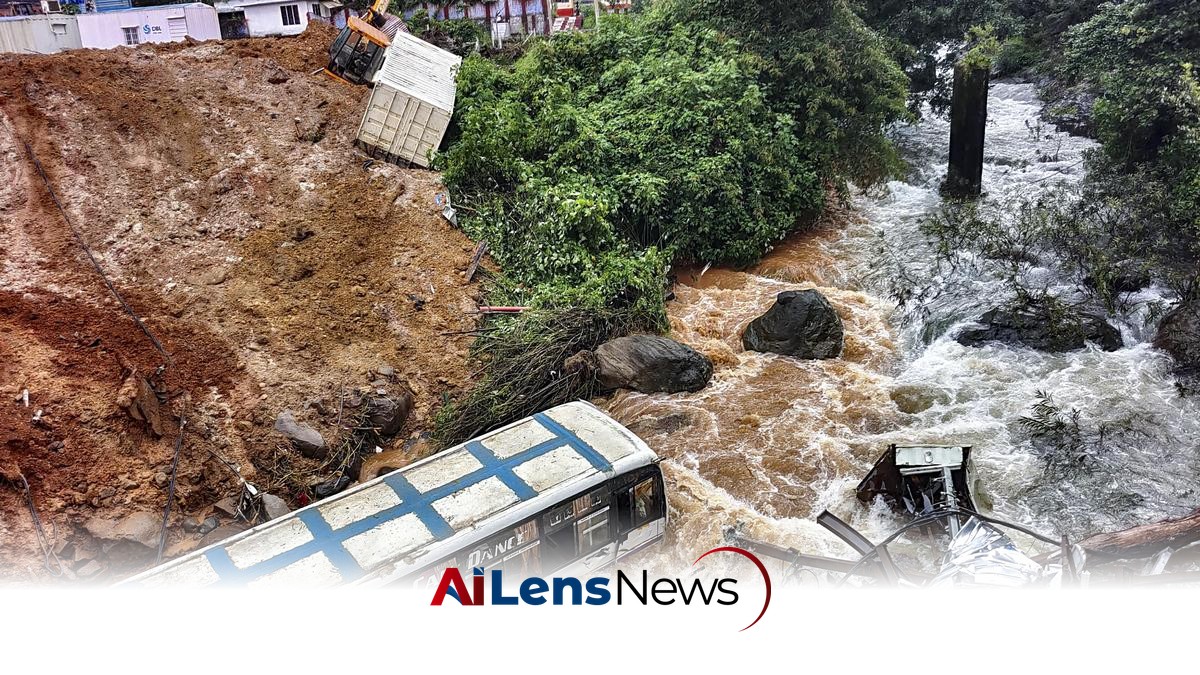


A devastating mudslide in Wayanad, triggered by heavy rains and inadequate construction practices, resulted in multiple casualties and raised concerns about safety protocols.
Thiruvananthapuram, India Jul 14, 2026 ALN: A loud sound shook Palraj and Koodammal, tea plantation workers in their forties, as they waited for a bus near the Meenakshi bridge at Kalladi in Wayanad on the rainy morning of July 7. Clasping Koodammal’s arm, Palraj started running.
A perfect storm: On the Wayanad debris slip
“The sound had come from atop a hill just behind us. A few minutes later, we heard another booming noise and a huge pile of mud and debris charged towards us,” Palraj recalls a day later.
The wave of mud crashed down the road, sweeping away the bridge and a tanker lorry parked along its way. As the heavy vehicle screeched to a halt after hitting a four-wheeler, Palraj and Koodammal found themselves under the lorry, stuck deep in mud.
ALSO WATCH Massive debris slip hits Wayanad tunnel project site
The couple were among the lucky few who escaped from a debris slide triggered by torrential monsoon rains near the portal of the under-construction Anakkampoyil-Kalladi-Meppadi twin-tube tunnel road between Wayanad and Kozhikode.
“Some other labourers employed in the tunnel road project were also standing near the bus stop. We don’t know what happened to them,” says Koodammal, while nursing a wound on her wrist at a rescue camp set up at the Government Polytechnic College, Meppadi, hardly a kilometre away from the site of the incident.
Wayanad debris slip: Why Minister said it was not a natural disaster
The Meenakshi bridge at Kalladi was covered with mud, and a mosque in the locality and a nearby house were destroyed after the incident. As the rescue and rehabilitation works are progressing, the residents in around half a dozen houses in the locality are yet to free themselves completely from fear.
The soil excavated for the construction and related works had been dumped in large mounds near the yet-to-be-bored tunnel entrance at the foot of a rocky slope. Cement lining, about three inches thick and up to a height of 10 to 20 metres, had also been done on the land slope on both sides of a newly formed road that leads to the entrance. After the downpour, the rocky slope gave way along with the soil underneath. The sliding heap also carried soil from the forested area above the hill and construction debris and the excavated mud below. Though the construction work had been stopped in view of the monsoon in June, a few labourers and engineers were present there for monitoring purposes.
People carry the mortal remains of Bikram Singh Rana, a construction manager from Himachal Pradesh, recovered during a search operation following the debris slip at the tunnel project site in Kalladi, Wayanad on July 12, 2026. | Photo Credit: PTI
The rescue and search operations, carried out by teams from the National Disaster Response Force, police, and the Fire and Rescue Services, recovered the bodies of eight people — all of them migrants. The deceased are Chandra Bahn from Madhya Pradesh, Azharuddin Ansari from Uttar Pradesh, Mohammed Imran and Bikash Kumar Singh from Bihar, Anmol from Jharkhand, Rakesh Guchait from West Bengal, and Rahul Sharma and Bikram Singh Rana from Himachal Pradesh. All of them were employees of Dilip Buildcon Ltd., the company responsible for constructing the 8.73-km tunnel road.
The execution of the project, estimated to cost approximately ₹2,100 crore, is supervised by the State Public Works Department. It is being financed by the Infrastructure Investment Fund Board. Konkan Railway Corporation Limited, the special purpose vehicle for the project, is responsible for its execution and implementation. The initiative had received its final approval earlier this year and is slated for completion within four years.
The Meenakshi bridge at Kalladi was covered with mud, and a mosque in the locality and a nearby house were destroyed after the incident. | Photo Credit: K Ragesh
Soon after the tragedy unfolded, experts cited glaring lapses in its execution. P.U. Das, former District Soil Conservation Officer, Wayanad, noted that water flowing down from the sprawling rock formation — situated 180 meters above the road level — soaked and weakened the soil that was to be excavated for the project.
Between July 6 and July 7, the area recorded 221 mm of rain, the highest in the district that day. “The water flowing into the flat, low-lying area at the base of the rock rapidly seeped into the soil, exerting immense pressure, shattering the roadside cement lining and destabilising the underlying soil, thereby triggering a massive mud slip. Approximately 20,000 tonnes of soil surged forward in an instant,” he says. “It is concerning that there was a failure to take into account soil characteristics, water absorption capacity, drainage properties, and the potential for piping. There were monitoring lapses during the implementation of the work,” Mr. Das points out.
The former official said that there is a distance of around 50 metres from the road to the tunnel entrance. Soil has been removed up to about 30 metres already. “Excavation of soil for another 20 metres remains. If the work had been completed before the onset of the monsoon, this disaster could have been averted,” Mr. Das said. Because of the unfinished work, the angle of repose of the remaining portion of earth — the angle at which a pile of material remains stable without sliding — weakened. Along with it, rainwater seeped into the soil from above the rocky slope, and the cement lining and a drainage line installed for the discharge of water also collapsed, he adds.
The incident, however, set alarm bells ringing as it came less than two years after the Mundakkai-Chooralmala landslides on July 30, 2024, which claimed over 250 lives, and less than seven years after the Puthumala landslip on August 8, 2019, which left a dozen people dead. From Kalladi, the Mundakkai-Chooralmala area is just five km away, and Puthumala is around 800 metres away. Landslides had been reported from the region since the 1960s. Kavalappara in Malappuram district, which reported a landslip resulting in the death of 226 people in 2019, is on the western side of the tunnel road project site.
Environmental activists sought immediate suspension of all construction work, claiming that the project was pushed through with “suspicious haste” during the previous Left Democratic Front (LDF) government’s tenure “without sufficient scientific evaluation.”
In a resolution, the Wayanad Prakrithi Samrakshana Samithi, led by N. Badusha and Thomas Ambalavayal, which had earlier approached courts seeking its scientific appraisal, said its activists were branded “anti-development,” subjected to public slander, and targeted by hired elements for highlighting this. The Samiti leaders claimed that the LDF government had secured a Stage-I clearance for the infrastructure initiative from the Union Ministry of Environment, Forest and Climate Change by providing “misleading information” and employing “unlawful means.”
Environmental activists also pointed out that the State-level Expert Appraisal Committee of the State Environment Impact Assessment Authority (SEIAA) had made serious observations about the fragile ecological region even while granting approval for it on March 1, 2025.
The committee had observed that the tunnel alignment passes through “highly fragile terrain prone to landslides” where massive destructive landslides occurred during 2019 and 2024, thereby “necessitating precautions during the construction stage to avert vibration-induced landslips.”
According to the committee, the project area is also known for its rich biological diversity, as it is part of the Nilgiri Biosphere Reserve and falls within a 10-km radius of the project alignment. It is home to endangered bird species such as Banasura Chilappan and Nilgiri Sholakili.
Four tribal colonies are located close to the proposed tunnel road on the northern side. A tribal settlement, Aranamala Kattunaikka Colony in Wayanad with 27 families, has been identified as project-affected families. Tribal populations in Mammikkunnu, Kuppachi, Kalladi, and Aranamala Colony also fall close to the proposed tunnel road. Thiruvambady village in Kozhikode and Vellarimala village in Wayanad, categorised as Ecologically Sensitive Areas, are part of it. There is every possibility of aggressive human-wildlife conflict too.
The committee had also laid out 25 conditions while giving the project its stamp of approval. They included micro-scale mapping of landslide vulnerable zones to delineate critical areas where regular monitoring should be undertaken to prevent any actions that aggravate land fragility.
“The task of mapping should be entrusted to experienced institutions and subjected to the approval of the disaster management authority. The task of regular monitoring of critical areas should be entrusted to the environmental management committee (EMC) constituted by the proponent of the project, and the observations of the EMC should be submitted to the respective grama panchayat and the district disaster management authority. The map should be uploaded on the project website and should be accessible to the public,” it had said.
“Automated weather stations along with telemetry data transmission should be installed in the northern and southern nodes of the tunnel road to provide warning signals regarding extreme rainfall events and stoppage of tunnelling activities. All construction material of any kind should not be dumped on public roads or pavements or near the existing facilities outside the project site,” the committee had said.
Sridhar Radhakrishnan, an environmental activist, however, criticized the document, calling it “a classic case of bureaucratic rubber-stamping—a ridiculous theatrics of due diligence that essentially disregards its own damning findings.” He said that the project’s ecological fragility, landslip risks, threats to biodiversity, and social impacts were all acknowledged in the clearance document, which resembled an indictment rather than an approval. “However, it then overrides these concerns with a sweeping list of 25 conditions, the majority of which are contradictory, unenforceable, impractical, or deliberately ambiguous,” Mr. Radhakrishnan says.
In a petition filed in the High Court in July 2025, the Samithi functionaries claimed that the social and environmental impacts of the project were not properly considered in the Social Impact Assessment Study (SIA) required to be conducted under Section 4 of the Right to Fair Compensation and Transparency in Land Acquisition, Rehabilitation and Resettlement Act, 2013. The agencies which conducted the SIA Study were not competent, and the study conducted was flawed “due to bias and lack of objectivity.”
“The Environmental Impact Assessment Report was stated to be prepared by Konkan Railway Corporation, which is not an accredited agency. Further, Konkan Railway has an interest in the project, and the report is flawed on the grounds of bias,” the petition said.
The Samiti also highlighted the lack of experts in geology and earth sciences in the SEIAA, which granted approval for it. However, the High Court dismissed the petition in December 2025. A similar petition was turned down by the Supreme Court in April 2026.
While granting clearance for the final stage-II clearance for the project in February 2026, the Union Ministry of Environment, Forest and Climate Change laid down 24 strict conditions for its execution without harming nature and the ecosystem.
The clearance permitted the conversion of 17.26 hectares of forest land under the provisions of the Forest (Conservation Act), 1980. The conditions included “clear demarcation of the converted forest land at the project cost,” “undertaking compensatory afforestation on an equivalent extent of non-forest land,” and “planting at least 1,000 saplings per hectare within two years.” The approval also mandated minimized tree felling and strict compliance with wildlife protection steps.
However, environmental activists alleged that the conditions laid down by both the State-level committee and the Centre have not been followed so far.
“The project should not have received approval at all. But the nod was given under political pressure. We are facing the consequences now,” says Mr. Radhakrishnan. He also sought the cancellation of the environmental clearance given by the SEIAA and the constitution of a fresh panel to study the project’s social and environmental impact. Geologists and scientists have called for strict guidelines and ecological safety steps before launching infrastructure projects in the fragile Western Ghats region.
Dilip Buildcon Limited, the company involved in construction, claimed that all applicable engineering, safety, and environmental approvals and protocols were being complied with during the work.
In a statement, company secretary Abhishek Srivastava said the project was subject to multiple regulatory oversight and monitoring mechanisms considering its location in an ecologically sensitive region. This included supervision by a Supreme Court-appointed Central Empowered Committee. All excavated materials were being handled in accordance with approved methodology. The room for technical error is limited, the statement added.
In a note presented to the authorities on July 8, Konkan Railway stated, “all construction works were carried out in accordance with the approved drawings, specifications, and engineering practices. Necessary temporary supports, drainage arrangements, and slope protection measures had been implemented before the incident. Since the work was already stopped during the onset of the monsoon from mid-June, no tunnelling/excavation work was ongoing.”
Calling the incident a “man-made disaster,” experts and activists are now calling for a thorough investigation into the circumstances surrounding the mudslide, emphasizing the need for stricter regulations and adherence to environmental guidelines in future construction projects.
To learn more about the latest developments in Crime & Law, stay updated with our exclusive reports and analyses on AiLensNews.

