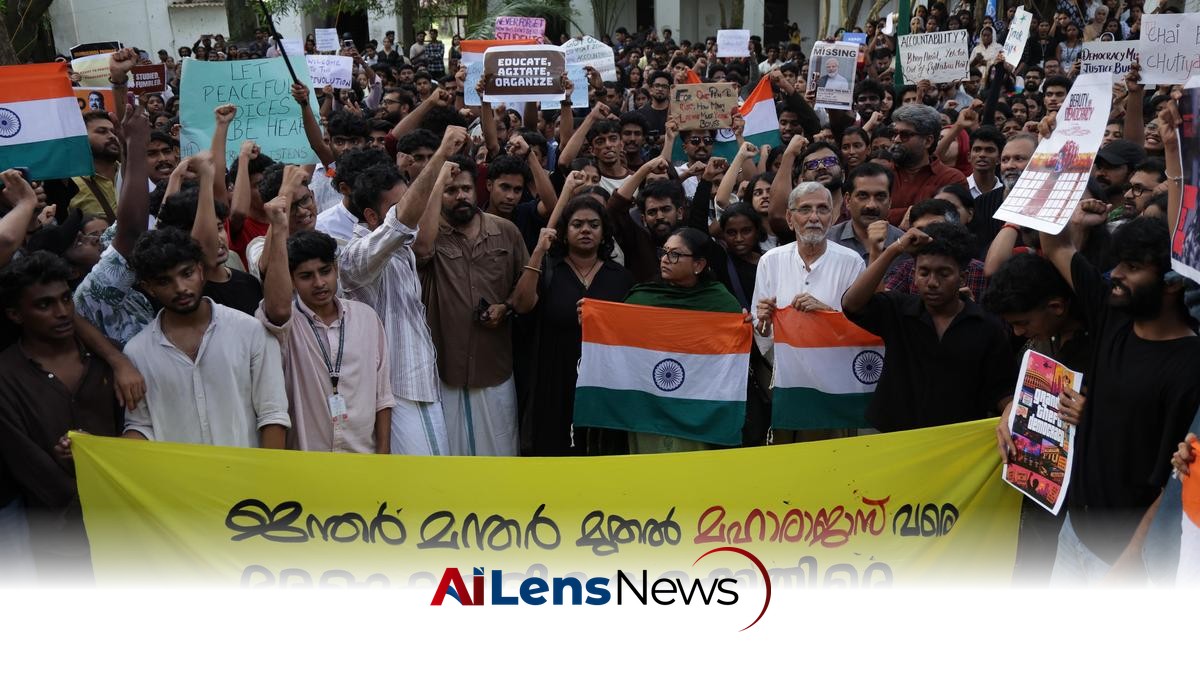


In a show of solidarity, writers, filmmakers, and activists joined protests in Kochi against police actions and the alleged NEET paper leak, echoing the voices of students in Delhi.
Thiruvananthapuram, India Jul 23, 2026 ALN: The recent protests in New Delhi, sparked by the leak of the National Eligibility cum Entrance Test (NEET) question paper, have ignited widespread unrest among students and activists across India. In a show of solidarity, activists and celebrities gathered in Kochi to voice their support for the student protests, which have gained momentum amidst concerns over the integrity of the education system and the treatment of demonstrators by law enforcement.
On a Wednesday marked by multiple demonstrations, gatherings were held at prominent locations in Kochi, including Maharaja’s College, Panampilly Nagar, and Kacheripady. These protests were organized by various groups, all united under the banner of the Cockroach Janata Party-led agitation in Delhi, which has become a focal point for those advocating for accountability in the education sector and the protection of student rights.
At Maharaja’s College, a significant protest meeting was convened by the college union under the theme “In Solidarity with the Youth of the Nation.” Writer N.S. Madhavan, a prominent figure in the literary community, addressed the crowd with a passionate speech. He expressed grave concern regarding the alleged involvement of masked civilians, purportedly supporting the Central government, in violent confrontations with student protesters in Delhi. Madhavan drew historical parallels, likening the current situation to the actions of the Brownshirts in Nazi Germany, who were known for their brutal suppression of dissent. He warned that the unfolding events in Delhi could have dire implications for the future of democracy in India.
Despite his concerns, Madhavan conveyed a sense of hope, suggesting that the government's attempts to suppress the protests would ultimately be futile. His remarks resonated with many in attendance, highlighting a collective determination to uphold democratic values and student rights.
Actor-filmmaker Joju George echoed these sentiments, comparing the current political climate to the Emergency period in India, a time marked by significant restrictions on civil liberties and press freedom. George characterized the NEET question paper leak as a symptom of a failing education system, describing it as a form of “slow poisoning” that undermines the future of the nation. He condemned the violent responses to student protests, emphasizing the need for a peaceful and constructive dialogue regarding educational reforms.
Filmmaker Ashique Abu also spoke passionately at the gathering, urging the public to lend their support to the student movement. He highlighted the resilience and hope embodied by the protesting students, framing them as the future of the country. Abu announced plans for a march organized by the student community, which was set to take place from the college to the BSNL office in Kochi, further galvanizing support for the protests.
Legal perspectives on the protests were offered by lawyer Harish Vasudevan, who criticized what he viewed as the judiciary's reluctance to intervene in cases of alleged police brutality against student protesters. This critique points to a broader concern regarding the role of the judiciary in protecting civil rights and ensuring accountability in law enforcement actions. The lack of judicial intervention raises questions about the balance of power and the protection of individual rights in the face of state authority.
TV anchor Ranjini Haridas, who had recently participated in the protests in Delhi, recounted her experiences, expressing doubts about the state of democracy in India. Her comments reflect a growing sentiment among many citizens who feel that democratic principles are being eroded in the face of increasing authoritarianism.
The solidarity meeting in Kochi was not limited to speeches; it also featured a diverse array of voices, including writer K.R. Meera, CPI(M) Ernakulam district secretary S. Sathish, and various filmmakers and activists. Notable attendees included LGBTQI activist Sheetal Shyam, actors Gowri Kishan and Jolly Chirayathu, and singer Resmi Sateesh, all of whom contributed to the collective call for justice and accountability.
In addition to the main gathering at Maharaja’s College, rapper Vedan addressed a separate solidarity meeting at Panampilly Nagar, emphasizing the importance of artistic expression in activism. Activists K.P. Sankaran and Sreemoolanagaram Mohan staged a satyagraha at Gandhi Square in Kacheripady, further demonstrating the widespread support for the student protests. The Indian Socialist@100 collective also organized a solidarity meeting, underscoring the cross-political nature of the protests.
The ASTRA Students’ Union of Government Medical College, Ernakulam, played a significant role in organizing a solidarity protest on their campus. The union emphasized the necessity for open dialogue and transparency in addressing students' concerns, advocating for a more accountable educational system that prioritizes the well-being and rights of students.
In a poignant display of unity, a public meeting was held at Gandhi Square in Poonithura, where attendees condemned the police violence against student protesters in Delhi. The meeting, chaired by Kochi Corporation Councillor V.P. Chandran, featured speeches from various activists, including student leader Athul Krishna, who called for an end to the repression of dissenting voices.
Demonstrations in Kochi also included a candlelight vigil held late on Tuesday night, where approximately 100 young individuals gathered at Queen’s Walkway to express their solidarity with the ongoing protests in Delhi. Clad in black, the participants lit candles and raised slogans, holding placards with powerful anti-government messages. The absence of political leaders at this vigil highlighted the grassroots nature of the movement, which is driven by the youth and their demand for accountability and justice.
One particularly striking placard read: “You messed with the wrong generation,” encapsulating the frustration and determination of young people who feel marginalized and unheard by those in power. This sentiment reflects a broader generational divide in Indian society, where many young citizens are increasingly vocal about their rights and the need for systemic change.
The protests in Kochi, alongside those in Delhi, represent a significant moment in India's ongoing struggle for democratic rights and educational integrity. As activists and citizens rally together, the implications of these movements extend beyond the immediate context of the NEET leak, touching on broader issues of governance, accountability, and the future of democracy in India. The solidarity displayed in Kochi serves as a reminder of the power of collective action and the importance of standing up for one's rights in the face of adversity.
To learn more about the latest developments in Crime & Law, stay updated with our exclusive reports and analyses on AiLensNews.

