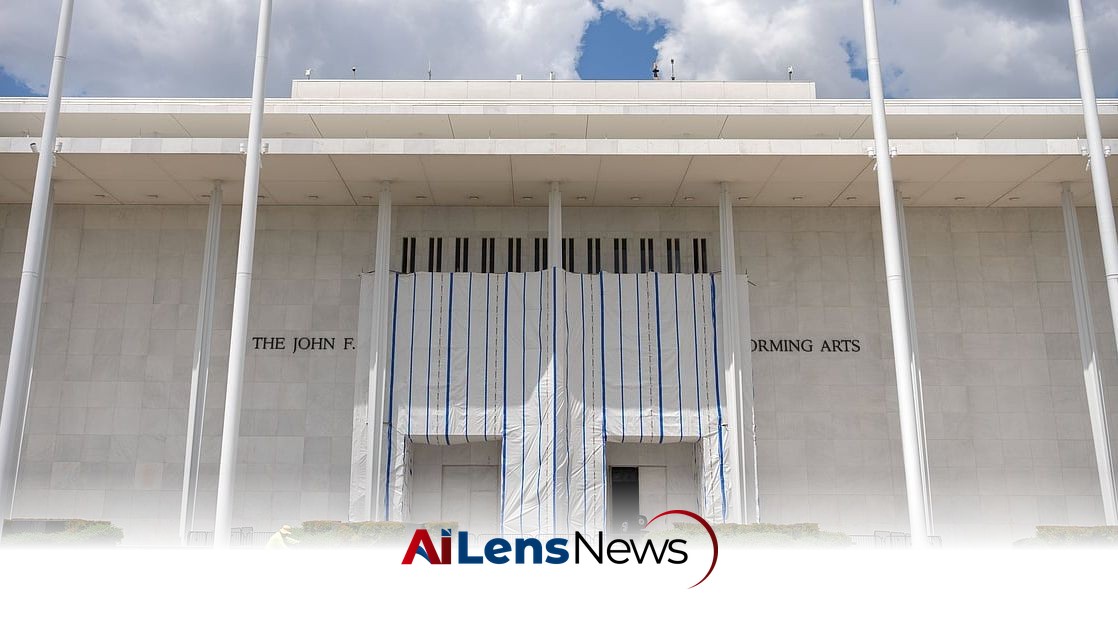


The Kennedy Center's board voted to add Trump's name to the building's facade and close for renovations, defying a federal court ruling.
New Delhi, India Aug 14, 2026 ALN: The battle over the Kennedy Center's future escalated Thursday as US President Donald Trump's allies on the board took new steps to commemorate him with physical changes to the iconic performing arts institution that could defy a federal court order.
During an hours-long meeting that was conducted virtually, the board voted to add Trump's name to the building's facade so it would read "The John F. Kennedy Center for the Performing Arts Restored and Renovated By President Donald J Trump." This decision marks a significant shift in the narrative surrounding the Kennedy Center, which has long been viewed as a symbol of American culture and artistic excellence.
The plaza in front of the building would be named after Trump, and most of the space at the venue would be closed for two years to allow for substantial renovations. The changes, described by Rep. Joyce Beatty, an Ohio Democrat who is an ex-officio board member, and her lawyers, amount to a dramatic test of US District Judge Christopher Cooper. He ruled in May that letters affixed to the building that spelled out Trump's name were added illegally and he ordered their removal, a decision that the Republican administration failed to persuade courts to overturn.
At the same time, Cooper blocked a two-year closure that was set to take effect July 5, saying an earlier board vote authorizing the shuttering was "ill-informed and seemingly preordained." This ruling has sparked a contentious debate about the board's authority and the implications of their decisions on the future of the Kennedy Center. "This latest development is a transparent effort to circumvent the Court's ruling, and flies in the face of the statutes that Congress passed," Beatty said in a statement. "I will continue to fight for this treasured national monument." A representative of the Kennedy Center did not immediately respond to a request for comment.
Much of Thursday's board meeting was expected to focus on the extent of closures required to allow for renovations that the Kennedy Center's management says are needed to improve safety. The management's insistence on the necessity of these renovations stems from a range of infrastructure issues that have been documented over the years. In response to the judge's criticism of the earlier vote, the institution's leaders said they would provide the board with three options to consider. These included a complete closure or a partial closure that would allow "some continued public access and limited programming in spaces unaffected" by the work. A third option would "consider a highly limited series of phased closures to address only the Center's most serious infrastructure needs while scheduling and maintaining a full slate of programming."
Ultimately, the board decided to close the building for two years while leaving the potential for some degree of programming to still happen in an outdoor space known as the Reach. This decision to move ahead with the two-year closure, in addition to the moves to memorialize Trump, could revive questions about whether the board seriously considered the full range of options available to them. Critics have expressed concerns that the board's actions may be more politically motivated than genuinely focused on the welfare of the institution.
During Trump's second term, the Kennedy Center has become an unlikely — and highly visible — metaphor of presidential power. While he largely ignored the institution during his first round in Washington, Trump moved quickly to oust the institution's leadership when he returned to office in January 2025 and replaced it with a board of trustees that named him chairman. His name was quickly added to the building before coming down in June in response to Cooper's order. The area where it once stood is now covered by a massive tarp, a stark reminder of the ongoing legal battles surrounding the institution.
Trump's push to remake the nation's capital
The Kennedy Center moves are part of Trump's broader push to reshape the physical landscape of the nation's capital in ways that have few modern parallels. This effort has raised eyebrows and sparked discussions about the implications of such changes for the cultural and historical fabric of Washington, D.C. He demolished the East Wing of the White House and is building a controversial ballroom in its place, though an appeals court ruled last week that construction should stop because Congress didn't approve the project. Trump has said he will take the case to the Supreme Court, further entrenching the legal disputes around his administration's actions.
His remodel of the Lincoln Memorial Reflecting Pool has also stumbled after algae returned and US Attorney Jeanine Pirro refuted his claims that a vandal was responsible for the damage. These incidents highlight the challenges faced by Trump's administration in executing its ambitious plans for the capital. Meanwhile, Trump is planning extensive renovations of a golf course in East Potomac Park, which could significantly reduce the public's access to running and biking paths. He is also moving forward with a triumphal arch that will sit near Arlington National Cemetery, an endeavor that has raised questions about the appropriateness of such a structure near a site of national mourning.
Trump has derided the Kennedy Center as "rusted, rotted, and rat and bug infested" and threatened to hand the building over to Congress after Cooper rejected the closure and the addition of the president's name to the building. This rhetoric underscores the contentious relationship between Trump and the cultural institutions that have long been seen as pillars of American society. The institution's leadership has argued that it's in genuine need of repair and updating, a sentiment echoed by many who recognize the importance of maintaining such a significant cultural landmark.
Matt Floca, the Kennedy Center's executive director and chief operating officer, guided a group of journalists through the building in April, highlighting severe water damage that he said corroded steel in some places as thin as tissue paper. This visual evidence of decay has prompted calls for urgent action to address the building's infrastructure issues. Some pieces of equipment, including several 800-ton chillers that help cool the building, are decades old and in need of replacement. At the time, Floca said he considered doing the repairs individually but insisted it was his recommendation to Trump to close the building and move forward with the renovation all at once.
"When the president asked: 'How do you make these projects the best? How do you make them really excellent and deliver them efficiently?' my recommendation was you close the building and you do everything over a definite period of time, two years," he said. This approach reflects a broader strategy of addressing systemic issues in a comprehensive manner rather than through piecemeal fixes.
More recently, the legal battles became the subject of barbs and jokes as comedian Bill Maher accepted the Mark Twain Prize for American Humor in late June. The intersection of politics and culture has become a frequent topic of discussion in contemporary media, with public figures using humor to comment on the absurdities of the political landscape.
At the start of the program, Pamella Roland DeVos, a Kennedy Center trustee appointed by Trump, described the institution as a "national cultural center open not just for some but for every American patron who wants to experience the greatest art and expression the world has to offer." This statement emphasizes the Kennedy Center's role as a cultural touchstone and a gathering place for diverse audiences. "The responsibility that comes with it is one our board takes very seriously," she said. This assertion reflects the board's commitment to navigating the complex landscape of governance, cultural representation, and political influence as they move forward with their plans for the Kennedy Center.
To learn more about the latest developments in Politics, stay updated with our exclusive reports and analyses on AiLensNews.

