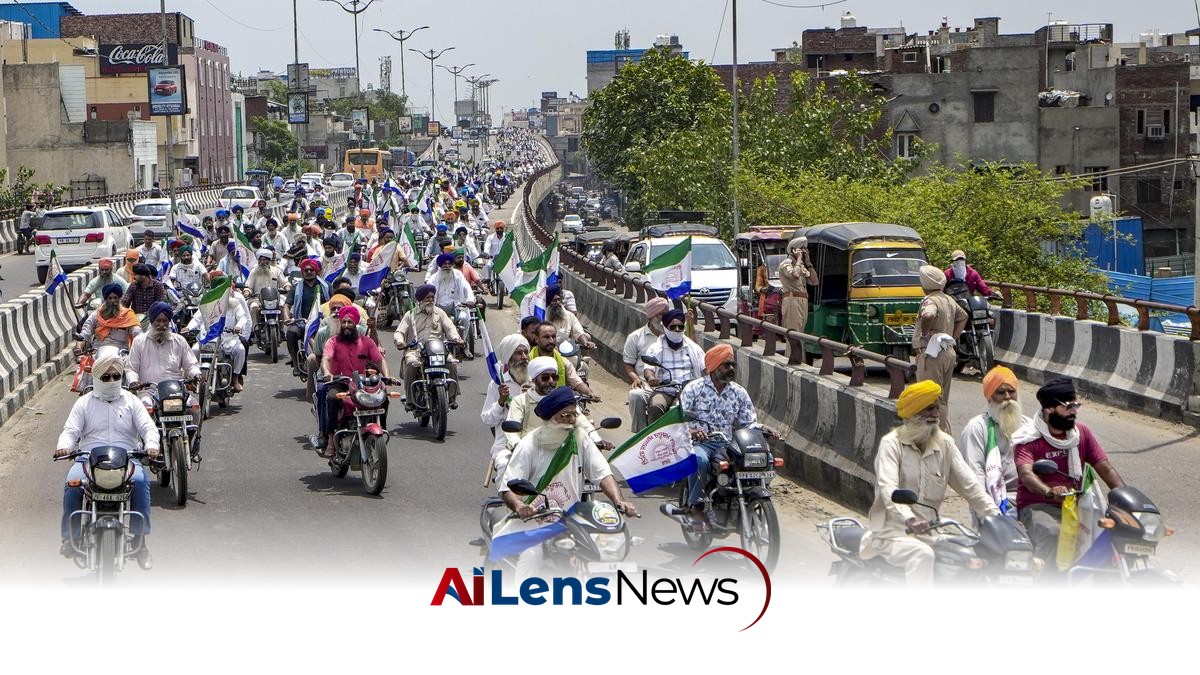


Haryana police halt farmers' motorcycle rally at inter-State borders, issuing traffic advisories while leaders call for dialogue with authorities.
Chandigarh, India Jul 21, 2026 ALN: Farmers from Punjab, organized under the banner of ‘Desh Bachao Morcha’ (Save the Country Rally), faced police obstruction on Tuesday, July 21, 2026, at the Shambhu-Ambala and Khanauri-Jind borders between Haryana and Punjab. They were en route to Delhi to protest against the proposed India-U.S. trade deal. This protest is part of a larger movement among farmers and agricultural workers who have been increasingly vocal about their concerns regarding trade agreements that they believe threaten their livelihoods and the agricultural sector as a whole.
As farmers attempted to enter Haryana in their vehicles and buses, they encountered multi-layer barricades set up by the Haryana Police at the inter-State boundaries. The Ambala police issued a traffic advisory, urging motorists to take alternative routes due to the closure of the Shambhu-Ambala road. The barricades were indicative of the tensions surrounding the protest, as authorities sought to prevent a large gathering in the capital that could draw significant media attention and public support.
Despite their peaceful intentions to participate in the rally, the Bharatiya Janata Party (BJP)-led Haryana government halted their progress by erecting barricades. Sarwan Singh Pandher, a farmer leader and coordinator of the Desh Bachao Morcha, stated, “We are ready to talk to the local administration and are in no mood for confrontation.” This statement reflects the farmers' desire for dialogue and negotiation, rather than conflict, as they seek to express their grievances regarding the proposed trade deal.
In a related incident, Gurnam Singh Charuni, president of the Bharatiya Kisan Union (BKU)-Charuni, was reportedly detained by police in Kurukshetra on Monday, July 20, 2026, while heading to Delhi for the rally. His vehicle was intercepted near Pehowa, according to BKU (Charuni) spokesperson Prince Waraich. The detention of prominent farmer leaders has raised concerns about the government's approach to dissent and the right to protest, particularly in the context of agricultural policies and trade agreements.
Waraich emphasized the need for the Central government to prioritize the interests of farmers, workers, small traders, and small industries, urging them to avoid agreements that undermine India’s economic and food sovereignty. “If our concerns continue to be ignored and the agreement is pushed forward, the movement will be intensified,” he warned. This statement underscores the broader apprehensions among farmers about the implications of inter trade agreements on domestic agricultural practices and food security.
The Desh Bachao Morcha, an umbrella organization of farmer unions from various states, had announced plans for a rally in New Delhi on July 21. They argue that the India-U.S. trade deal extends beyond a simple exchange of goods, potentially impacting critical sectors such as agriculture, dairy, industry, digital trade, services, intellectual property rights, energy, investment, and market access. The fear is that such agreements could lead to a flood of foreign goods that would undercut local prices, making it difficult for Indian farmers to compete.
This protest is not an isolated incident; it is part of a series of demonstrations that have taken place in recent years, particularly in the context of the controversial farm laws introduced by the Indian government in 2020. Those laws sparked widespread protests, leading to a year-long agitation by farmers, primarily from Punjab and Haryana, who argued that the laws would dismantle the minimum support price system and leave them vulnerable to market fluctuations. The eventual repeal of these laws in late 2021 was a significant victory for the farmers, but many remain wary of new policies that could similarly threaten their livelihoods.
The India-U.S. trade deal has been framed by the government as a means to enhance economic ties and boost trade between the two nations, which could lead to increased investment and job creation. However, farmers and agricultural advocates argue that such agreements often prioritize the interests of large corporations at the expense of small farmers. They contend that provisions related to intellectual property rights could limit farmers' access to seeds and technology, while increased market access for U.S. agricultural products could lead to a decline in domestic production.
Furthermore, the implications of the trade deal extend beyond agriculture. The digital trade provisions could affect data privacy and local businesses, while changes in investment regulations might lead to increased foreign control over critical sectors of the economy. This has raised alarms among various stakeholders, including small traders, labor unions, and civil society organizations, who fear that the deal could exacerbate existing inequalities and undermine India's economic sovereignty.
As the farmers' rally approaches, the government's response will be closely scrutinized. The use of police barricades and detentions may be seen as an attempt to stifle dissent, which could further inflame tensions between the government and agricultural communities. On the other hand, the farmers' ability to mobilize and articulate their concerns could galvanize broader public support, potentially leading to a resurgence of protests similar to those seen during the farm laws agitation.
The situation at the Punjab-Haryana border is emblematic of a broader struggle that has been unfolding in India over the past few years. Farmers have increasingly organized themselves into unions and coalitions to voice their concerns about government policies that they perceive as detrimental to their interests. The Desh Bachao Morcha is just one of many such organizations that have emerged in response to perceived threats from trade agreements and agricultural reforms.
Historically, Indian agriculture has been characterized by a complex web of policies designed to protect farmers from market fluctuations. The introduction of liberalization measures and trade agreements has led to fears that these protections may be eroded, exposing farmers to greater risks. The current protest against the India-U.S. trade deal is rooted in these longstanding concerns about market access, pricing, and the overall sustainability of agricultural practices in India.
In light of these developments, it is essential to consider the broader implications of the India-U.S. trade deal on India's food security. The deal could potentially impact not only farmers but also consumers, as changes in agricultural production and pricing dynamics could lead to higher food prices or reduced availability of certain staples. The interconnectedness of global trade means that decisions made at the inter level can have profound effects on local economies and communities.
Moreover, the farmers' movement is reflective of a growing consciousness among various segments of society regarding the implications of globalization and trade agreements. As farmers articulate their concerns, there is an opportunity for a broader dialogue about the future of agriculture in India, the role of small farmers in the economy, and the need for sustainable practices that prioritize food sovereignty.
In conclusion, the situation at the Punjab-Haryana border highlights the ongoing struggle between farmers and the government regarding trade policies and agricultural practices. As the proposed India-U.S. trade deal looms, the farmers' concerns about its potential impact on their livelihoods and the agricultural sector remain at the forefront of their activism. The outcome of this protest and the government's response will likely have significant implications for the future of agricultural policy in India and the relationship between the state and its farmers. The farmers' ability to mobilize and articulate their grievances may serve as a catalyst for broader discussions about the future of agriculture, trade, and economic justice in India.
To learn more about the latest developments in Crime & Law, stay updated with our exclusive reports and analyses on AiLensNews.

