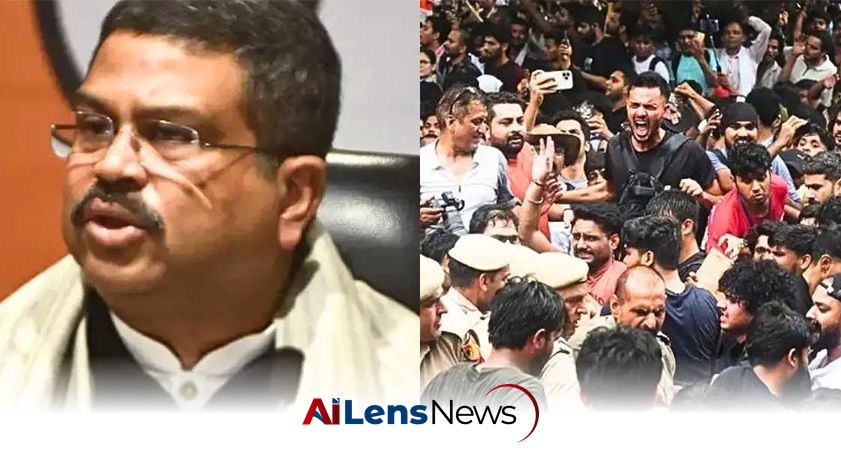


The Indian government rules out the resignation of Education Minister Dharmendra Pradhan despite protests over the NEET paper leak, indicating readiness for negotiations with the Cockroach Janta Party.
New Delhi, India Jul 23, 2026 ALN: New Delhi: The Centre is unlikely to seek the resignation of Union Education Minister Dharmendra Pradhan despite mounting protests over the alleged NEET paper leak, with the government maintaining that he cannot be held responsible for the examination irregularities, according to a PTI report.
A senior government official told the news agency that the top leadership believes Pradhan should not be blamed for the paper leak and is expected to continue in the Union Cabinet. This stance reflects a broader strategy by the government to maintain stability within its ranks, especially in a sensitive portfolio like education, which is pivotal in shaping the future of millions of students in India.
At the same time, the government has indicated its willingness to hold fresh discussions with the Cockroach Janta Party (CJP), which has been leading protests demanding Pradhan’s resignation. According to the report, the Centre has urged flexibility over the venue for the proposed meeting after the outfit insisted on holding talks at a neutral location near Jantar Mantar. This willingness to negotiate suggests that the government is keen on de-escalating tensions and addressing the concerns of the protesters without conceding to their demands outright.
The development comes as protests over alleged irregularities in competitive examinations continue to gather momentum. The National Eligibility cum Entrance Test (NEET) is a critical examination for aspiring medical students in India, and any hint of malpractice or leak can severely undermine public trust in the educational system. The protests have attracted significant media attention, highlighting the frustrations of students and their families who feel that the integrity of the examination process is at stake.
On Thursday, Prime Minister Narendra Modi announced that the government would establish fast-track courts to ensure swift and stringent punishment for those involved in paper leak cases. The announcement marked his first major public response to the nationwide protests, indicating that the government is taking the issue seriously and is willing to implement measures aimed at preventing future occurrences of such incidents.
However, the CJP said the Prime Minister’s announcement did not address the root causes of repeated examination leaks. “It is good that after one and a half months of protests, the Prime Minister has finally taken notice,” CJP spokesperson Ashutosh Ranka told PTI. He argued that punishing those responsible after a leak occurs would not prevent future incidents and maintained that accountability within the system was the real issue. This reflects a growing sentiment among the protesters that systemic reforms are necessary to restore trust in the examination process.
Ranka reiterated that the protest would continue until Pradhan resigns. The insistence on Pradhan’s resignation underscores the protesters' belief that leadership accountability is essential for meaningful change. This demand not only targets Pradhan but also symbolizes a broader call for transparency and integrity in the government’s handling of educational affairs.
The Centre has already initiated talks with the protesters. Union Health Minister J.P. Nadda met two CJP representatives, including spokesperson Saurav Das, earlier this week and assured them that their demands would be discussed with senior government leaders. This engagement is a significant step towards addressing the grievances of the protesters, indicating that the government is not entirely dismissive of the concerns raised by the CJP.
According to PTI, several high-level meetings involving Union Home Minister Amit Shah, Nadda, Commerce Minister Piyush Goyal, and Pradhan have also been held in recent days to assess the situation. These meetings reflect the seriousness with which the government is treating the protests, as they involve key figures in the administration who can influence policy and decision-making.
Nadda has since reiterated the government’s willingness to continue negotiations. Das, however, said the protesters would agree to another meeting only at a neutral venue near Jantar Mantar and if the government demonstrated a genuine intention to address their demands. The insistence on a neutral venue highlights the distrust that has developed between the protesters and the government, suggesting that the CJP is wary of the government's commitment to meaningful dialogue.
The report also said the government is open to favorably considering compensation for the families of those who allegedly died by suicide following the NEET paper leak controversy. This aspect of the discussion is particularly sensitive, as it touches on the tragic outcomes of the pressures faced by students in high-stakes examinations. Providing compensation could be seen as an acknowledgment of the emotional and psychological toll that such incidents can have on students and their families.
Meanwhile, Union Minister Jitendra Singh accused Leader of Opposition Rahul Gandhi of changing his stand after initially seeking a parliamentary debate on the issue and later making Pradhan’s resignation a precondition. Gandhi, however, has continued to demand the minister’s resignation, describing it as non-negotiable. This political maneuvering illustrates the contentious nature of the debate surrounding the NEET paper leak, as various political actors seek to position themselves in relation to public sentiment and the ongoing protests.
As part of the government’s outreach efforts, Nadda reportedly visited injured protesters at Ram Manohar Lohia Hospital and also met activist Sonam Wangchuk at a Gurugram hospital. Wangchuk has been on an indefinite hunger strike since June 28 after joining the CJP-led agitation seeking accountability for alleged examination irregularities, reforms in the education system, and Pradhan’s resignation. The involvement of prominent activists like Wangchuk highlights the broader implications of the protests, as they attract attention from various segments of society who are concerned about educational reforms.
The CJP has been spearheading protests over alleged examination irregularities since June. During its Parliament march on July 20, protesters were stopped near Parliament Street after police deployed multiple barricades and used force, including tear gas and a lathicharge, to prevent them from advancing. This response from law enforcement underscores the tension between the government and the protesters, as it raises questions about the right to protest and the limits of state power in managing civil dissent. The heavy-handed approach by police may have further fueled public outrage and sympathy for the protesters’ cause, complicating the government's efforts to navigate the situation.
As the situation develops, it remains to be seen how the government will balance its response to the protests with the need to maintain order and public trust in the examination process. The implications of these events extend beyond the immediate demands of the protesters, potentially influencing future policies related to education, accountability, and governance in India.
To learn more about the latest developments in Crime & Law, stay updated with our exclusive reports and analyses on AiLensNews.

