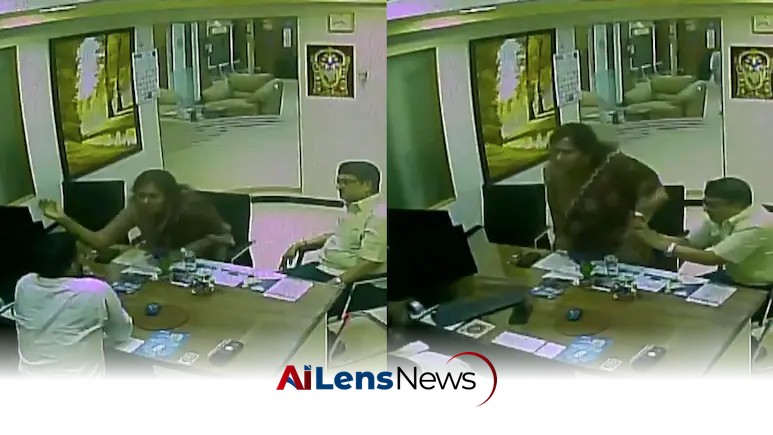


Kayalvizhi Alagiri, daughter of former Union Minister MK Alagiri, faces legal action for allegedly slapping a bank manager in Chennai. The incident was captured on CCTV.
New Delhi, India Jul 25, 2026 ALN: Chennai: An FIR has been registered against former Union Minister MK Alagiri’s daughter Kayalvizhi for allegedly slapping a bank manager. The incident has sparked significant media interest and public discourse, particularly given the political lineage of Kayalvizhi, whose father, MK Alagiri, is a prominent figure in Tamil Nadu politics.
The police took action following a complaint lodged by a senior State Bank of India (SBI) official. The complaint alleges that the manager of the bank’s NRI branch in Adyar was threatened and assaulted by Kayalvizhi, who is also the owner of the building that houses the branch. The incident has raised questions about the conduct of individuals in positions of power and the implications of such actions on public institutions.
The altercation reportedly occurred when the bank manager, identified as Harsheen Singh, sought to address the issue of a faulty lift in the building. According to the complaint, Singh had previously attempted to communicate with Kayalvizhi's representative regarding the necessary repairs, but his requests went unanswered. Frustrated by the lack of response, Singh approached Kayalvizhi directly to discuss the matter.
The confrontation escalated quickly, culminating in Kayalvizhi allegedly slapping the bank manager. This incident was captured on CCTV, and footage of the altercation has since gone viral, further fueling public interest and scrutiny. In the video, Kayalvizhi can be seen initially engaged in a discussion with a man before the argument with Singh ensues. The suddenness of her action has raised eyebrows and has led to discussions about the need for accountability, especially among those connected to influential political families.
As the investigation unfolds, the police are expected to gather more evidence, including witness statements and further video footage, to ascertain the full context of the incident. The legal ramifications for Kayalvizhi could be significant, depending on the findings of the investigation and any potential charges that may be filed against her.
This incident is not an isolated occurrence; it reflects broader societal issues regarding the treatment of authority figures and the expectations of decorum in public interactions, especially in a banking environment where professionalism is paramount. Furthermore, it raises questions about the influence that political connections might exert in such situations. The public's reaction to this incident may influence perceptions of the political elite in Tamil Nadu and their accountability to the public.
MK Alagiri, the father of Kayalvizhi, has had a notable political career as the second son of the late M. Karunanidhi, a former Chief Minister of Tamil Nadu. Alagiri served as the Union Minister of Chemicals and Fertilizers from May 28, 2009, until March 20, 2013. His political journey has been marked by both prominence within the Dravida Munnetra Kazhagam (DMK) party and a subsequent fall from grace. In 2014, he fell out of favor within the party, particularly as his brother, M.K. Stalin, rose to prominence, leading to a significant shift in the party's dynamics.
The DMK, founded by Karunanidhi in 1949, has a long history of influencing Tamil Nadu politics, advocating for social justice and the rights of the marginalized. The party has been known for its strong stance against perceived injustices and has often positioned itself as a champion for the people. However, incidents like this can complicate the party's image, especially if they are perceived as indicative of entitlement or a lack of respect for institutional authority.
As the political landscape in Tamil Nadu continues to evolve, the implications of this incident could resonate beyond the immediate legal consequences for Kayalvizhi. It may serve as a catalyst for discussions about the behavior of public figures and their responsibilities towards civic institutions. The public's response to this incident will likely shape the narrative surrounding the DMK and its leadership, particularly as the party prepares for future elections.
In the wake of the incident, there may also be calls for reforms within the banking sector to ensure that employees are protected from harassment and intimidation, regardless of the social or political status of individuals involved. This could lead to increased scrutiny of workplace policies and the establishment of clearer protocols for handling conflicts between bank officials and property owners.
Overall, the FIR against Kayalvizhi Alagiri not only highlights individual behavior but also reflects larger patterns in society regarding power dynamics, accountability, and the rule of law. As the investigation progresses, it will be important to monitor how this situation develops and the responses from both the political sphere and the public at large.
In recent years, the Tamil Nadu political landscape has been marked by a growing scrutiny of political families and their influence on governance. The DMK, under the leadership of M.K. Stalin, has been working to revitalize its image following years of internal strife and public criticism. The party has been focusing on issues such as social justice, welfare schemes, and economic development, which are critical to its electoral success. However, incidents like the one involving Kayalvizhi can undermine these efforts, potentially alienating voters who expect integrity and accountability from their leaders.
The incident also raises broader concerns about the behavior of individuals in positions of power, particularly in the context of a society that is often grappling with issues of privilege and entitlement. The public's reaction to Kayalvizhi's actions may reflect a growing intolerance for perceived abuses of power, especially among those who are perceived as benefiting from political connections. This could lead to a more significant demand for accountability and transparency across various sectors, not just in politics but also in business and public service.
Moreover, the fallout from this incident could have implications for the banking sector as well. Banks are expected to maintain a professional environment, and incidents of harassment or intimidation can have lasting effects on employee morale and public trust. There may be increased pressure on banks to implement stricter policies to protect their employees and ensure that all customers are treated with respect, regardless of their social or political status. This could result in a reevaluation of how banks handle disputes and conflicts, emphasizing the importance of conflict resolution and communication.
As the investigation continues, the media will likely play a crucial role in shaping public perception. Coverage of the incident will likely focus on the implications for Kayalvizhi, her family's political legacy, and the broader societal issues at play. The narrative surrounding this incident may serve to highlight the challenges faced by political families in maintaining their public image while navigating the complexities of modern governance and social expectations.
In conclusion, the FIR against Kayalvizhi Alagiri is emblematic of ongoing tensions between authority, accountability, and public perception in Tamil Nadu. As the situation develops, it will be essential to observe how it influences both public discourse and the political landscape, particularly as the DMK seeks to solidify its position in the state and respond to the evolving expectations of its constituents.
To learn more about the latest developments in Crime & Law, stay updated with our exclusive reports and analyses on AiLensNews.

